Harry Dexter White Quotes
Much of the animus toward the Soviet Union within the American political establishment is political hypocrisy born of an ideological inability to acknowledge the success of socialist economics?
This quotation illustrates the statements of White that caused conservatives to dislike him. However, most historians agree that White passed classified information to the Russians. He was accused of being a Communist, but there was never any evidence of that. Some people believe that he was a spy for the Russians and committed espionage, but others disagree observing that White was very much his own man and felt that much information that was classified never should have been. White substituted his own judgment, it is believed, about what could be given to the Russians for the security system. He was an admirer of what Russian socialism had accomplished economically, educationally and medically since the 1917 revolution deposing the Czar. Russia had been a valuable military ally, which had taken the brunt of both military and civilian casualties in WWII. White’s economics were certainly not Marxist but very much Keynesian. He was subpoenaed by the House Un-American Activities Committee where he was accused of being a Communist which he denied (see {634907}). He died of a heart attack 3 days later.
Harry Dexter White, 1892–1948, Economist, Assistant to the U. S. Secretary of the Treasury, Liaison between the Treasury & State Departments, Manager of the Exchange Stabilization Fund, Senior Negotiator, 1944 Bretton Woods Conference, Major architect of the International Monetary Fund & World Bank, 1st Director and U.S. representative of the International Monetary Fund. Quoted in Benn Steil, The Battle of Bretton Woods
Sourced by: Eigen's Political and Historical Quotations

He was subpoenaed by the House Un-American Activities Committee where he was accused of being a Communist which he eloquently denied starting with this statement. He died of a heart attack 3 days later. However, most historians agree that White passed classified information to the Russians. He was accused of being a Communist, but there was never any evidence of that. Some people believe that he was a spy for the Russians and committed espionage, but others disagree observing that White was very much his own man and felt that much information that was classified never should have been. White substituted his own judgment, it is believed, about what could be given to the Russians for the security system. He was an admirer of what Russian socialism had accomplished economically, educationally and medically since the 1917 revolution deposing the Czar. Russia had been a valuable military ally, which had taken the brunt of both military and civilian casualties in WWII. White’s economics were certainly not Marxist but very much Keynesian.

The British suspected that the Turks of Anatolia were complicit with Bolshevism


Immediately after the Russian Revolution, the provisional government appointed him as Ambassador to the United States. However, the provisional government was supplanted when the Bolsheviks took over. Not enamored of Communism, he stayed in the United States with many other Russian refugees.
In retrospect, the Marshall plan was so successful that most people forget or never knew that there was much domestic and foreign opposition and criticism. See {615799}.


3rd Earl Russell of Kingston. He favored and argued for a middle ground of a capitalistic socialism or a socialized capitalism, which is what most democracies became.


This memo was written a few days before his death and it was the last document he wrote. The communists tended to use the word “socialist” so they could make it seem that the Soviet Bloc was allied or part of the same grouping as the Scandinavian countries, India and other countries that were neither ideological communists nor controlled by the Russian or any other Communist Party. Those nations, in contrast tended to use the word, “socialist” to distinguish themselves from the Communist countries. This mostly confused many Americans. Some conflated the socialist countries and the communist countries making no distinctions. Others, like most European politicians kept the distinction in mind. Most Americans were confused as the Red Scare perpetrators tended to conflate, and the liberals tended to distinguish.

Some on the extreme left of the Labor Party at the time were extolling Soviet Russia while denigrating the United States. Crossman, an avid socialist thought that was absurd and said so at every opportunity. The pro Soviet wing of the Labour party got smaller and smaller. He and many others thought that Russian Communism was a very poor implementation of socialist ideas.


Most classic socialists would not agree, but Deng’s approach created the most economically successful socialist economy in history.

Ever since the end of WWII, many Republicans have called their Democratic Opponents Marxists and Communists even for a conservative Democrat like Kennedy. Even Ronald Reagan stooped to this tactic before he ran for the Presidency.
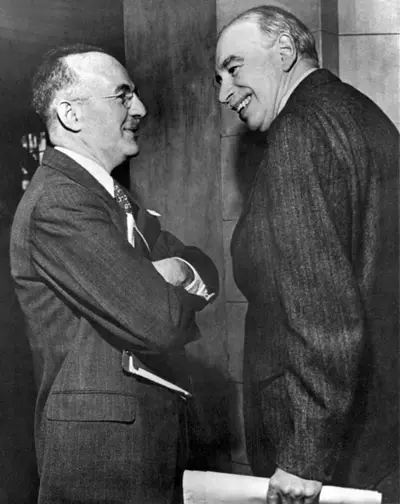
- Born: October 29, 1892
- Died: August 16, 1948
- Nationality:
- Profession: Economist
Harry Dexter White was a senior U.S. Treasury department official. Working closely with the Secretary of the Treasury Henry Morgenthau, Jr., he helped set American financial policy toward the Allies of World War II. He was later accused of espionage by passing information to the Soviet Union.
