Robert Kennedy Quotes
Nothing is more false than the notion that the triumph of Communism is inevitable or that the Communists are steadily pushing the free world into a corner.
Kennedy, Robert F. Just Friends and Brave Enemies. Harper & Row, 1962.


The 40 Committee was a secret committee of officials to deal with major national security covert operations possibilities. Chile had democratically elected Salvador Allende, a strong socialist, as President. He then, as he had promised in his campaign, begun to nationalize mining and other heavy industry and nationalized the very large farms. Kissinger and some others thought that Allende might probably transform Chile to communist state. The committee was discussing whether or not the United States should, via covert operations, try and destabilize or overthrow the Allende government. There was a strong minority aristocracy of the wealthy who would definitely support such an activity. Kissinger argued for intervention and some others observed that Allende had been fairly elected as a leftist by the people. Kissinger made this famous statement, and America covertly though the CIA worked with the Chilean right wing and fascists to overthrow Allende. The military, having been given the “green light” started attacking the Presidential Palace. Allende made a radio speech to the nation. A few hours later, the military seized the palace and reported that Allende had committed suicide.
Kissinger stating that the US should “correct” the election “mistakes” of other countries was of course Top Secret and the official US position was to support the right of any people to elect their preferred leaders. Normally, the public would never have seen the transcript of the meeting until many decades had passed but part of the transcript found their way to a manuscript of a book about the CIA. That agency went to the courts to block the publication and Kissinger’s statement. However, although the quote was removed from the book, enough people had now seen it, and the quote was leaked.
The quote is historically important for the real story of what really happened in Chile as General Pinochet who seized power turned out to be guilty of Crimes Against Humanity and Allende is today a national hero and martyr. In addition, it is a wonderful example of “overclassification”. After the action was completed, why should the American Public not know that its Secretary of State did not believe in democratic elections if the people would elect communists? --especially when the official stated policy he was presenting was just the opposite. The argument faded when the Watergate Scandal broke and consumed America’s attention.

This was a very prescient prediction. Russia and China as well as lesser communist states have followed his prediction.


He was convicted of various felonies including threatening federal officials and sentenced to prison.


This quotation was obtained via an FBI wiretap on Dr. King’s telephone. What makes it historically important is that J. Edgar Hoover’s FBI steadfastly maintained that King and his movement were philosophically communist in their reports to the President and others. For example, a CIA memo of the time reported that “According to the FBI, Dr. King is regarded in Communist circles as a genuine Marxist-Leninist who is following the Marxist-Leninist Line.” However, Hoover had this and other evidence of King’s antipathy to communism but suppressed this leading the administration and others to believe that the Civil Rights Movement, to which Hoover was unalterably opposed, was Communist influenced. See {603873}, {603891}, {603872}, and {603889} showing Hoover’s view of King and Blacks.

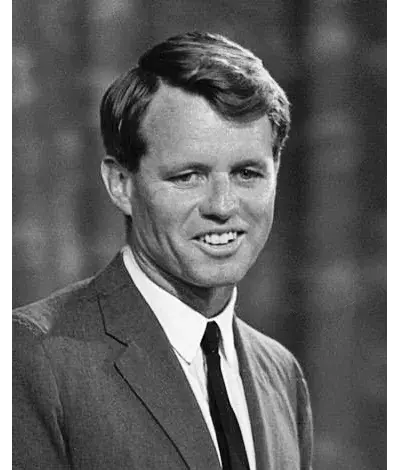
Robert Francis Kennedy, also referred to by his initials RFK or by the nickname Bobby, was an American politician and lawyer who served as the 64th United States Attorney General from January 1961 to September 1964, and as a U.S. Senator from New York from January 1965 until his assassination in June 1968. He was, like his brothers John and Edward, a prominent member of the Democratic Party and has come to be viewed by some historians as an icon of modern American liberalism.
