Peter Schiff Quotes
My mother always taught me that two wrongs don't make a right. We shouldn't bail out Wall Street. We shouldn't bail out Detroit. It will cost the economy more than the cost of the bailout which is more than the politicians think. We'll run into the hundred of millions to prop these companies up.
Schiff, Peter. The Real Crash: America's Coming Bankruptcy - How to Save Yourself and Your Country. St. Martin's Press, 2012.


There was a financial crisis in the country and the world when highly risky home mortgage loans defaulted leaving investors and speculators in mortgage-backed securities in a poor position. The investors had been reaping very high interest rates for their risky investments, but this was the first time that this form of risky investment had failed. The investors, of course were looking for a bailout from government. When the Bush administration failed to bail out investment bank, Lehman, there was a panic and the banking system of the country and much of the world froze up. Bush and his Secretary reversed their bailout of speculators policy and provided various assistants and bailouts to the very bankers and other investors who had caused the economic meltdown. The policy was continued by the Obama administration although the bailouts were just as distasteful to Obama as they were to Bush, but most economists agree that the two presidents very distasteful and unpopular bailout actions probably saved the nation from a massive depression. After being bailed out by the taxpayers, the Bankers then paid themselves exorbitant bonuses while the results of their management put 10 percent of the country out of work.


Geithner, the Treasury Secretary immediately after the Meltdown of 2008, facing complete collapse of our financial system, among other ameliorations, advocated and implemented many subsidies to bail out the banks most of whom had been greedy, foolish and often dishonest. He even allowed banks to use taxpayer money to pay bonuses to Bank executives who had brought the bank to ruin being a cause of the crisis. However, the banks not only survived but recovered and made huge profits while many of the taxpayers whose funds were used to help the banks were still struggling to make ends meet and it was they who received little, if any, government assistant.


Privatization is a proposal whereby individuals invest their own money in the Sock and Bond Market in an effort to get a better return than the government Social Security System produces. However, the initial cost is very high and the idea might be good for an individual hose investments pay off, but there could be no coverage for someone who invests poorly, is unlucky or whose investing agency goes bankrupt. There would be a lesser or no safety net which people would be guaranteed as they are with Social Security. In 2006 the George W. Bush administration tried to privatize the Social Security system. They failed in a major defeat for the administration.

In the midst of the Great Depression, Townsend had organized millions of Americans into “Townsend Clubs” to save money for their old age retirement. Townsend had proposed that the Government should run such a program where workers paid in every week and then all who were retired or disabled received $30 a week for like. Most economists of the time thought the Townsend old age pension plan unworkable: There was no national pension plan at the time. When Townsend together with two right wing religious extremists formed the Union Party, the one vulnerability that the Roosevelt Administration felt it had was the lack of an old-age pension plan. Within a few days, Roosevelt proposed a new plan of the New Deal to Congress. It was called Social Security. It passed in record time. See {616648} for Harry S Truman’s view of economists.

In 1915 the British asked for a billion dollar war loan to be floated by the Morgan Bank.
Islamic modernists like him are many among the educated Muslims but their views are often drowned out by the violence and extremist statements of the fundamentalists.

For many general government regulations—labor, environment, non discrimination—the small business has a proportionately heavier burden of compliance. So large businesses have always been able to count on small business to lobby against regulation and for deregulation. However, when it comes to financial regulation such as the Dodd-Frank regulations essentially apply to large businesses. As a matter of fact, small businesses were on many ways the most frequent victims of the large banks and investment bank excesses in the Meltdown of 2008. Before most of the regulations could even take effect, the financial industry was already trying to get small business to lobby to roll back the protective regulations preventing future meltdowns and bank failure resulting from loose regulation and greedy irresponsible financial industry behavior. The President campaigned to convince the small business not to support the finance industry over their usual “knee jerk” reaction to any regulation.
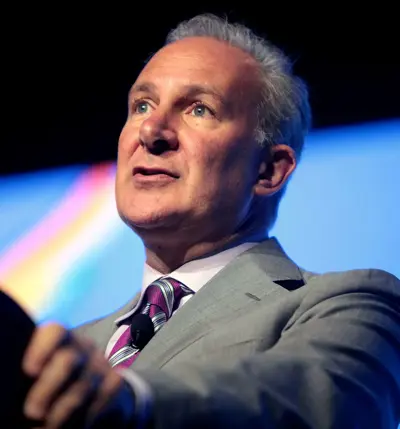
Peter David Schiff is an American stock broker, financial commentator, and radio personality. He is CEO and chief global strategist of Euro Pacific Capital Inc., a broker-dealer based in Westport, Connecticut. He is also involved in various roles in other financial services companies, including Euro Pacific Asset Management, an independent investment advisor, Schiff Gold (formerly Euro Pacific Precious Metals), a precious metals dealer, and Euro Pacific Bank, a full-reserve bank.
