Billy Graham Quotes
Mr. Kennedy's victory has proved that there was not as much religious prejudice as many had feared.
Billy Graham, Christian Protestant Evangelist, Quoted in New York Times, January 17, 1961
Sourced by: Eigen's Political and Historical Quotations


Kennedy had never been at the left wiing of the Democratic Party. His father, Joseph Kennedy, was known to all Irish Catholic politicans and disliked by most. He had supported big finance and business and was no great friend of labor. He was fired by FDR for publicly supporting Hitler before WWII and urging non support of England. He badmouthed FDR and Eleanor Roosevelt--Democratic icons. President Truman had to be stopped by a Secret Service agent from throwing the elder Kennedy out the window of a Boston hotel. He was a nasty man who threw his money around. But Senator Kennedy himself had never said a word criticizing Joeseph McCarthy or comdemning McCarthism and his other exceses leaving the criticism to other Democrats and even Republicans. (His silence was at the advice of his father.) Ribicoff a strong liberal knew Kennedy well and felt that Kennedy would not be constrained by his father's views, and that Kennedy was a true liberal at heart and would demonstrate that if elected President.

Kennedy was a Roman Catholic and there was a great deal of anti-Catholic prejudice in the country then. Al Smith, the only Catholic who had run for the Presidency, was defeated with almost all his opposition coming from anti-Catholic forces appealing to the then popular prejudice that if a Catholic became President, the Pope and the Vatican would be running America. Richard Nixon, a master politician with few scruples, cleverly kept raising the religious question in the voters minds by saying that he would not make Kennedy’s religion and issue of the campaign. Kennedy barely won.

The traditional Hindu social structure established castes – levels of society with Brahmins at the top and untouchables at the bottom. When India gained independence, the caste system was made illegal. Nonetheless, it is still followed by hundreds of millions of Indians. Religiously the Buddhists and the Hindus have had different philosophies. Ilaiah is a Buddhist who opposes the traditional Brahmin social structure and is a supporter of “Dalitization” – a change in the Indian culture to make the Dalits (untouchables) equal de juro and de facto.


He was out of office and speaking as an individual. The then President was spewing hate and barbaric fundamentalism which represented the views of the Mullahs who control Iran. (The President has very little power and he can be overridden by the religious authorities whenever those authorities feel that Islam is being compromised.

The place of non-Muslims in an Islamic country, if any, has been a point of great anxiety among Christians, Jews, Bhais, and others. These have been persecuted and expelled from numerous Islamic countries while in others such as modern Turkey there is no problem. This particular cleric is seen as more “modern” and “liberal” than most. Even he has little concept of equality and freedom of religion.


The letter was publicly posted on the religious school’s website.

JFK was running for the Presidency and was Roman Catholic. There was a great deal of anti-Catholic prejudice in the country with many people fearing that a Catholic President would mean Papal control of the United States. Peale was the most influential American clergyman of the day, and while he did not overtly oppose the Kennedy candidacy, he did state that he thought the election of a Catholic would profoundly change America. Kennedy won by a thin margin, but none of the events that the anti-Catholics feared, came to pass.

The major religions differ when it comes to conversion. Buddhism, Judaism, Hinduism, and some Christian Religions do not aggressively seek converts but will accept converts who come themselves. Other Christian religions and Islam aggressively try and convert others and see it as their religious duty to do so.

Many, if not most, non-Muslim scholars and thinkers very much disagree with Hamid on this point. The great exceptions of Islam are almost 1,000 years in the past. Current Islam, they argue, is not more exceptional than the beliefs of modern Mongolia which dominated most of the known world centuries ago, but has little that deserves special respect in the 21st country beyond the general respect which is owed to all religions and nationalities. With the exception of Turkey, Islamic nations are for the most part, backward, and virtually no other non-Muslim nations try to emulate them in any way.


Statement made after losing her bid to become Georgia’s governor to Brian Kemp (R). Abrams made multiple variations on this statement up until Donald Trump made a pariah of “election denial” after which she began to modify her statements.

Constantine the Great. Roman Emperors saw Christians as their most dangerous foes. However, Constantine, with this edict, enabled Christianity to thrive and grow legally in the Western world. Later Constantine himself converted to Christianity. This edict ceased the vicious Roman persecution that Christians had endured.
“Africa” then meant Northern Africa or what we today call the Middle East. Even in the 4th century it was a hotbed of internecine religious strife. He was not the first to try and cope with the religious strife of Palestine and the rest of the Middle East, and he was certainly not the last.

His intolerance and bigotry not only is of Muslims and Hindus, but extends to some Protestant denominations as well. See {643060} for additional examples of bias on the part of this erstwhile Presidential aspirant. To him, religions, unless they agree with his religious beliefs, are evil and dangerous to society.
Robertson does not mention the fact that Hindus are the majority of the world’s largest democracy—India. Freedom thrives there and political equality is extensive. However, economic equality is sadly lacking as in the Untied States. However, India is more unequal.


France, like the other European nations had suffered through the bloodbaths and civil and other wars including the Protestant Reformation, the Holocaust and others. They. like the Untied States chose a separation of church and state—a secular government to combat the inner and intrareligious bloodbaths that have historically killed millions.
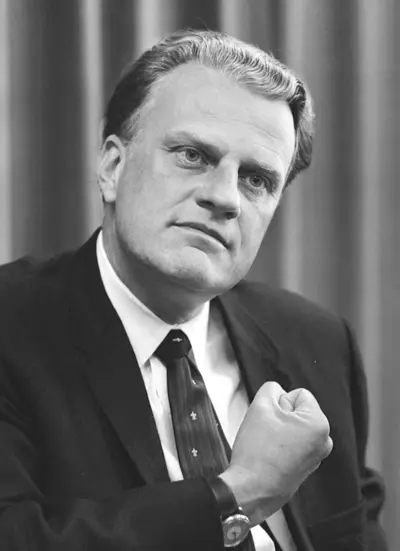
William Franklin Graham Jr. was an American evangelist, a prominent evangelical Christian figure, and an ordained Southern Baptist minister who became well known internationally in the late 1940s. One of his biographers has placed him "among the most influential Christian leaders" of the 20th century.
