Fulton J. Sheen Quotes
Monopolistic capitalism is to blame for this; it sunders the right to own property from responsibility that owning property involves. Those who own only a few stocks have no practical control of any industry. They vote by postcard proxy, but they have rarely even seen "their" company. The two elements which ought to be inextricably joined in any true conception of private property - ownership and responsibility - are separated. Those who own do not manage; those who manage; those who manage and work do not control or own.
Sheen, Fulton J. Communism and the Conscience of the West. Bobbs-Merrill, 1948.


The National City Company was formed expressly as an attempt to dominate and monopolize the United States economy. It was a holding company that included Standard Oil, National City Bank, 16 other banks, and the Union Pacific and Southern Pacific railroads among others, all controlled by the same 3 men--William Rockefeller, .James Stillman, and Frank Vanderlip.


Alexander Dubcek, Communist leader of Czechoslovakia, had pushed reform so far that 5 Soviet armies invaded. Dubcek was brought to Russia where he tried to persuade the Russian premier that the invasion was contrary to the principles of socialism.


At the time, land was much more of a necessity for the average person than today in America. But in early America and much of the rest of the world today, without land one had little or no opportunity to do almost anything. So equality of land distribution was necessary for equality of opportunity. America never solved the problem of equality of land distribution; we just developed an economy where land was not longer so critical to opportunity.


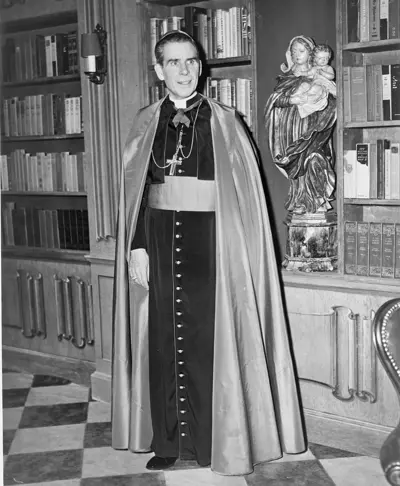
Fulton John Sheen was an American bishop (later archbishop) of the Catholic Church known for his preaching and especially his work on television and radio. Ordained a priest of the Diocese of Peoria in 1919, Sheen quickly became a renowned theologian, earning the Cardinal Mercier Prize for International Philosophy in 1923. He went on to teach theology and philosophy at the Catholic University of America as well as acting as a parish priest before being appointed Auxiliary Bishop of the Archdiocese of New York in 1951. He held this position until 1966 when he was made the Bishop of Rochester. He resigned in 1969 as his 75th birthday approached, and was made the Archbishop of the titular see of Newport, Wales.
