Ludwig von Mises Quotes
If history could prove and teach us anything, it would be the private ownership of the means of production as a necessary requisite of civilization and material well-being. All civilizations have up to now been based on private property. Only nations committed to the principle of private property have risen above penury and produced science, art, and literature. There is no experience to show that any other social system could provide mankind with any of the achievements of civilization.
Mises, Ludwig von. Human Action: A Treatise on Economics. Yale University Press, 1949, p. 264.


While generally true, Mises here again exaggerates his “proof” by selectively ignoring or being ignorant of counter-examples. The Roman Catholic Church is a classic counter-example where priests, monks, and others owned nothing as individuals, but produced some great science (eg Gregor Mendel), art (the illuminated texts of the middle ages), literature (St Thomas Aquinas, etc). The best counter example that was just evident in the last decade of Misis’ life is Communist Russia. Russian science was better than Fance and Germany and second only to the United States. The Russian ballet and orchestras were second to none. Great literature came out of the Soviet Union and the best of it complained about and attacked the Soviet system of the times. In general, Mises principle tended to be correct throughout history but not always as he dogmatically stated.


Commenting on the status of the Cherokee Indians.


Alexander Dubcek, Communist leader of Czechoslovakia, had pushed reform so far that 5 Soviet armies invaded. Dubcek was brought to Russia where he tried to persuade the Russian premier that the invasion was contrary to the principles of socialism.

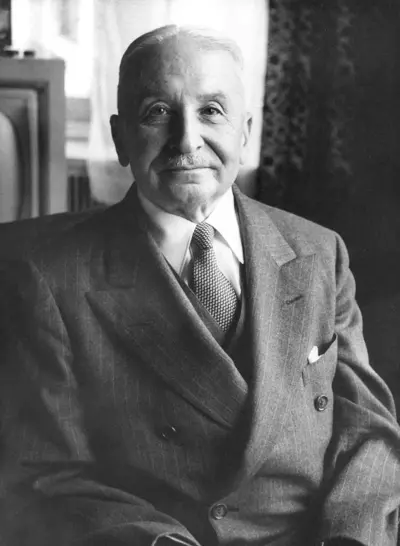
Ludwig Heinrich Edler von Mises was an Austrian School economist, historian, logician and sociologist. Mises wrote and lectured extensively on the societal contributions of classical liberalism. He is best known for his work on praxeology, a study of human choice and action.
