Jonas Clark Quotes
Many inhabitants both of the town and country, are daily abused and insulted, by the troops. The devotion of God’s people, in their worshipping assemblies, is frequently interrupted, and marks of the utmost contempt are cast upon religion itself. Bodies of troops from time to time march into the country, with a view … to alarm, terrify, or awe the inhabitants to a submission.
The presence of British troops triggered an angry revolution. Ironically, during the Iraq war, this sentiment was communicated over and over again by Iraqi leaders and held by most peoples who undergo military occupation.
Jonas Clark, 1730-1805, Protestant Minister of Lexington, Massachusetts, Sermon, Lexington, April 19, 1776
Sourced by: Eigen's Political and Historical Quotations

Brant had an English style Missionary education and was an Anglican, belonging to the Church of England. During the American Revolution, he persuaded most of the Iroquois tribes to fight for the British against the revolutionary colonists. However, the Oneida tribe was not persuaded and joined the rebel side. A few New England Presbyterian missionaries had targeted the Oneida people, and when that tribe chose the “wrong” side, Brant believed that the reason was their different religious point of view. After the Revolution, Brant and his Iroquois followers were driven out of their American lands and escaped to Canada, while the Oneida were given complete title to their lands by George Washington.

As a result of Henry VIII establishing himself as the head of the Church in England and Ireland in place of the Pope, Henry’s heirs also became head of the Church. And that was the role that Queen Elisabeth had inherited in addition to the Crown. Many of those loyal to the Pope found most offensive the fact that a woman was making decisions for men and women on matters of faith. A Papal representative travelled with FitzGerald and probably helped him compose this document of which this is but 2 sentences. He may have drafted it completely. The Pope was a factor in many of the Irish rebellions against the English, and this caused great suspicion of all English Catholics whose loyalty to the Queen was in conflict with their loyalty to the Pope who was plotting for a Catholic takeover of England and Ireland.

This quotation shows that the dissent leading to the American Revolution did not emerge suddenly in 1776 after the Battle of Bunker Hill. Dissent, sedition and even violence was documented here in 1774. Salem at the time was the second largest port in the colony and the customs tax collectors—Loyalist Americans—were run out of Salem.
In April of 1689, Protestant William of Orange landed in England against Catholic King James I, in a Catholic-Protestant civil conflict which not only affected England but its colonies as well. The Governor and Lieutenant Governor of New York City were confused and wary as to taking immediate sides, but there was a strong anti-Catholic movement in New York City. This group, functioning as “The General Convention for the Province of New-York,” elected Leysler, its leader—later appointing him Lieutenant Governor of New York. Leysler’s forces seized the government and imprisoned the King James Appointed Officials who would not turn against James. Leysler actually governed New York for almost two years. The old guard of New York, after William had been crowned King, attempted to regain the status quo ante. Leysler and his extremist followers saw them as traitors and Papal supporters although they themselves were English Protestants. But their appointment, loyalty and wavering regarding James I made them traitors in the view of Leysler. When initial troops tried to regain power for the original governor and council Leysler, he simply dismissed them as Papists. Finally, in March of 1691 Governor Slaughter, arrived with more troops, and after a significant Battle for New York, captured Leysler and his major followers where were executed shortly thereafter. This incident, sometimes referred to as “Leysler's Rebellion,” represents these American “firsts.” First successful revolution in America; First military coup; First military dictator. First successful counter-revolution. There were some contemporary critics who thought Leysler as interested in custom duties as Papists.

This letter drafted by Adams was sent by the Congress complaining about the Closing of Boston Harbor. The letter was right about the consequences except for the last; the rift between American and the mother country was not only healed but there is no European nation that has been closer to the United States over the years.

20th century Africa and South America were particularly good examples.

The Irish Rebellion of 1641 The Rebels wanted to take control of the government and expel the English. However, the Irish rebels got out of control of their leadership and embarked on a number of bloody massacres of what they regarded as English usurpers and destroyers of their Catholic religion. It was the policy of the rebel leadership not to even disturb Scotts. They used the technique to tell the difference between English whose homes should be seized and Scotts who should be undisturbed that the ancient Jews used on the Exodus from Egypt: Marking the lintels of their doorway. The rebels who were so full f hate and demanding of vengeance did not always discriminate and many Scotts were massacred along with the English.


New Ross was under siege by Cromwell and his English Parliamentarian troops. After two days, the town tried to negotiate terms of surrender and one of the main things they asked for was freedom of religion to practice Roman Catholicism. This famous response set the stage for religious bigotry over the next years. Cromwell’s reasons for not allowing Catholicism to be practiced was not only one of religious zeal. At the time, the Roman Catholic Church was a major geopolitical power under a Pope who commonly supported or even dispatched troops for geopolitical and religious ends. The Vatican was particularly resentful of England for separating from the Church and asserting that the King of England was the head of the Church and not the Pope. Therefore Cromwell and many Englishmen had to deal with the reality that every practicing Catholic in the realm was a potential spy, traitor, and/or rebel. This fear of control of countries by the Pope strongly affected America, and was responsible for the defeat of the first Catholic Presidential Candidate, Al Smith. It was also a major factor in the election of John F. Kennedy so he dealt with it head on.
In the history of America


He had secretly asked the United States to send American troops back to Cuba to help keep law and order as the Cubans could not nor could they govern the polarized society that had been festering under incompetent Spanish rule. President Roosevelt was furious that the Cubans could not govern the country. See {640520}.

It was repealed the next year, but much damage had been done to the relationship between the American Colonists and the mother country. It set the tone for American transition to a desire for independence. . Fox, a conservative on most issues was an absolute radical on the issue of America. To aggravate the hawks in parliament, he used to dress in the colors of George Washington’s uniform to show his support once the war broke out.

Earlier, his father had also castigated the ministers over their inept hard-line handling of the American Revolution. See {641505} .


Howe had written Franklin attempting to stave off a American break with England. Franklin, with the approval of the Continental Congress, replied.

The Empress had earlier decided not to try and suppress the Boxers when they started attacking foreigners--{641838}. But now things had gotten out of hand and many ordinary Chinese people—especially Chinese Christians-- were suffering Boxer abuse. Cixi thought the government had to “ally” with the Boxers in the hope that she could influence directions in the future. This, of course, made her anathema in the West and forever damaged her reputation and legacy in Western history.

China had learned to grow new crops from the Americas and their greater ability to produce food led to large population growth which was straining the other national resources and the economy, technology and government could not handle the growth, producing much unhappiness and discontent.

The Netherlands and Belgium then belonged to Spain. However, Protestantism was spreading to the Netherlands. The Duke was a Catholic fanatic and advised the King to send him and an army into the Lowlands to root out and kill the heretics. In contrast, the Duke of Feria counseled allowing the lowlands tolerance. The King, himself a bloody fanatic sent Alba with the army. Over the next decade he murdered and executed thousands of Protestants and many Catholics who were more tolerant and thought Alba, who was given the derogatory nickname of “The Iron Duke. Ironically, this led to the Lowlands revolting and gaining independence from Spain.

During the American Revolution, conditions were very difficult for Washington’s soldiers who were ill armed, ill clothed, and ill fed while they were paid irregularly. At one point morale was so low that some of the soldiers revolted. Smyth observes that Washington and Congress disciplined the mutineers very mildly, especially when compared with the way the British would deal with such things. The British Governor Clinton tried to take advantage of the mutiny and the poor morale by announcing that all of Washington’s troops who wished could obtain amnesty and join the British forces where the pay and conditions were much better. Professor Smyth found it fascinating that none of the Americans would join the British and he credits it to the wise and mild discipline policies of Washington and Congress as well as the general perception of the justice of the American cause among the American troops.
The American plan was to capture Quebec and add that province to the 13 colonies. See {636940} . However, the American officers botched the invasion and did not attack as soon as they arrived when the British had almost no troops to defend Quebec.

2nd Earl of Guilford. This bill cut off all trade with the American Colonies. It was meant as pressure to cease the rebellion. It did not work.
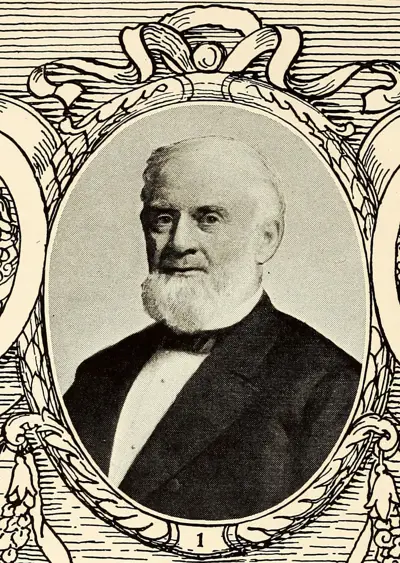
Jonas Gilman Clark was an American businessman, and the founder of Clark University. He started his business career in Massachusetts, before moving to California in the 1850s. He had a successful entrepreneurial career. He moved to Worcester in 1878, and founded Clark University in that city in 1887.
