Albert Bushnell Hart Quotes
Many attempts had been made by colonial legislatures to cut off or to tax the importation of slaves.
Hart, Albert Bushnell. Formation of the Union, 1750-1829. Longmans, Green, and Co., 1892, p. 19.


This treaty shows slaves were a major currency of the times and cultures. The Arab Armies of Egypt and the Nubians with this treaty declared an armistice. The extensive Arab use of Black slaves officially begun at this time, has plagued Africa since. Arab slave traders were the middle men who met the European and American demand for slaves until the 19th century. Even at the millennium the Sudanese civil war between the Arab North and Black South has reflected this resentment and hostility and has involved the Northerner’s enslaving tens of thousands of Black Southerners.

Louisiana to this day has a different legal system from the rest of the United States as it was originally based on the French Napoleonic Code. Most people did not realize that Louisiana had strictures against breaking up families—even with slaves.


He was also himself a ship owner in the slave trade and he was the brother of the leading Rhode Island abolitionist, Moses Brown. See {585793}. Brown became the first American, prosecuted in federal court for illegal slave trading –-- a prosecution brought, in part, by his own brother. He was, however, acquitted.


Prior to 1799 it was common for Slave Ship owners to insure their cargo, the life of the slaves. Without such insurance the slave trade was a very risky business. There were cases of captains murdering “difficult” slaves and collecting the insurance on them and the most horrible of all, throwing lots of slaves overboard to avoid arrest by those countries which had outlawed the slave trade, and then collecting insurance on the dead “cargo.” One insurance company simply refused to write insurance on slave ships. See {622020}.


The colonists had united for a war against the Narraganset Indians. The Charter allowed them to keep captives as slaves.
Most of us think the California was not a slave state, but in the early 1850s the California law (such as it was) allowed a slave owner to “sojourn” in California with his property that could include slaves. A number of Southern save owners took slaves to the California gold fields to do mining. There was a great deal of resentment on the part of the other miners and the free labor of the territory. In 1855, slavery in California was abolished.


In the Jim Crow era and well into the 20th century, many school books and historians, wanting to minimize the enmity between North and South, tended to a historical revisionism where the real brutal and immoral edge of slavery was minimized and slave owners were depicted as being in error by modern standards but well-meaning and paternalistic. Foner, with this famous quotation, put the lie to the false image of paternalistic slavery. By the beginning of the 21st century, there were very few serious historians who still tried to characterize slavery in the South as “paternalistic” otherwise humane. See {584014} for another of Foner’s famous quotes regarding slavery
Many historians of higher education to not agree with Wilder’s overall generality. However, it was certainly the case that slavery was a major factor in generating the funds for some early universities in the North, but others were “hotbeds” of abolition from their very inception.


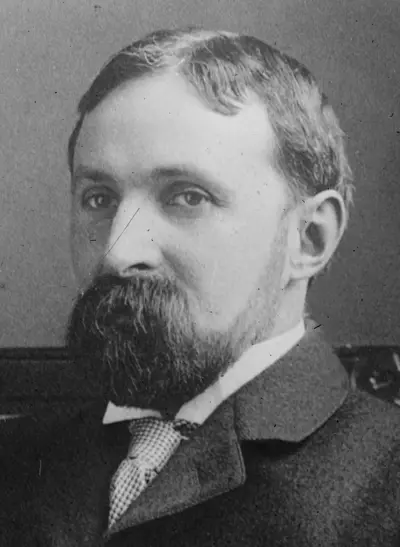
Albert Bushnell Hart was an American historian, writer, and editor based at Harvard University. One of the first generation of professionally trained historians in the United States, a prolific author and editor of historical works, Albert Bushnell Hart became, as Samuel Eliot Morison described him, "The Grand Old Man" of American history, looking the part with his "patriarchal full beard and flowing moustaches."
