John Stuart Mill Quotes
Laws never would be improved, if there were not numerous persons whose moral sentiments are better than the existing laws.
John Stuart Mill, 1806-1873, Member of Parliament, British Political Economist, The Subjugation of Women, 1869
Sourced by: Eigen's Political and Historical Quotations


Fiji had been divided ethnically between the indigenous tribes and Indian immigrants. The latter were pushing for modern democracy and the latter wanted it tempered by traditional authority of tribal leaders and traditional values.


The inventor of the Chi Square and Correlation Coefficient statistical methods. The lecture was also published as a political pamphlet. Pearson criticized the English Socialists who were calling for substantial immediate reforms on many fronts. Many of the reforms had much general support and the major political issue was the pace of reform.
There had been a major labor strike in the textile mills of Lawrence. Ettor was one of the major strike leaders and strategists. The city authorities sided totally with the mill owners and used police and militia to try and break the strike. When one of the strikers was shot and killed (historians generally agree that the police had fired the shot), the authorities used the death to incapacitate the leadership of Ettor and two other “socialist” leaders who were professional strike organizers and leaders. The 3 were arrested and charged with murder, firing the shot that killed the striker. Ettor and the others were miles away at the time giving speeches to the strikers at another mill. None-the-less, they were arrested, jailed, and not even tried until after the strike was ended. The three were quickly acquitted. The jailing of the strike leaders backfired and made the strikers even more resolute. The laborers finally won the concessions, not to have their pay cut. The defendants went on to lead other strikes.


At the time “publicity” as a field had not been invented. The word meant “transparency” of “openness”.

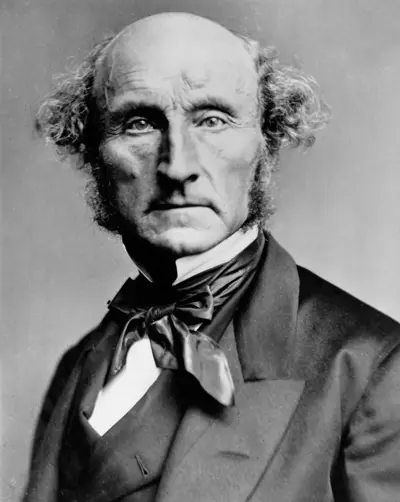
John Stuart Mill, usually cited as J. S. Mill, was an English philosopher, political economist, Member of Parliament, and civil servant. One of the most influential thinkers in the history of classical liberalism, he contributed widely to social theory, political theory, and political economy. Dubbed "the most influential English-speaking philosopher of the nineteenth century", he conceived of liberty as justifying the freedom of the individual in opposition to unlimited state and social control.
