Karim Sadjadpour Quotes
Khomeini had spent far more time thinking about the religious penalties for fornicating with animals than how to run a modern economy.
The inspiration and first Supreme Leader of the theocracy of Iran ordered many Iranians machine gunned or executed on other ways for various sexual offenses where arguably he did a good job of enforcing Islamic Law. However, he made a mess of the economy—one of the many areas about which he was very ignorant had had no desire to learn about. See {635611} for an example of his preoccupation with sex in national policy making.
Karim Sadjadpour, Policy Analyst, Carnegie Endowment, “The Ayatollah Under the Bedsheets”, Foreign Policy, May / June 2012
Sourced by: Eigen's Political and Historical Quotations

The American to whom he referred was a member of one of the many Think Tanks. This illustrates his naïve and ignorant view of American politics as he perceives such people in America are powerful and important. Another creative think tank analysis wanted to airdrop pornographic pictures throughout Iran, claiming that this would cause more dislocation and crisis for the Iranian Theocracy than anything short of a full scale invasion. He was joking, but when one examines the quotations of Khomeini and other Iranian leaders, it might well be a very successful tactic.


Gabriel exaggerates in the sense that while the quotation is correct for many Muslims, it is by no means true of all. Iran for example is an Islamic theocracy, but Turkey is a 99 percent Muslim nation which is totally secular and in some ways is much more restrictive of Islamic teaching and practice than most secular democracies. The fundamentalist Muslim view of the state and religion is essentially the same as the ultra orthodox Jews and Christians. It is true that a greater proportion of Muslims believe in the merging of civil and religious law than Jews and Christians, but by no means all. The non Arab Muslims are much less likely to see the unity of state and religion.


Bureaucracy has always been a problem for communist and capitalist alike.


Indeed she did. In actuality, she was the ruler of the largest nation on Earth. However, she was not a very clever ruler and actually was responsible for keeping China very backward and weak because she was convinced that China was the most advanced of nations and very strong. Therefore nothing should be changed. Over 5 decades with no change is sure to make a nation backward, even if it started as advanced. See {620090}.


There are many who observe that Saudi Arabia has the world’s most efficient oil deposits without which the nation would be poorer than most other Middle Eastern nations. With such huge oil revenues, there is no need of good governance.
This was a book on Islamic law—Sharia. According to Khomeini, if a Muslim kills a Muslim he should be punished for murder. However of a Muslim kills a non Muslim, he should not be punished unless he is a serial killer of non-Muslims. This is not in the context of Jihad but in the ordinary course of normal human activity where murder may be committed. This is just another way in which Christians, Jews and others who are not Muslims are second class citizens in Islamic law.

She was observing that while some autocrats try to change societies like Catherine the Great, and Kamal Attaturk, many try to maintain the traditional status quo like Franco of Spain and Kaiser Wilhelm of Germany


The irony of this quotation is that he is the architect and controller of the Russian system that he is criticizing.

The problem priests who sexually prey on young boys is not a modern problem only. This quotation demonstrates that the problem has existed for over 1000 years and probably existed in the earliest days of Christianity. This has been a problem of many clergies of different religions. However, the Roman Catholic authorities of the day seemed to be more proactive in dealing with it than in the scandals of the end of the 20th century and the beginning of the 21st.

One of Ferguson’s theses is that historical change often happens very rapidly.
His is the most cogent explanation of the early Muslim acceptance of slavery. However, he does not explain why Islamic nations were the last to make slavery illegal—usually under pressure from Christian nations or why illegal slavery continued to be openly practiced in Sudan and a few other Islamic countries even into the 21st century.

An American ambassador and 3 staff had been killed in a terrorist attack on our Consulate in Bengasi, Libya. The CIA and the rest of the American intelligence had initially analyzed the event and gave a report to the Administration “explaining” the event. American officials who did not see the incorrect intelligence report, hypotheses that it was a planned terrorist attack which it appeared to be from the news reports read by amateurs, However, the United Nations Ambassador was given the incorrect report and was asked by the White House to appear on the News Shows, reveal the contents of the report and state that this was a preliminary analysis and subject to change upon further data and analysis. She did that, but many journalists and politicians thought that her version did not comport with the facts. Soon it was discovered that the initial Intelligence report was all wrong and not even close to the truth and the people who guessed from the press reports had gotten it right. Graham and other members of Congress were very angry. So Graham made a public announcement stating the U. N. Ambassador was unfit for a senior job as she either lied to the country of was too naïve to see the truth which so many others had seen. There were dozens of people who might have either made a mistake or were otherwise responsible for the erroneous report which in hindsight appeared very flawed. At the top of the list was the CIA Director who had been America’s best heroic and victorious general who had recently taken the post and was very popular. So Graham and some of his fellow members of Congress called for the head of the one person involved and at a high level who had NOTHING to do with preparing and approving the wrong and misleading intelligence report and did not cast blame on any of the people who made the error or approved it. The quotation is typical of members if Congress who, insist on having the public stage before they know most of the facts, have little idea of how to manage anything, pick the easiest target to attack without worrying top much about the real culprits if any, and the lack of courage enough to blame a very powerful figure who if he did not personally err, the problem occurred on his watch. See {625924} for a view of the courage of Congressmen. Graham was actually a much better than average Senator, at the time but Congress had a 90% disapproval rating with the citizens.
The Labor Department never would commit to a recommendation. The Job Corps leadership examined the insufficient data and made their best guess which for the most part turned out to be right as the Job Corps was the most effective youth job training program in the history of the country. It and Head Start were the only two of the anti-poverty programs that were still operational into the 21st century. Supreme Court Justice Learned Hand expressed the same idea more generally in {482001}.

This quotation shows FDR doing something that politicians rarely do. The country was in the midst of the Great Depression and he was running for the Presidency against Herbert Hoover who as President would do little to help the destitute part of the population or improve the economy. Roosevelt did not lay out specific programs which he claimed would fix the problem. He himself really didn’t know for certain what would and what would not. However he promised bold experimentation—trying new things. When he was elected, he was able to fail with one program and just shift to another until enough were successful. But the great contrast was to Hoover who would do little.
Two of the 20th centuries greatest political leaders were Mao Tse-Tung and Franklin Delano Roosevelt. In most respects, these two were polar opposites. However, they had one characteristic in common. They were both willing to try things they were not certain of. If they succeeded, make it a part of the national program. If it failed, try something else. See Mao {642795}.


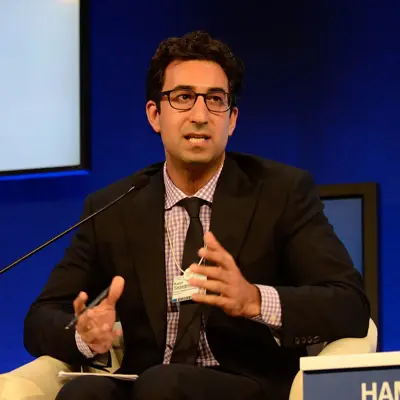
- Born:
- Nationality: American
- Profession: Policy Analyst
Karim Sadjadpour is an Iranian-American policy analyst at the Carnegie Endowment. Prior to that he was "chief Iran analyst" at the International Crisis Group. He is a contributor to BBC TV and radio, CNN, National Public Radio, PBS NewsHour and Al-Jazeera, and has also appeared on the Today Show, Charlie Rose, Fox News Sunday and the Colbert Report. He contributes regularly to publications such as the Economist, Washington Post, New York Times, International Herald Tribune and Foreign Policy.
