Ruhollah Khomeini Quotes
A Moslem will not be punished for killing an infidel, unless a Moslem has a habit of killing infidels.
This was a book on Islamic law—Sharia. According to Khomeini, if a Muslim kills a Muslim he should be punished for murder. However of a Muslim kills a non Muslim, he should not be punished unless he is a serial killer of non-Muslims. This is not in the context of Jihad but in the ordinary course of normal human activity where murder may be committed. This is just another way in which Christians, Jews and others who are not Muslims are second class citizens in Islamic law.
Ruhollah Khomeini, 1900-1989, Iranian High Cleric (Ayatollah) & Revolutionary Leader, Tahrir al-Vasileh, 1961
Sourced by: Eigen's Political and Historical Quotations

This quotation demonstrates that religious persecution of non Muslims was a duty, This has been a characteristic of all religious persecution regardless of religion. The quotation also shows that after 600 years, the original limited tolerance the Prophet had urged for People of the Book (Jews and Christians) was waning. Instead of non-believers being tolerated if they paid the special tax and were second class citizens, leaders were urged to convert or eliminate “infidels.”

In the early stages of Islam, Muhammad had hoped to convert the Jews and others on the Arabian Peninsula. When they refused to be converted, he warred against them usually killing the men, and taking the women and children as slaves. The result was that non-believing tribes were “cleansed” from the Arabian Peninsula. The Muslims at the time preferred children as slaves. For then they could convert the children against their will. Adults in Islam must accept Islam in order to convert. Children are regarded as having no such maturity of decision making and therefore opposition to conversion may be ignored and they may be forced. Critics of Islam and those who argue that Islam is at odds with all other religions point to this quotation. They claim that it is the only religion whose founder and fundamental scriptures demand war against others for no other reason than that they believe in a different religion. The Catholic Church during the Crusades and the Inquisition had a similar philosophy as did Christian missionaries colonizing Africa later. One difference is that most Christians today repudiate the doctrine as against the true spirit and teachings of Christ and view it as historical error, while very few modern Muslims repudiate this quotation of the Prophet.

It is this verse that for some Muslims justifies terrorism against non-Muslims. See {584354} for a specific example. There are similar provisions in the Old Testament which a few extremely conservative Jews and Christians have used to advocate for blasphemy being a capital crime. Note that if an unbeliever repents and becomes a Muslim, he should be spared.
While not all Islamic Religious legal authorities agree any more than Christian or Jewish religious experts do, this quotation is often used to illustrate that the militant Muslim fundamentalists would not only use a nuclear or other kind of weapon if they could get and deliver one, but that some actually think that would be a moral act. He gives no source for his 10 million estimate and most observers think the number wildly exaggerated, And most of the weapons in the world that end up killing people are small arms, made mostly by China, Russia and other nations providing more than the United States. But in politics, and especially in the middle East, perception is reality. See {585931}.

See {586041} for a Koranic quotation that urges world domination by Islam. In this quotation, The Prophet was talking to his followers at a time when Islam was not even a dominant religion in Arabia. And war was the way in which tribes, groups, and religions and sects, established themselves and grew. Although there are other Koranic passages which tell the faithful that people can only legitimately come to Islam through individual commitment and willingly, this passage not only seems to contradict that but also reflects a desire to punish and disgrace “non-believing” groups. This vengeance motif is also contradictory to much else of the Koran which generally preaches love, forgiveness, and understanding. However, there are contradictions and intellectual inconsistencies within the Koran just as there are within the Old and New Testaments.
See {586916} for a passage from the Koran supporting his point.

She was born a Muslim herself and her life has been threatened by other, Muslims who are fundamentalists who are living proof or her point.
Religious obligation of Islam requires all Muslims to try and convert all others. However that is not different from some of the Christian, fundamentalist religions where attempted conversion of non-believers is a duty. However, where many in the Islamic world see that obligation as a peaceful, nonviolent, effort to persuade others to accept Islam, there are many others who believe that Jihad should impose Islamic law—Sharia—upon the world and the use of force and violence is not only acceptable but is necessary and desirable to achieve their objection.

She is a leading American Arab who is a Syrian expatriate.
Since Muslims try and convert others, one who changes religion and becomes a Muslim is exempt. The death penalty is reserved for Muslims who leave the religion.
The Governor had introduced Sharia, Islamic Law, into his state. When a woman was sentenced to death by stoning, the Federal Government nullified the sentence on the ground that stoning was not morally right nor was a death penalty for her actions. The woman was not executed

While this hadith has been used to justify murdering converts or even those who criticize actions taken in the name of Islam, this statement should be seen in historical context whereby Christians also commonly murdered “heretics,” and during the Protestand reformation, both Catholics and Protestants routinely murdered not only converts from their faith, but non believers such as Jews and Muslims. The Old Testament also advocated death for heretics.
The religious people in Saudi Arabia are very powerful and don't allow anyone to step on their toes.
Criticize them in the press.
The reason he claimed that Governor Taseer was a blasphemer was that the governor opposed death penalty for saying or writing anything that was heresy or blasphemy as interpreted be fundamentalist Muslims. The Governor knew he was taking a risk. See {620970} .
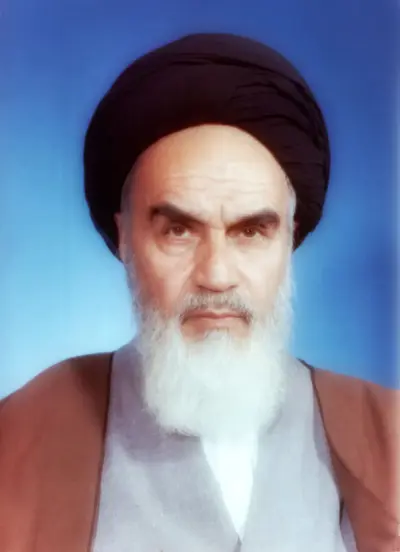
Sayyid Ruhollah Musavi Khomeini, also known in the Western world as Ayatollah Khomeini, was an Iranian political and religious leader. He was the founder of the Islamic Republic of Iran and the leader of the 1979 Iranian Revolution, which saw the overthrow of the last Shah of Iran, Mohammad Reza Pahlavi, and the end of the 2,500-year-old Persian monarchy. Following the revolution, Khomeini became the country's Supreme Leader, a position created in the constitution of the Islamic Republic as the highest-ranking political and religious authority of the nation, which he held until his death. Most of his reign was taken up by the Iran–Iraq War of 1980–1988. He was succeeded by Ali Khamenei on 4 June 1989.
