William Westmoreland Quotes
I’ve had the cross around my neck for years and years and years, and now I want to put it down and fade away.
He had commanded the American Forces in Vietnam, and that dominated all relationships with him thereafter. It was as if no one was interested in his views on any other subject, and he could never escape the constant burden of explaining and defending Vietnam policy.
William Westmoreland, Army General & Commander in Vietnam, Statement upon his retirement
Sourced by: Eigen's Political and Historical Quotations


This was only 10 months into Nixon's Presidency. He stepped up the war.


Podharetz was citing the Vietnam war. The two American occasions where the plausibility seemed to fade were the Vietnam War and The Irag war. Both Presidents Lyndon Baines Johnson and George W. Bush as Bismarck predicted, had much political trouble over the wars.

Boggs was working on some compromise positions that could be taken by the party at the 1968 Democratic National Convention to provide the anti war wing of the party with something. The President found out and met with Congressman Boggs.

The occasion was the visit to Washington of French Minister M. Jean Letourneau. The French were fighting the communists in Vietnam and the U. S., not yet in the fight, promised material and political aid, but no military participation. It was almost a decade later that America sent its first military personnel to Vietnam. The West was persuaded that the French could handle the situation. When they were defeated, America and Britain assumed that it was the notorious military incompetence of the French that accounted for the situation rather than the competence and commitment of the Vietnamese Communists and their support of the majority of the people.

The senator proposed that the U. S. withdraw its forces from Vietnam and declare victory:


The Vietnam War did not appear to be going well for the United States. Congressman Murtha and a few other members of Congress asked the Commanding General what Congress should do in its oversight role. One problem is that most members of Congress took Westmoreland’s advice. It turned out that the military was fabricating statistics to show a more favorable outcome, and although the military could and did win any particular battle, the South Vietnamese Regime we were supporting was inept and corrupt, and we were making little strategic progress in the war. Congressional patience was later blamed by many for allowing the war effort to bog down and deteriorate with little or no oversight. At the time the statement was made, this was not a significant quotation. It became more important in the light of what happened. It was then heavily quoted in the Iraq war where the administration counseled Congressional and public patience although significant progress was not being made.
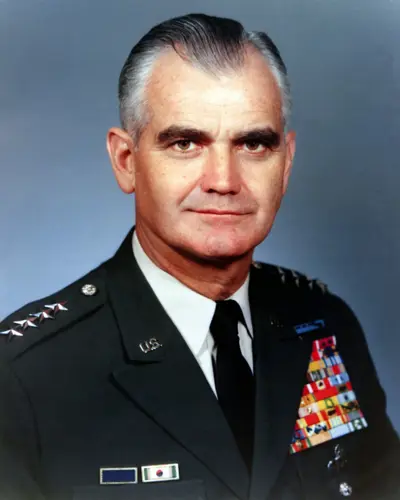
William Childs Westmoreland was a United States Army general, most notably commander of United States forces during the Vietnam War from 1964 to 1968. He served as Chief of Staff of the United States Army from 1968 to 1972.
