Manuel Puig Quotes
I've always wondered why there isn't a great French novel about the German occupation. The nouveau roman authors weren't interested in telling that sort of thing.
Puig, Manuel. "The Art of Fiction No. 114." Interview by Kathleen Wheaton. The Paris Review, no. 113, Winter 1989, pp. 128-147.


Leval was an appeaser and a collaborator with the Nazi’s. He led the government in name but the Germans really controlled the country. His actions killed tens of thousands of French men and women by turning them over to the Germans. After the Germans were defeated in WWII, Leval was shot as a traitor by the Free French forces.

Leahy also served as the U. S. Ambassador to the Vichy French Government. This was the German puppet government where traitors like Laval operated a government that was French in name only. After the war Laval was executed as a traitor. Vichy was the area of France where the Fascist French set up their government. See {587230} and {587229}.


This new form of patriotism, this encouragement of pregnancy—even outside of marriage—was just too controversial. Himmler withdrew the order. It illustrates that even in a brutal dictatorship, public opinion can influence government.

The general was replacing George S. Patton as commander of the Third Army. Patton had opposed the deNazification policy of the allies and caused a great deal of public relations difficulty for the army command and the administration, as reporters would frequently print his views. Truscott was one of Patton’s loyal assistants. The minute he took over, the press wanted to find out if his views were the same as his former boss regarding the Nazis. They were quite different. Reporters had no story.


Wilson had asked him to give more consideration to the German point of view in World War I peace negotiations.

One of the predictions of the oncoming war with Germany.


The military security people were so used to ferreting out communists in the 1930s that they had a hard time adjusting to the fact that the security risks or people who might have German connections or backgrounds. Many immigrant scientists were recruited for work on the Manhattan project to build the atomic bomb and they only did security clearances. The military security people kept checking on any communist background they might have had as opposed to possible connections with fascist organizations. By the end of the war they had adjusted but then had to go back to looking for communists as the Cold War evolved.

De Gaulle was a very difficult ally. He was ashamed that so many of his countrymen collaborated with the German invaders including fighting against the allies and the collapse of the French Army which, although it was larger than the German invader, had exhibited much cowardice. His way of dealing with this shame was to exaggerate the positive role that the loyal French and the serious Free French Fighters and to deny the extent of the negative behavior. He was always demanding that the small Free French Army be included in all military operations, and when successful, they be given equal credit along with the British, Americans, and Russians even though the French only contributed a tiny proportion of the effort. De Gaull’s ego, personal and national was enormous and Churchill had just as great a national ego. Hence for De Gaulle, Churchill was a kind of enemy. The “Channel” referred to the English Channel.
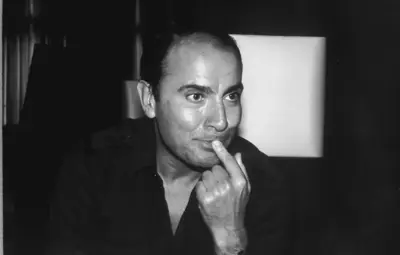
Juan Manuel Puig Delledonne, commonly called Manuel Puig, was an Argentine author. Among his best-known novels are La traición de Rita Hayworth (Betrayed by Rita Hayworth, 1968), Boquitas pintadas (Heartbreak Tango, 1969), and El beso de la mujer araña (Kiss of the Spider Woman, 1976) which was adapted into the film released in 1985, directed by the Argentine-Brazilian director Héctor Babenco; and a Broadway musical in 1993.
