Georges Clemenceau Quotes
No, but the Germans have been to France twice in my lifetime.
Wilson had asked him to give more consideration to the German point of view in World War I peace negotiations.
Georges Clemenceau, 1841-1929, French Premier & Journalist, Answer to Woodrow Wilson's question of whether he had ever been to Germany, Versailles
Sourced by: Eigen's Political and Historical Quotations


Shortly after he refused to join, his brother who had joined the Resistance had been captured, tortured and murdered by the Germans. He then joined the active resistance even though the Americans had not yet arrived. He realized that resistance was just an annoyance to the Germans, and the time the Resistance could really make a difference was after the Americans and British had landed in France.

A few days before the Germans had bombed a few places around Paris. The French President and high officials after stating that they would defend the city against the Nazis ran out of town to the South. Then the city officials all ran including most of the police officers. All the foreign diplomats followed except for Ambassador Bullitt, a close personal friend of President Roosevelt. When he sent this cable, he and his staff had 2 revolvers and 40 bullets and asked FDR to send him some sub-machine guns to help him maintain order in the city. When the Germans arrived, there was not a single Frenchman who tried to stop them. The French Army had already run from the Battlefield outside of Paris. It is this dreadful, cowardly showing of the French which plagued De Gaulle and other French Patriots for years causing a great exaggeration of the extent of the French Resistance which was indeed heroic but only involved few Frenchmen and women. Fortunately, there was almost no looting of civil breakdown and the Germans arrived and took over. Bullitt never had to use his “armaments”.


1st Viscount Grey of Fallodon. He was advocating British entry into WWI in defense of the Neutrality of Belgium as was their treaty obligation.

The Times regretted that the Germans did not speak to the Austrians more vigorously when they were threatening to attack Serbia who harbored anti-Austro-Hungarian terrorists (see {642085}). What the Times editors did not realize was that the Germans had already made their war plans (see {642092}) and the Serbian issue was just the justification they needed to implement them. So there was no real reason for the Germans to discourage the Austro-Hungarian Empire from its mission to punish Serbia.

After WWI, the Germans were reluctant to make the reparation payments that they had agreed to in the WWI peace treaty. The French, to “motivate” the Germans, occupied the German Ruhr Valley—an area that contained very important German heavy industry and coal mines that could not function under the occupation. See {640090}.

Germany had just attacked Russia with whom it had a treaty. For a while, Hitler paid little attention to Italy and just gave their “ally” orders and instructions. Italian public opinion was concerned about the same question. See {627973} .


There were a number of world leaders who were not happy about the German Reunification. See Henry Kissinger {610355} for another.
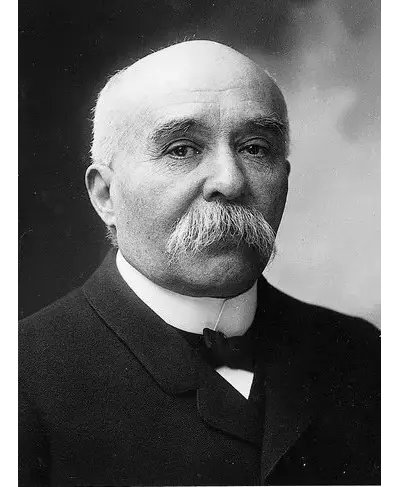
Georges Eugène Benjamin Clemenceau was a French statesman who served as Prime Minister of France from 1906 to 1909 and again from 1917 until 1920. A popular figure of the Independent Radicals, he played a central role in the politics of the Third Republic, most notably successfully leading the country through the end of the First World War.
