Robert M. Gates Quotes
It’s just a fact of life that Congressmen vote on bills that they have never even read..
At the time, most members never read the bills they voted on, though some tended to read earlier versions. The bills were very long—sometimes as long as 2000 pages. Usually a few members of Congress worked with Congressional Staffs and lobbyists to finalize bills. It was believed that the lobbyists were the only people who read the entire bills in all their versions.
Robert M. Gates, U. S. Secretary of Defense (Republican), Director of the CIA, Interview, C-SPAN Radio, October 2014
Sourced by: Eigen's Political and Historical Quotations

In general, there are so many versions of a bill as it goes through the Congressional process, that the members of Congress do not read each and every draft. Some do not read any of the drafts and leave it to the Committee; others trust their staffs or their party leadership. More often they trust the lobbyists who donate to their campaigns. Sometimes, the bills are so large—many thousands of pages that the members of Congress lose track of all the aspects of the proposed law and only read a few sections in which they may have participated in debate. Often, the only people who read the entire bill are the lobbyists and one or two of committee staff.

the largest economic and banking reform in decades The Dodd-Frank reform legislation was very complicated. It was extensively debated including attacks against provisions that were not even in the bill (See {632833}.) Few of the supporters and fewer of the opponents understood the bill. Many members on both sides had not even read the entire bill. It passed.
The Congress at the time was one of the worst in American history, accomplishing little more than nothing, mired in gridlock and ideological hyperpartisanship, with little concern for the nation as a whole. Other critics observe that it is the voting public that elected and re-elected the Congress and therefore must share the responsibility.


The bills and legislative processes in Congress had become so large and convoluted that literally members of Congress either voted on bills that were so lage that they rarely read the entire bill or on procedures so arcane that the members could not determine ehate they were voting for. As a result most just followed the lead of their party's Congrssional Leadership.

For complex legislation, there are very few members of Congress who vote on the legislation who could honestly say that they have read the entire bill. Breyer and many others do not see this as a major problem; many others consider it a disgrace that members of Congress will vote for or against a law that they have not even read.


At the time most legislatures never had recorded votes but instead often depended on voice votes and other methods. Edison’s invention was a huge failure. Transparency was not a popular concept amongst politicians as it still is not, but some standards have changed.


On that day, the Republican Majority in the House adopted a strategy to attach conditions to the normal budget process that they knew was unacceptable to the Senate and the President. The United States Government, the greatest nation on Earth, literally shut down all but the most essential services. What was worse is that the majority of the House of Representatives would pass a clean budget if they could vote on it. But the Tea Party Republicans blackmailed the Republican speaker that he would lose his speakership if he did not follow their strategy which was ironically controlled by a Republican Senator who had already lost on the issues they wanted in the Senate and in a Presidential election.


That particular Congress was the worst in American history in terms of passing legislation. Mainly there was philosophical gridlock between conservatives and liberals and worse between Tea Party Conservatives and mainstream conservatives. The Iraqi legislature was gridlocked religiously between Sunni and Shiite Muslims.


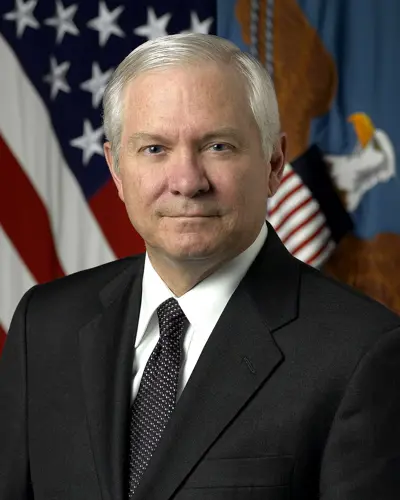
Robert Michael Gates is an American intelligence analyst, and university president who served as the 22nd United States secretary of defense from 2006 to 2011. He was originally appointed by President George W. Bush and was retained for service by President Barack Obama. Gates began his career serving as an officer in the United States Air Force but was quickly recruited by the Central Intelligence Agency (CIA). Gates served for 26 years in the CIA and the National Security Council, and was Director of Central Intelligence under President George H. W. Bush. After leaving the CIA, Gates became president of Texas A&M University and was a member of several corporate boards. Gates served as a member of the Iraq Study Group, the bipartisan commission co-chaired by James A. Baker III and Lee H. Hamilton, that studied the lessons of the Iraq War.
