Donald Rumsfeld Quotes
It's a difficult thing today to be informed about our government even without all the secrecy.
Donald Rumsfeld, U. S. Secretary of Defense (Republican), U. S. Congressman (Republican, IL), White House Chief of Staff, Quoted in Chicago Tribune, April 13, 1966
Sourced by: Eigen's Political and Historical Quotations


There were many critics who were concerned that the ITU was trying to regulate the Internet, but no one could be sure as the proceedings and meetings of the ITU are not publicly available. This is a classic UN problem. They see themselves as representing governments and not people. The Governments have the information and so they delude themselves into believing that they are transparent, when the reality is that for the individual they are totally opaque. Most critics who worry about UN regulation of the Internet, are just as concerned with what other countries are proposing than what there own government’s position is. And most governments themselves do not release the actual transcripts or proceedings of the ITC meetings but only documents giving their positions. This is an example of secrecy being promoted as transparency where the UN covers for member nations who want to maintain secrecy.
The improved access comes from the rapid technological and economic development of open source information available to the public. Governments will also benefit although governments will not be able to maintain as much secrecy,
Who does and does not get parole often depends more on politics and political contributions than on any issue of merit. Keeping all the records secret and the meetings closed allows much of this to happen. In Georgia, the politicians are so desperate to be sure that no one can determine the truth about parole decisions that they have passed a law that even the highest judges of the state cannot subpoena parole board records even if they are material and necessary for criminal or civil trials.


The executive order to which this statement referred was the then new President’s first—Executive Order 13489. It was enthusiastically received by the public, historians, researchers and the media. However at the end of Obama’s two administrations, the system was a little better than when George W. Bush, blocked much of the Freedom of Information Act from being implemented. However, the agencies who want to operate in secrecy without having to deal with public criticism, had developed even more sophisticated techniques of avoiding transparency and when they must disclose, they have developed techniques to delay the process, sometimes even for years, while they study whether the material should be disclosed. The president personally declassified a few CIA files from decades ago that the agency maintained should be secret, but he did nothing else systemic so solve the problem of declassifying and material and nothing to control the over classification which virtually everyone agrees is a major problem. More material is being classified than ever.


The next article itemizes a few exceptions such as national security, but by and large government documents are accessible.

Agree resigned from the CIA in protest to its political position.


At the time most legislatures never had recorded votes but instead often depended on voice votes and other methods. Edison’s invention was a huge failure. Transparency was not a popular concept amongst politicians as it still is not, but some standards have changed.

of the September 11 Commission

_0_thumbnail_47x47.jpg "Statue of Robert Hall in Leicester.")
For many people the implication of this quotation is that there should be no government secrets withheld from the citizens who have the right to examine. Others argue that government may have temporary secrets to protect against foreign enemies for example, but that these must be declassified very promptly so that the citizens can examine the actions of their government in time to replace the government if they are not satisfied. Almost all government officials tend to reject the first implication out of hand, and grudgingly accept the second with their discretion controlling when declassification should take place. The problem of America is twofold. There is much over-classification (material kept secret that should not be at all), and the time till declassification is long in general and truly absurd in many cases. For example, there are documents from WWII that by 2013 had still not been declassified. See {591444}, {641317}, and {589105} for exemplar views. William Jennings Bryan introduced this principle into the American political dialogue. See {641027}.


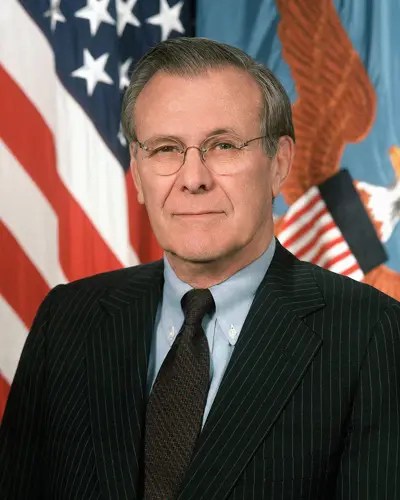
Donald Henry Rumsfeld is a retired American politician. Rumsfeld served as Secretary of Defense from 1975 to 1977 under Gerald Ford, and again from January 2001 to December 2006 under George W. Bush. He is both the youngest and the second-oldest person to have served as Secretary of Defense. Additionally, Rumsfeld was a three-term U.S. Congressman from Illinois (1963–69), director of the Office of Economic Opportunity (1969–70), counsellor to the president (1969–73), the United States Permanent Representative to NATO (1973–74), and White House Chief of Staff (1974–75). Between his terms as Secretary of Defense, he served as the CEO and chairman of several companies.
