Hafez Al-Assad Quotes
It was high time … [for Syria] to take the initiative in destroying the Zionist presence in the Arab homeland.
Just before the Six Day War. Syria did take the initiative and provoked the war which the Arabs lost badly. Ironically, Egypt and Jordan, pushed into the war by Syria, lost the most in manpower and territory.
Hafez al-Assad, 1930-2000, President of Syria, Statement, 1967
Sourced by: Eigen's Political and Historical Quotations


”Palestine” to the Arabs of the area meant the territory of the West Bank, Gaza, and Israel itself. They wanted to expel the Jews and or take over the whole area as a single state—Palestine—with an Arab majority. With the Israeli Defense Forces successes under Dayan, this notion of Palestine was “finished”. The notion of a Palestinian State which included the West Bank and Gaza but not Israel was then negotiated and these negotiations were ongoing for years. Minorities of Arabs and Israelis did not want to see a any Palestinian state that did not include Israel proper, and they blocked it whenever they could.


At that time Jews in Palestine were in the minority. The issue of how to obtain the land was hotly debated amongst Jewish groups. Jabotinsky was at one extreme—colonize and take the land just as the Arabs had done to the Jews when there was a Jewish majority. His view did not however prevail. The policy was to buy the land from individual Arabs and Jewish land up to 1948 was obtained that way. In that year the UN partitioned Palestine and 11 Arab armies attacked the new state of Israel and asked the Arab civilians to leave the area so that the Army could cleanse it of Jews. Many did not, and they or their descendants are still on their land or have sold it. The Arabs who left, were suspected of being possible collaborators or terrorists, and they have never been paid for their land or allowed to return. Compensation is still in dispute. At the same time Jews driven out of Arab countries by law and the military have never been compensated or given any right of return either.


The Arab armies of Egypt, Syria, Jordan and the PLO were preparing a coordinated attack on Israel. After statements like this, the Israeli’s preempted the attack, routed the Egyptian Airforce and Army, and then defeated the other three. The Arab “War of Liberation” resulted in the Arabs losing more with Israel tripling it’s control of area. The quotation however cast a pall over attempts thereafter to create a Palestinian State as in effect the PLO had announced a policy of a Holocaust—the extermination of the Israelis. The dispute over land was not for the Jewish state a land negotiation amenable to compromise and give and take, but instead was an existential threat to Israel whereby any compromise might result in the death of the entire population. As the ultimate intention of the PLO had been revealed.


This statement hardened the Israeli population away from anything that would bring Hamas more power. The PLO leader had, for ALL the Palestinian people, recognized the right of Israel to exist {633062}. Now Hamas was not only reneging on the Arafat declaration, but also would not even use the term “Israel” and instead calls the nation which in less time than the Palestinians have had, has developed a modern, industrial, democratic state far in advance of the Palestinians or any of the Arab nations for that matter. Yet it is relegated to a “project” with the great hope of having it come to an end—the destruction of Israel. The Israelis observe that this is a de facto declaration of war, and hence treat Gaza and Hamas as an enemy force to be reckoned with. See {635338} for another alarming reneging of the recognition of Israel.


This was one of the most accurate foreign policy assessments ever made. The next year the first Arab-Israeli war began when the state of Israel came into being. See {624566} for another accurate prediction.

Just like Spain and Persia, the Arabs by fighting lost not only more land, but also lost the respect of most of the non-Muslim War. The conscious decision to choose an irrational strategy that would cause loss of life, land and respect has none-the-less repeatedly been chosen by the Arab culture. much to its detriment. Azzam is one of the few Arabs to admit this to the non-Islamic World.

When the United Nations partitioned Palestine into a Jewish and a Palestinian State the Arab Countries all jointly attacked the fledgling Jewish State of Israel. Despite the Israeli’s being overwhelmingly out numbered in man and weapons, they beat back the invaders. However while many Arabs stayed on their Israeli land and some helped the Jews defend against the Arab Armies some abandoned their homes and land and went to neighboring Arab Counties. This is what they had been asked to do by the Arab governments who wanted to be able to attack communities without worrying about killing Arabs. To spur the evacuation the spread false propaganda about Israeli atrocities and frightened them into leaving. As a motivation to leave they were told that they could move into the Jewish lands and property when the Jews had been driven out. To make matters worse, some Israeli radicals repeated the lies to induce the Arabs to abandon their lands. In at least one case Arabs who stayed were subjected to violence. After the defeat of the Arabs, the Israelis had a dilemma in that they could not tell which Arabs were residents who had just been frightened and which had fought on the Arab side or helped the invaders. The result was that with few exceptions, the Arab refugees were not allowed back. Meanwhile, the Arab countries would not allow the refugees to settle and become citizens of the Arab countries (except for Jordan). The Palestinian refugees were a particularly fertile population and were cared for by the United Nations and have multiplied to many times their original size maintaining a continuous festering problem.

When the United Nations partitioned Palestine into a Jewish and a Palestinian State the Arab Countries all jointly militarily attacked the fledgling Jewish State of Israel. Despite the Israeli’s being overwhelmingly outnumbered they beat back the invaders. However while many Arabs stayed on their Israeli land and some helped the Jews defend against the Arab Armies, some others abandoned their homes and land and went to neighboring Arab Counties. This is what they had been asked to do by the Arab governments who wanted to be able to militarily attack communities without worrying about killing Arabs. To spur the evacuation the Arab leadership spread false propaganda about Israeli atrocities and frightened them into leaving. As a motivation to leave they were told that they could move into the Jewish lands and property when the Jews had been driven out. To make matters worse, some Israeli radicals repeated the lies to induce the Arabs to abandon their lands. In at least one case, Arabs who stayed were subjected to Jewish violence. Each side has since railed about what the other side did at that point in time and each fails to mention how they contributed to the refugee problem.


Syria constantly goaded Nasser and Egypt to attack Israel. However, Nasser was receiving huge foreign aid in the form of wheat which was needed to feed his population. See {595373}
14 Arab Armies in a coordinated attack on the 1 day old Israeli state, intended to massacre all the Israelis as demonstrated by this quote. Note that this kind of extermnination intent was advertised with pride. To everyone's surprised, the Jewish defenders not only beat back the viscious attacks but enlssarged their terroitory by capturing strategic sites from which the attacks had been launched. Many people credit to the Israely victory to the fact that they were litterally fighting for their lives. Defeat would have meant death for them and their families. The Arab armies, in contrast, were fighting for land that other Arabs claimed that should have been theirs. The willingness to stand and fight for this goal did not match the self preservation that motivated the Israelis--especially in the aftermath of the Holocaust killing 6 million Jews in WWII.
There are some who argue that the quotation was made earlier and was not meant as an incendary call for massacre of Israelis. It well may be that in his original thinking, he was predicting what would happen if the State of Israel was created, basing his thoughts on historical artrocieties of the past. And many think he was concerned about that possible outcome and was trying to avoid it. The import of the quotation was not necessaruly to hisltorically blame Assam for the point of view but to simply establish that there were many Arab voices calling for victories of history where there were massacres in the Middle East. And there were those who took Azzam's quotation and broadcasted it on Arab radio, calling for the very massacre that Assam may have been warning about. Note that this notion of Jewish massacre and extermination was also picked up 60 years later and called for by the President of Iran.

Two years later, In August 1990, Iraq invaded and conquered Kuwait. This quotation was used in the 1990 Iraq crisis by President George W. Bush in his television speech to the Iraqi people.
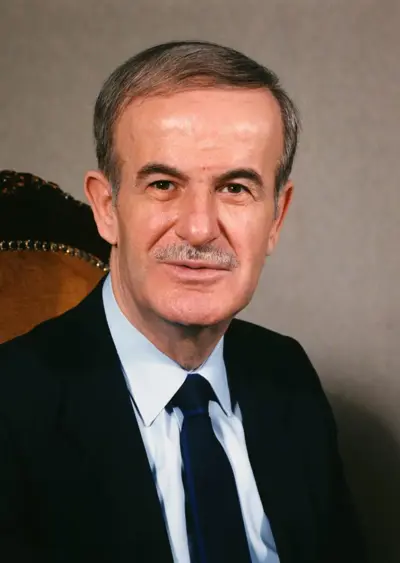
Hafez al-Assad was a Syrian politician who served as President of Syria from 1971 to 2000. He was also Prime Minister of Syria from 1970 to 1971, as well as regional secretary of the regional command of the Syrian regional branch of the Arab Socialist Ba'ath Party and secretary general of the National Command of the Ba'ath Party from 1970 to 2000.
