George C. Marshall Quotes
It must be assumed that members of Congress are just as patriotic as we [the military] are.
The only soldier ever so honored. He was then the Chief of Staff of the Army.
George C. Marshall, 1880-1959, General & U. S. Army Chief of Staff, U. S. Secretary of State, U. S. Secretary of Defense, Nobel Peace Prize Winner 1941
Sourced by: Eigen's Political and Historical Quotations

This may be Kennedy’s most famous line. However he was not the first orator to express this idea however. See Khalil Gibran {601423}, Warren G. Harding {622594} and {629021}, St. John Broderick {595734}, and Oliver Wendell Holmes Jr. {603707} for earlier expressions of similar sentiments. Holmes seems to be the first to express the idea while the earliest seems similar phraseology seems to be the British Politician St. John Broderick in 1893 {595734}. Although, these earlier expressions existed, Theodore C. Sorensen, who assisted Kennedy with this speech and wrote the draft, had distilled it from earlier expressions and views of JFK and said that these were Kennedy’s words. At the time, he stated that was unaware of the Gibran, Harding, Broderick and Holmes sentiments. Gibran had not yet even been translated into English. However it is not clear whether Kennedy himself had inadvertently recollected the phrase from any of the other quotations. (The question was never put to him.) The St. John Broderick quotation is a possible source. Kennedy was quite familiar with British political history, and his father and been U. S. Ambassador to Great Britain. Regardless, the quotation was as great for the place and timing—his inaugural—as it was for the phraseology which might have originated elsewhere.


At the time Harrison, one of the signers of the Declaration of Independence, was a Colonel serving under Washington. The war had been somewhat successful but the country was very weak and in great danger, and Washington and many others thought that Congress needed a better quality of leadership. Harrison’s son and great grandson would both become Presidents of the United States.

In early America, it was very hard to get people to serve in Congress. Johnson was actuall elected President of the Continental Congress, but refused to accept the office in that he had decided to leave as soon as replacement from North Carolina could be found.


Once he assumed the Presidency however, he flip flopped on this issue and approved prosecution of the Drake case and other whitle blowers. At the beginning of his second term, Edward Snowden, tried to get his superiors to do something about the massive surveillance of the American Public that the intelligence agencies were carrying out in secret. When Snowden was ignored, he went public through two newspapers. Obama castigated him for revealing that the government officials had lied and were operating a secret spying and eavesdropping system monitoring virtually every American. The Obama Administration chased him around the world trying to get him extradited for criminal trial in the United States.

He was an ally of the Ku Klux Klan and shared their vision of a binary moral and ethical world. There was no room for critics of the war effort.

He had been asked about the so called American “atrocities” for the bombing of North Vietnam targets. For this response Denton was tortured even more than he had been before which he disclosed on the television by blinking his eyes in Morse Code spelling TORTURE.


This is another example of a common practice amongst dictators and extremists of the Right and the Left. First they define “Patriotic” as accepting and following their norms, politics, regulations or laws. Then they define out any dissidents as not bona fide citizens of the nation. In the next step, the lack of citizenship and patriotism allows imprisonment, torture and even death at times. It is one thing to accuse dissidents as being citizens in opposition to the existing government; it is quite another to define them as no longer a citizen who is entitled to the respect or rights of a citizen. This was typical of both Soviet Communism in the 1950s and the followers of Senator Joseph p. McCarthy in the United States.


Samuel Langhorne Clemens, 1835-1910


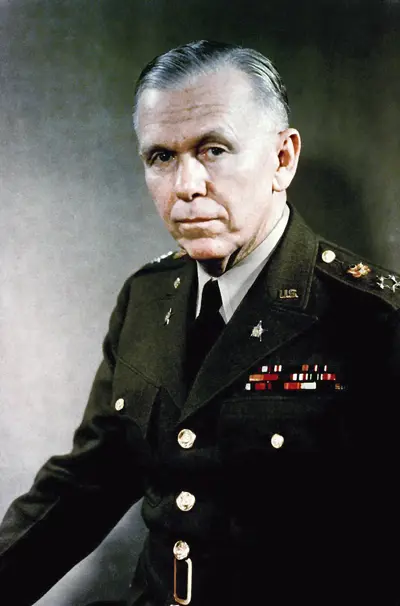
George Catlett Marshall Jr. was an American soldier and statesman. He rose through the United States Army to become Chief of Staff under presidents Franklin D. Roosevelt and Harry S. Truman, then served as Secretary of State and Secretary of Defense under Truman. Winston Churchill lauded Marshall as the "organizer of victory" for his leadership of the Allied victory in World War II. After the war, he spent a frustrating year trying and failing to avoid the impending civil war in China. As Secretary of State, Marshall advocated a U.S. economic and political commitment to post-war European recovery, including the Marshall Plan that bore his name. In recognition of this work, he was awarded the Nobel Peace Prize in 1953.
