Ignatius of Antioch Quotes
It is outrageous to utter the name of Jesus Christ and live in Judaism.
Ignatius of Antioch. "Epistle to the Magnesians." The Apostolic Fathers: Greek Texts and English Translations, edited and translated by Michael W. Holmes, 3rd ed., Baker Academic, 2007, ch. 10.


“Mormon” is a nickname for members of “The Church of Jesus Christ of Latter-day Saints.” Romney was a Mormon who was running for the Republican Presidential nomination. There remains a good deal of anti-Mormon religious bigotry in the nation.


Some of the founding fathers were deeply religious men while others were not so. Some varied in their believes at different times of their lives, and a number were not very favorable towards orthodox religion. At the time, Roman Catholic and Protestant churches were persecuting other religions throughout Europe and people were still being killed for their “heretical” beliefs. Most important to some of them, kings and other monarchs whom they abhorred, all at the time claimed the Divine Right of Kings and the established churches were the most important support for monarchs. At the time most organized religions were opposed to freedom of conscience and certainly opponents of separation of church and state. American churches tended to take on American values but were never given the chance to dominate the American government they way many religions had in Europe and the rest of the world.


This sura is used by moderate Muslims showing that The Prophet was somewhat tolerant of those who even mock the word of Allah. Nonetheless, most fundamentalist Muslims believe that anyone who mocks the word of Allah or His Prophet should be killed. Muhammad said not to sit with them—his modern followers too often call it heresy and want to kill them.


See Matthew Hale for a concurring view and Thomas Jefferson for a contrasting one.

The Sultan responded (see related quote): The King should have worried. The Sultan’s troops soundly defeated the French and then beheaded tens of thousands of French prisoners. The King was captured and ransomed.

This quotation illustrates two interesting facets of colonial politics. First, as in modern times, the title of an act often was inconsistent with the substance, and in many cases, this act among them, the act itself completely contradicts the implication of the title. The draconian intolerance exhibited by this clause was typical of the targets of the framers of the Constitution in erecting the separation of church and state. The fascinating thing about this act is another clause which acknowledged the difficulty of enforcing a common religion, and allowed that no one should be

Religious and ethnic political conflict had broken out in Fiji. Some in the Christian majority strove to make Fiji officially a “Christian country” and marginalize the Indian Hindu minority. The archbishop opposed and thwarted them.

The Papacy was at one of it’s lowest points. Two men, Clement and Urban, both claimed the Papacy and each had raised an army to fight the other. Each was promising indulgences to those who would fight, and in a modality similar to the Muslim terrorists of the 21st century, the soldiers were promised ascendancy to Heaven if they fell in battle for such a holy cause. The armies of the popes marched under the cross as their banner, and Wycliffe found that obscene and actually wrote a treatise saying so. See {618087}.

“Goyim” is the Hebrew and Yiddish word for non-Jews. In early Christianity, all Christians were Jews. Christianity was a new form of Judaism. The Last Supper was the Jewish Passover which was observed by all the early Christians who followed all the Jewish laws. Even goyim who wanted to convert to Christianity in the early days were converting to Judiasm and following the teachings of the famous Rabbi, Jesus. Later, St.Paul, allowed some goyim conversion without maintaining the Jewish dietary laws and without males having to be circumcised. The two religions split thereafter, but for many Jews of the time, especially the followers of Jesus, one of the Jewish obligations was to bring light to the goyim. The Cardinal was born of Jewish parents and converted, but just as the disciples of Christ considered themselves Jews so always did Lustiger.


Samuel Langhorne Clemens, 1835-1910. This viewpoint of Twain’s was just too jarring for an English newspaper to publish as England had been the leading Christian missionary nation in the 19th century. In the 20th century United States parents had a taste of Twain’s description with the Krishna’s, Scientologists, and other religions or cults doing what Christian missionaries had done elsewhere.
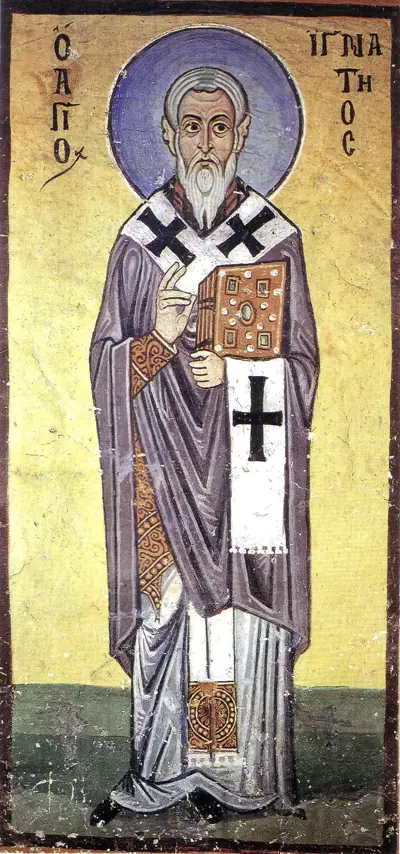
Ignatius of Antioch (/ɪɡˈneɪʃəs/; Greek: Ἰγνάτιος Ἀντιοχείας, Ignátios Antiokheías; died c. 108/140 AD), also known as Ignatius Theophorus (Ἰγνάτιος ὁ Θεοφόρος, Ignátios ho Theophóros, lit. "the God-bearing"), was an early Christian writer and bishop of Antioch. While en route to Rome, where he met his martyrdom, Ignatius wrote a series of letters. This correspondence now forms a central part of a later collection of works known to be authored by the Apostolic Fathers. He is considered to be one of the three most important of these, together with Clement of Rome and Polycarp. His letters also serve as an example of early Christian theology. Important topics they address include ecclesiology, the sacraments, and the role of bishops.
