Edward Teller Quotes
It is not the scientist's job to determine whether a hydrogen bomb should be constructed, whether it should be used or how it should be used. This responsibility rests with the people and with their ... representatives.
Edward Teller, 1908-2003, Nobel Laureate in Physics, Nuclear Physicist, Director, Lawrence Livermore National Laboratory, Quoted in Newsweek, August 2, 1954
Sourced by: Eigen's Political and Historical Quotations

Although generally a right wing conservative, Clark today sounds like almost like an extreme leftist on the issue. At the time however, many thought that he had taken leave of his senses. He not only was completely contrary to bipartisan national policy but opposed by almost universal American public opinion. He is one of the very few significant American officials to oppose the war policies.

This quotation not only illustrates the discomfort of the atomic scientists who developed the atomic bomb regarding the ethics and decision making regarding use, but also how complex a man Teller himself was. Here he sounds like a left-leaning centrist. A little later he would side with the hawks in the military and the political world and slander his colleague Oppenheimer publicly advocating an arms race and the development of the hydrogen bomb when the existing technology of the atom bomb could wipe out Russia or any other nation. His new allies however kept everything about nuclear weapons a secret and thus the public could never weigh in and influence any nuclear decision making. This state existed until President Eisenhower declassified much of the nuclear weapons information as part of his Atoms for Peace program.


Bethe was the head of the Theoretical Division of Los Alamos and was one of the Senior Scientists who developed the Atomic Bomb. At the time, he was very enthusiastic about scientists helping to stop the Germans and Japanese from winning WWII. He had been a refugee from Nazi Germany and became a great American Patriot. However, when there were tens of thousands of nuclear weapons—enough to destroy the entire population centers of the earth several times over, he urged a reduction and finally made this plea the year before he died. See {628438} for a recent expression of the principle of individual scientist’s responsibility.


Llewellyn H. Rockwell, Jr.

In the political debate about the Start Disarmament Treaty, Sara Palin, who had no experience of any kind with weapons or treaties of any kind, made a public statement that made little sense given the complex natures of the serious discussion that was ongoing.

There were many who thought that the Russians would view the Mutual Security Act as aggressive and they might respond with some kind of aggressive retaliation and this could lead to war. Others felt that containment would reduce the likelihood of war.

See Hans Bethe {628530} for a practical implication of this principle.
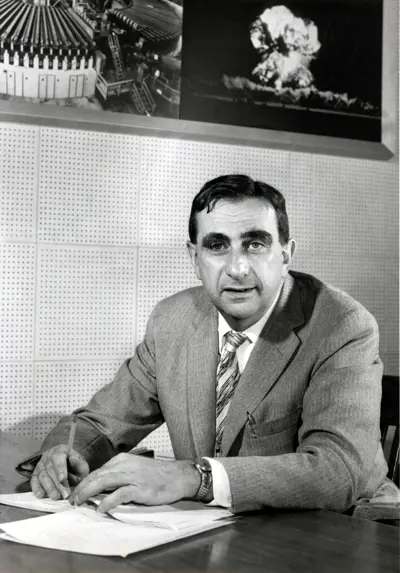
Edward Teller was a Hungarian-American theoretical physicist who is known colloquially as "the father of the hydrogen bomb" (see the Teller–Ulam design), although he did not care for the title, considering it poor taste. Throughout his life, Teller was known both for his scientific ability and for his difficult interpersonal relations and volatile personality.
