Moshe Dayan Quotes
It is not in our hands to prevent the murder of workers… and families… but it is in our hands to fix a high price for our blood, so high that the Arab community and the Arab military forces will not be willing to pay it.
This view has had a profound influence on the attitudes and actions of many Israelis in dealing with Arab terrorism. “Proportionate” retaliation is only retaliation and perhaps vengeance, but this doctrine developed out of frustration that little else worked has in many subsequent occasions driven Israeli government defense policy. The Lebanese War of 2006 was perhaps the best illustration.
Moshe Dayan, 1915-1981, Chief of Staff, Israel Defense Forces, Israeli Defense Minister (Labor), Quoted in Warrior: the autobiography of Ariel Sharon, 1928-2014
Sourced by: Eigen's Political and Historical Quotations


The Minister equates the unintended consequences of war and civilian casualties with a terrorist retaliation which has as its purpose the killing of as many civilians as possible. The proliferation of terrorism complicated the ethics of counter terrorism. In the case of Palestinian terrorists their tactics included using civilian facilities---schools, hospitals, homes---from which to launch rocket attacks or to store weapons or hide terrorists. Under international laws of war, a civilian facility and the civilians in it become legitimate military targets the minute that weapons are stored in or fired from that location or that location is used for planning, training, equipping or manufacturing of military material. Palestinian terrorists claim that even though civilians were harmed in legitimate, legal attacks on military targets, a proper response is to send suicide bombers into civilian areas and preparing the explosives with nails and rat poison to cause as much pain as possible.

Darwish’s father, a Colonel in the Egyptian Army, was assigned by Nasser to Direct the Intelligence Operations for the Palestinian Terrorists in Gaza. After many Israelis were killed, the Israeli Defense forces targeted the Colonel and killed him. Nasser’s concept of revenge was to kill any Jews, anywhere, not the Jewish soldiers who had retaliated against his soldiers.

It was speeches like this which created a distrust of the Palestinian intentions when there were negotiations of land for peace. Worry that peace was just a pretext for war or takeover, inhibited many Israelis from wanting to give up anything unless they could get a more reliable partner. The Palestinians had a traditional fertility rate that was several times that of the Israelis.


Most were tracked down and assassinated by Israeli agents. The mastermind, Abu Daud was seriously wounded but was not attacked again when the Israeli’s and Palestinians began their peace negotiations.

This proverb only makes sense in the light of understanding the Arab concept of revenge—“blood.” In a rural desert environment where little can be expected of government, the Arabs have developed a law enforcement and peace keeping mechanism which while primitive from modern standards, nevertheless worked to some degree. It is that revenge—“blood” is a moral necessity and obligation of all people, and revenge is not limited by time or to the individuals involved in the first incidence. The immediate family are the first to extract revenge, but the extended family follows and often the entire clan. Sometimes revenge is tribal or even national. Anyone who fails to revenge a member in his group is not only a disgrace, but is a clear and present danger to the group because then they can be attacked with impunity. So revenge is a strong obligation of the group members and blood must be paid with blood no matter how many generations it may take. The only thing that keeps me and my family safe, is the surety what whosoever kills one of us will themselves be killed or if they die a natural death we will take revenge on one of the evildoers relatives. Crime must never pay!

Darwish’s father, a Colonel in the Egyptian Army, was assigned by Nasser to Direct the Intelligence Operations for the Palestinian Terrorists in Gaza. After many Israelis were killed, the Israeli Defense forces targeted the Colonel and killed him. Nasser’s concept of revenge was to kill any Jews, anywhere, not the Jewish soldiers who had retaliated against his soldiers.

Muslim extremist terrorism was rampant, even before Israel was established. A few of the early Zionists took the Biblical view and responded in kind using the same terrorist tactics of the Arabs. Ben Gurion argued against that. The debate has continued in Israel ever since. With relatively few exceptions the Israelis have not engaged in terrorism although the Arabs and their supporters have defined terrorism against them as Israel using modern weapons of war within the international rules of war. Also, the Arab terrorists argue that this is the only weapon that they have available that can equalize the conflict and further if it is in “defense of Islam” terrorism or any other act is allowed by the Koran. Ben Gurion also was prescient in that the assassins of some key Israelis leaders over the years were Jews who advocated terrorism against the Arabs just as most of the victims of Islamic Terrorists have been Muslims.


This was one of the most accurate foreign policy assessments ever made. The next year the first Arab-Israeli war began when the state of Israel came into being. See {624566} for another accurate prediction.


The president believes that Israel was created solely to atone for the Holocaust. He has suggested that Israel should be in Europe. He does not mention the fact that that most of the Middle East including Israel, Palestine, Syria, Jordan, Lebanon, and others where part of a Jewish Kingdom over 2000 years ago and Jews were in the Holy Land ever since. He also does not consider the fact that Arab leaders were allies of the Nazis and supported the Holocaust.

At that time Jews in Palestine were in the minority. The issue of how to obtain the land was hotly debated amongst Jewish groups. Jabotinsky was at one extreme—colonize and take the land just as the Arabs had done to the Jews when there was a Jewish majority. His view did not however prevail. The policy was to buy the land from individual Arabs and Jewish land up to 1948 was obtained that way. In that year the UN partitioned Palestine and 11 Arab armies attacked the new state of Israel and asked the Arab civilians to leave the area so that the Army could cleanse it of Jews. Many did not, and they or their descendants are still on their land or have sold it. The Arabs who left, were suspected of being possible collaborators or terrorists, and they have never been paid for their land or allowed to return. Compensation is still in dispute. At the same time Jews driven out of Arab countries by law and the military have never been compensated or given any right of return either.

Just like Spain and Persia, the Arabs by fighting lost not only more land, but also lost the respect of most of the non-Muslim War. The conscious decision to choose an irrational strategy that would cause loss of life, land and respect has none-the-less repeatedly been chosen by the Arab culture. much to its detriment. Azzam is one of the few Arabs to admit this to the non-Islamic World.
When the United Nations partitioned Palestine into a Jewish and a Palestinian State the Arab Countries all jointly attacked the fledgling Jewish State of Israel. Despite the Israeli’s being overwhelmingly out numbered in man and weapons, they beat back the invaders. However while many Arabs stayed on their Israeli land and some helped the Jews defend against the Arab Armies some abandoned their homes and land and went to neighboring Arab Counties. This is what they had been asked to do by the Arab governments who wanted to be able to attack communities without worrying about killing Arabs. To spur the evacuation the spread false propaganda about Israeli atrocities and frightened them into leaving. As a motivation to leave they were told that they could move into the Jewish lands and property when the Jews had been driven out. To make matters worse, some Israeli radicals repeated the lies to induce the Arabs to abandon their lands. In at least one case Arabs who stayed were subjected to violence. After the defeat of the Arabs, the Israelis had a dilemma in that they could not tell which Arabs were residents who had just been frightened and which had fought on the Arab side or helped the invaders. The result was that with few exceptions, the Arab refugees were not allowed back. Meanwhile, the Arab countries would not allow the refugees to settle and become citizens of the Arab countries (except for Jordan). The Palestinian refugees were a particularly fertile population and were cared for by the United Nations and have multiplied to many times their original size maintaining a continuous festering problem.
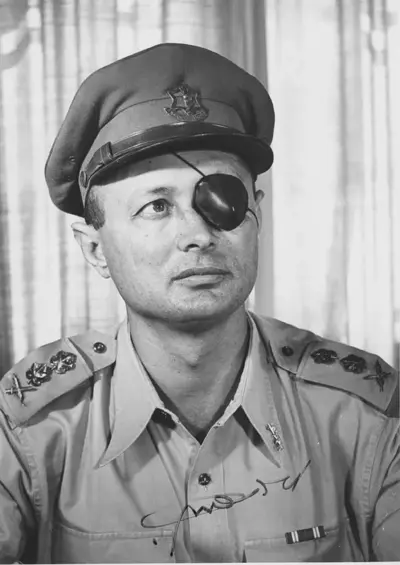
Moshe Dayan was an Israeli military leader and politician. As commander of the Jerusalem front in the 1948 Arab–Israeli War, Chief of Staff of the Israel Defense Forces (1953–1958) during the 1956 Suez Crisis, but mainly as Defense Minister during the Six-Day War in 1967, he became a worldwide fighting symbol of the new state of Israel. In the 1930s, Dayan joined the Haganah, the pre-state Jewish defense force of Mandatory Palestine. He served in the Special Night Squads under Orde Wingate during the Arab revolt in Palestine and later lost an eye in a raid on Vichy forces in Lebanon during World War II. Dayan was close to David Ben-Gurion and joined him in leaving the Mapai party and setting up the Rafi party in 1965 with Shimon Peres. Dayan became Defence Minister just before the 1967 Six-Day War. After the Yom Kippur War of 1973, during which Dayan served as Defense Minister, he was blamed for the lack of preparedness; after some time he resigned. In 1977, following the election of Menachem Begin as Prime Minister, Dayan was expelled from the Labor Party because he joined the Likud-led government as Foreign Minister, playing an important part in negotiating the peace treaty between Egypt and Israel.
