Edward R. Murrow Quotes
It is necessary to investigate before legislating. But the line between investigation and persecution is a fine one.
Referring to Senator Joseph R. McCarthy:
Edward R. Murrow, 1908-1965, Journalist, Director, United States Information Agency, CBS See It Now, March 7, 1954
Sourced by: Eigen's Political and Historical Quotations


He was asked to comment on the poor initial response of the Federal Government during the Hurricane Katrine crisis.

The Secret Service was then the only Federal police force. Some members of Congress were protecting constituents who were involved with these crimes and some were themselves owners who were committing the crimes.


In 2015, a group of hyper-partisan Republicans initiated yet another investigation of the attack on an American Consulate in Libya where the U. S Ambassador was killed. The incident had occurred when Hilary Clinton had been Secretary of State some time earlier. However, she was then the leading Democratic Candidate for President, and some Republicans wanted to question her under oath in the hopes that they could find something to embarrass her and derail her surging campaign. Hanna and a few other Republicans admitted the truth as they were opposed to the abuse of the Congressional power to investigate for partisan purposes. However, the reaction against Hanna by some members of his own party was extremely harsh. The theory of the Hanna critics was that telling the truth was in this case highly embarrassing to the Party and damaged the credibility of many accusations made against Mrs. Clinton who turned the tables on the investigators in when they questioned her for over 11 hours straight, and despite the total absurdity of the hearing and the questions—all of which had been asked before, she comported herself with Presidential dignity and pretended to take the hearings very seriously and answered the same loaded questions repeatedly. See {582957} for his earlier statements.


The investigations were by the House Un-American Activities Committee and Senate Internal Security Subcommittee. At the time we were in the midst of the Red Scare and McCarthyism was rampant.

In a celebrated case involving the right of the U. S. House of Representatives' Un-American Activities Committee to "expose" someone as a Communist, Mr. Justice Brennan wrote:


Referring to the narrowly drawn censure resolution of Joseph R. McCarthy that passed the Senate:


Reacting to Senator Joseph R. McCarthy who accused without any evidence 26 state department employees of "pro-communist" leanings, McFarland, the Majority Leader, took the Senate floor:


Hollings who was one of the senior experienced senators was offended by the degree to which the George W. Bush Administration and the Republican leadership had turned to lobbyists to draft legislation and amendments to pending legislation. Lobbyists often have specialized information that members of Congress do not have, so there has been in modern times communications between lobbyists and members of Congress and their staffs. However, during the Bush Presidency the practice reached an extreme where lobbyists would even write the legislative language and give it to the members in whom they had invested by giving them large campaign contributions and many perks. K Street is the fanciest street in Washington DC with some of the most expensive office space. A substantial proportion of the lobbyists have K Street offices, hence the metaphor.


Sparta, an ancient Greek city-state, trained all its young men for war. One “test” was each youth was to sneak into the countryside and murder someone’s slave and not get caught. The murder was against the laws of the society, but if the young man was caught he was punished severely, not for murder or attempted murder, but for getting caught.

Americans had never had the opportunity to see this committee in action before. While many Americans were intimidated, many were also very distressed to see how a Congressional Committee was abusing its power. And although the frightened Hollywood and network executive executives were intimidated into blacklisting Lawson and others, more and more Americans were lining up against this committee and Senator McCarthy’s committee in the Senate. This culminated in the Senate sanction of McCarthy and the discrediting of HUAC which never again had the influence that they had before this hearing.

Seeger had been a member of the Communist Party and had left it in 1950. See {635866}. He was later called before the House UnAmerican Activities Committee and asked to reveal the names of others who had been members. In those days of the red scare and McCarthyism, most people asked to name names and not wanting to do so “took the 5th Amendment” and could not be legally forced to reveal the names. Seeger as a matter of principle refused to plead the 5th Amendment because he was not afraid of incriminating himself and had done nothing criminal anyway. So he, a war veteran of WWII, instead refused to answer {635867} citing his First Amendment right of freedom of association. There was no legal precedent for this, and he was indicted and convicted for Contempt of Congress. However, his conviction was overturned as unconstitutional by the U. S. Federal Appeals court. Seeger had prevailed legally. But in retaliation Seeger was blacklisted and none of the radio of TV networks or Hollywood Studios would allow him (and other blacklisted artists) to appear. Today most Americans view what McCarthy, The Congressional Committee, the networks, and Hollywood studios had done as contemptible.


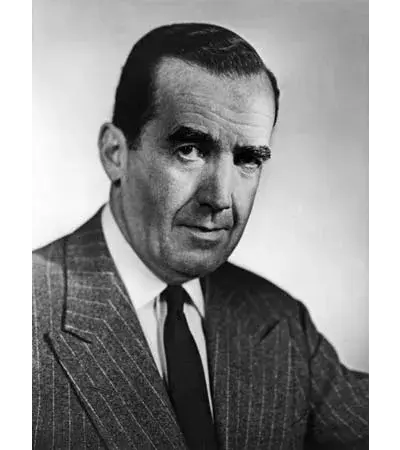
Edward Roscoe Murrow, born Egbert Roscoe Murrow, was an American broadcast journalist and war correspondent. He first gained prominence during World War II with a series of live radio broadcasts from Europe for the news division of CBS. During the war he recruited and worked closely with a team of war correspondents who came to be known as the Murrow Boys.
