Christopher Hitchens Quotes
it is interesting to find that people of faith now seek defensively to say that they are no worse than fascists or Nazis or Stalinists
Hitchens, Christopher. God Is Not Great: How Religion Poisons Everything. Twelve, 2007.


What the historian did not know was how similarly the Protestants would behave against the Catholics when they had the power. Since the Catholics were the established church, and the Protestants the new “heretics” the Protestants were on the receiving end of most of the atrocities at the beginning. However, as if they had been scholled by their horrible experiences, they repeated them just exchanging the perpetrators and the victims.


It was uttered in the King’s name by soldiers and officials throughout the land. It is not certain that the exact words of choice were created by Louis but they were uttered in his name. Protestants had been given the right to practice their religion in France by the King’s grandfather (the Edict of Nantes {617664}), but Louis XIV rescinded that {617765} and gave Protestants this choice. Some converted. Some were murdered. Some escaped to other countries.


It is this verse that for some Muslims justifies terrorism against non-Muslims. See {584354} for a specific example. There are similar provisions in the Old Testament which a few extremely conservative Jews and Christians have used to advocate for blasphemy being a capital crime. Note that if an unbeliever repents and becomes a Muslim, he should be spared.


This sura has unfortunately been used by some Serbians and other Christians to justify ethnic cleansing against Muslims.


In 1877 Wasburn was dropped from the List of Ministers by the Unitarian Church. He had become very critical of organized and orthodox religion of all kinds.


It was not until 1780 that Catholics were allowed to even be members of Town Corporations.

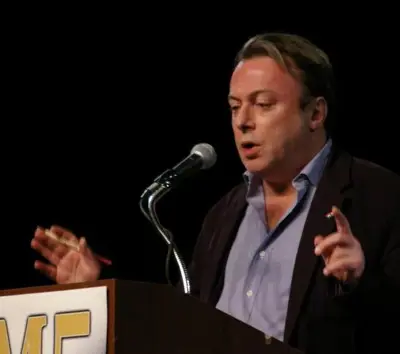
Christopher Eric Hitchens was an English-American intellectual, polemicist, and socio-political critic, who expressed himself as an author, orator, essayist and columnist. He wrote, co-wrote, edited or co-edited over 30 books, including five of essays on culture, politics and literature. Having contributed to several publications, he is broadly regarded as one of the most influential atheists of all time.
