Timothy Dwight IV Quotes
It is in vain to allege that our ancestors brought them [Negro slaves] hither and not we. We inherit our ample patrimony with all its encumbrances and are bound to pay the debts of our ancestors. This debt particularly we are bound to discharge…. To give them [slaves] liberty, and stop here, is to entail upon them a curse.
This is the first formal call for reparations of some kind for slaves after freedom. It is almost always quoted when the issue of reparations for Blacks is discussed. Dwight was not some left wing liberal. Actually he was one of the most conservative Americans at the time. He was an ardent opponent of Thomas Jefferson (see {600384}.) and a staunch supporter of the Federalists. He was one of the major spokesmen for the establishment and upper class of the day. He was also an ardent Christian minister who saw slavery for what it was—an evil sin and an injustice to any humans in that condition.
Timothy Dwight, 1752-1817, President, Yale College, 1810
Sourced by: Eigen's Political and Historical Quotations

The staid clergyman who headed Yale solemnly predicted that if Thomas Jefferson were to win the election for President of the United States:

Incredibly, the judges received a higher fee if they found that an accused Negro was a fugitive slave and must be returned, than if he found that it was a case of mistaken identity or the laws of the northern state allowed mandated freedom. Despite the bias, the moral issue was so profound that many Northern judges refused to return fugitive slaves, even after the Fugitive Slave Act.


See {625675}, {625686}, {625684}, {625682}, {625676} for additional quotations arguing for Black emigration.

This was part of his presentation to Northern influential business men showing them what he claimed was the New South. He was particularly complimentary about the negro Christian viewpoint that inhibited revenge or retaliation for their terrible treatment. The favorable lines about Negroes were well received by Northerners. However, they were mostly unaware of his racist views he expressed when in the South. See Quotation 643649.

Abraham Lincoln in his famous eulogy to Clay in Springfield, IL, used this quotation.


Negotiations regarding the exchange of prisoners and property. This was his view of his supposed obligation to return Negro slaves who had escaped and gone to the British during the war. The treaty of peace specified that all “property” including slaves, taken by, the British be returned to the Americans. But he and other officers did not always do so as they thought they had higher moral obligations. See {621936} for example.


Lev Davidovich Bronstein

This was a very creative solution to the problem of slavery. Slave holders and their supports have always claimed that the paid valuable money to acquire a slave and slaves were valuable personal property. Freeing slaves was the government confiscating their wealth. The Pennsylvania solution was to say that the labor of a slave for 7 years was worth far more than the cost of a slave, so that under this law, slave owners could get their monetary value back and make a modest profit, and slavery would gradually disappear over a 7 year period if no new slavery were allowed. Although it made a lot of sense, the Southern States felt that their economy was different—that they could never get free white men to pick cotton.
Parker and other escaped slaves in Christiana fought off slave catchers and killed the slave owner leading them. Charged with treason, he escaped to Canada with his family and lived there the rest of his life. While not a polished writer, after he himself had escaped and went to Christiana and leaned to read and write. He wrote this narrative of his life as a slave—one of the few written works we have from slaves.

As an entertainer she had toured much of the world and seen American slavery and that of some other nations. She became a staunch abolitionist and like entertainers in the 20th and 21st centuries she used her celebrity to give anti-slavery lectures and perform for audiences where she donated the proceeds of the event to the abolition cause. She is a particularly interesting political figure in that she seems to be one of the first entertainers to perform for a social cause and become an activist.

Jefferson’s views, actions and inactions regarding slavery are very complex and contradictory. This quotation is one example of the many statements and activities to end slavery. Yet he never freed his own slaves (as did George Washington) and he fathered a child by one of his slaves with no attempt at freeing even her and the child. The Andrew Dickson White article is one of the first serious studies of the Jefferson contradictions regarding slavery.


Many historians point to this quotation as demonstrating Jefferson’s antipathy to slavery. However, others, more cynical, observe that by curtailing the ability to bring new slaves into Virginia, the economic value of the slaves who already existed increased markedly, First because there was a limited supply and a growing economy, but more important because the slave owner could breed and sell slaves from the existing stock he had. Jefferson was very aware of this economic fact, had worked out the mathematics and economics, and even advised friends to take advantage of it. See {629765}. Jefferson’s view of slavery was very complex and ambivalent.

This is an important quotation because it shows that slavery was the principle reason that the South succeeded and began their rebellion. In the early 20th century, there was a movement to make the Confederacy and the rebellion more noble by promoting the idea that the Civil War was fought by the South for more lofty reasons such as States Rights, Original Construction, different economic philosophies and the like. This was a more noble cause then the right to deny other human beings their rights, to own other human beings who they could beat, torture, sexually use and even murder them was a pretty selfish and demeaning reason to have started a rebellion that would then cost more Americans their lives than any other American conflict. The succession documents and others of the Southern States and the Confederacy make it clear that slavery was THE issue and fleeting references to any of the others were only made to complain about the potential effect on abolition and the refusal of the abolitionist states to cease aiding and protecting fugitive slaves.
After the Civil War and Reconstruction, the American nation was still bitterly divided intelelctually, socially, emotionally and poliotically. In an effort to bring more unity to America, most of the power stucture and the influentials of the nation began to avoid those issues that would divide North and South and try and promote a narrative that both sides might be able to live with. And this is what Zeitz describes in this quotation. America went through a period of Revisionist History that even in the 21st century was held by many people. It wasn't until the middle of the 20th century that the real history and narrative of the Civil War and Reconstrution emerged from the few academics who had all along criticized the fabricated narritive that did unify the country at the cost of historical accuracy and truth. Many scholars point out that the price that America paid for this unity was the Jim Crow era and a century of legalized racism. Much of the nation was built on the labor of Negro slaves and the victims of the slavery era, also bore the brunt of American unity and reconcilliation.

The issue of slavery which had been suppressed in Congress for the first decades of the nation broke out when Missouri statehood was considered. By previous agreement, slavery was not even discussed in Congress but the time period elapsed. Tallmadge not only proposed that no more slaves could come into Missouri {613176} but most shocking to the Southerners was that every person born in the new state would be free at the age of 25. In a generation, there would be no more slavery in Missouri and there would be no economic compensation for slave owners at all. The House of Representatives accepted the amendment, but it failed in the Senate. At that time, Senators were not elected by voters but were appointed by the state legislators and the Southern slave states had a disproportionate share of the senate from a population point of view. But what this quotation shows clearly that a majority of the country in 1819 were opposed to slavery and were willing to end it without compensation.
Lincoln, just before the Civil War, quoted Jefferson that if slavery were not ended in America the results would be disastrous. But Lincoln at the time probably did not imagine how right Jefferson was, and Jefferson himself probably 1 how terrible the Civil War would be.
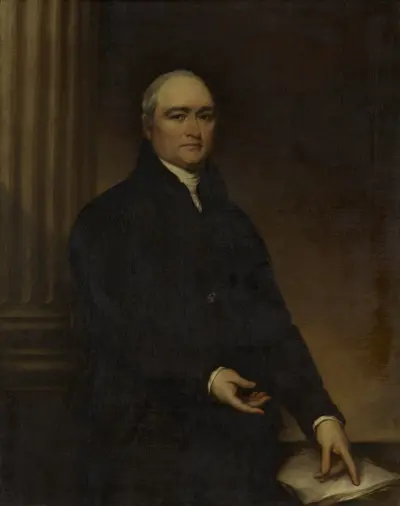
- Born: May 14, 1752
- Died: January 11, 1817
- Nationality: American
- Profession: Academic, Educator, Author, Clergy
Timothy Dwight was an American academic and educator, a Congregationalist minister, theologian, and author. He was the eighth president of Yale College (1795–1817).
