James Buchanan Quotes
It is, beyond question, the destiny of our race to spread themselves over the continent of North America, and this at no distant day.
James Buchanan Message to Congress in 1858
Sourced by: Eigen's Political and Historical Quotations


The Louisiana Purchase was part of a much larger grand vision for American expansion.


Jefferson had insisted that the expedition was purely scientific. The fact that it was lead by two military officers and involved soldiers led many to suspect the expedition was an “invasion” of what was then officially Spanish Territory. The very small size of the expedition made the concept of an expansion effort seemingly ridiculous to many. Jefferson was never public about his hopes fort the eventual possibilities but Martinez seemed to have gotten it right but was paid little heed.


He was referring to land where there were people already living. People included Indians and Mexicans. He was one of the few American Presidents who were not enthusiasts for Manifest Destiny and expansionism of America.


Between a purchase of lands from the Hudson's Bay Corporation and land grants, Canada annexed millions of acres of land without much political activity or any assent from the people who lived on those lands.

First Indian to hold the position

One of the reasons that Jefferson and others were so anxious to expand the territory of the United States was that Britain had operated with the policy that curtailed and limited the population growth of the American colonies and the resentment of this policy led to growth of America and the Westward expansion.


Clinton was a founder of the society. Many sophisticated Americans were in despair about the consequence of White contact with the Indian, and this was even before the worst of the treatment which came later, beginning under the presidency of Andrew Jackson and continuing well into the 20th century. Of particular interest is Clinton’s prescient observations regarding Africa and Africans interacting with whites with slavery the overriding white motive. Clinton was one of the many Americans who were abolitionists from the beginning of the nation.
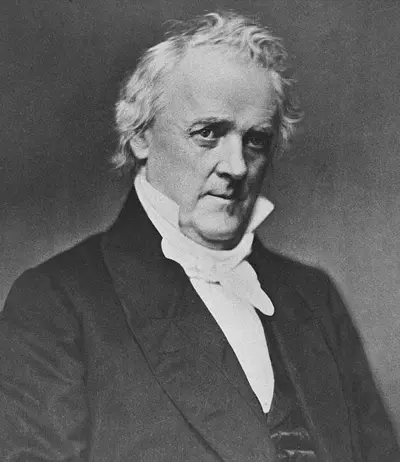
James Buchanan, Jr. was the 15th President of the United States (1857–61), serving immediately prior to the American Civil War. He represented Pennsylvania in the United States House of Representatives and later the Senate, then served as Minister to Russia under President Andrew Jackson. He was named Secretary of State under President James K. Polk, and as of 2016[update] is the last former Secretary of State to serve as President of the United States. After Buchanan turned down an offer to sit on the Supreme Court, President Franklin Pierce appointed him Ambassador to the United Kingdom, in which capacity he helped draft the Ostend Manifesto.; James McGill Buchanan, Jr. was an American economist known for his work on public choice theory (included in his most famous work The Calculus of Consent), for which he received the Nobel Memorial Prize in 1986. Buchanan's work initiated research on how politicians' and bureaucrats' self-interest, utility maximization and other non-wealth maximizing considerations affect their decision making. He was a member of the Board of Advisors of The Independent Institute, a member (and for a time the President) of the Mont Pelerin Society, a Distinguished Senior Fellow of the Cato Institute, and professor at George Mason University.
