Elizabeth Cady Stanton Quotes
In the criminal code we find no feminine pronouns, as "He," "His," "Him," we are arrested, tried and hung, but singularly enough, we are denied the highest privileges of citizens, because the pronouns "She," "Hers" and "Her," are not found in the constitutions. It is a pertinent question, if women can pay the penalties of their crimes as "He," why may they not enjoy the privileges of citizens as "He"?
Elizabeth Cady Stanton, 1815-1902, First President, National Woman Suffrage Association, The Woman's Bible, 1898
Sourced by: Eigen's Political and Historical Quotations

The party was not yet ready for women voting. Hardie resigned as Party Leader. In 1910 he agreed to return as Party Leader and the party was then not in opposition to women’s suffrage although many members were still against women voting.


The editorial was in support of women’s suffrage—the right to vote which at the time women did not have in Britain. Women were very active in protests and demonstrations. Tactics sometimes involved civil disobedience and chaining themselves to public buildings. It was the civil disobedience and disruptions that the newspaper referred to as the “follies and excesses.” In retrospect today, it is amazing how threatened the society felt and how they reacted to the “threat” of females voting. It does however give us a perspective on those contemporary societies which restrict women’s voting rights.

Although she was living proof of a woman’s ability to accomplish what most men could not, she was always publicly differential to men and their sexism. Although she opposed women voting in Parliamentary elections, she did believe that women should vote in local elections where the understood the issues much better.

She was overly optimistic. She would be dead for 30 years before women got the vote and some would argue that full equality has not been reached yet.

This was de facto Equal Rights legislation.


In one of the earliest claims that women should be allowed to preach, she made a theological argument and then challenged the male theologians to better her arguments. Although she was very demur, intellectually and theologically she “took it right at them.” Such intellectual aggression by women was virtually unheard of.
The speaking to which she was referring was Christian Religious preaching by women. At the time it was considered by most Christians to be sacrilegious for women to preach. This came down from the orthodox Jewish tradition, and there are several passages in the New Testament where the Apostles, who were Jews themselves were echoing the religious tradition. This then took on a meaning that went beyond tradition as in Judaism. Margaret Fox wrote this essay which was a completely theological defense of a woman’s right – indeed obligation—to preach. Theologically, there are many Christian churches for whom her argument would be too radical—even in modern times. However, in the middle of the 17th century to most male clerics, this was so unfathomable that they did not even deign to refute her theological arguments. Meanwhile, the Quakers began to accept women in theological positions of influence—for ahead of most other Christian and Jewish sects. See {619836} and {619837} for quotations from the essay itself.

In contemporary Iran, no one has any freedom in the International and Western sense of freedom. There is no freedom of speech, freedom of assembly, freedom of the press, freedom of religion, freedom to travel, freedom of the press, freedom of dress, or other fundamental freedoms of not only the West but the United Nations Declaration of Human Rights. However, within those restrictions, women tend to be treated more equally than in other Islamic Middle Eastern nations. Not completely equal as they have many additional restrictions that males do not have, but they can work, freely, teach and hold some positions of responsibility and power which women may not do in much of the Islamic world.


Although most politicians of the time opposed voting rights, Harding, whose wife was herself a suffragette, and an accomplished woman, tried to lead the nation in the new direction of female equality. It was one of the few laudatory things he did in an otherwise lap luster presidency.

He gave a litany of ills that have occurred when women had been educated. He did not provide any of the counter examples.


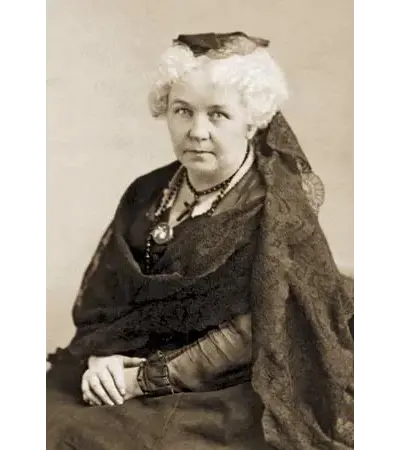
Elizabeth Cady Stanton was a leader of the women's rights movement in the U.S. during the mid- to late-1800s. She was the main force behind the 1848 Seneca Falls Convention, the first convention to be called for the sole purpose of discussing women's rights, and was the primary author of its Declaration of Sentiments. Her demand for women's right to vote generated a controversy at the convention but quickly became a central tenet of the women's movement. She was also active in other social reform activities, especially abolitionism.
