Mahmoud Ahmadinejad Quotes
Women in Iran enjoy the highest levels of freedom.
In contemporary Iran, no one has any freedom in the International and Western sense of freedom. There is no freedom of speech, freedom of assembly, freedom of the press, freedom of religion, freedom to travel, freedom of the press, freedom of dress, or other fundamental freedoms of not only the West but the United Nations Declaration of Human Rights. However, within those restrictions, women tend to be treated more equally than in other Islamic Middle Eastern nations. Not completely equal as they have many additional restrictions that males do not have, but they can work, freely, teach and hold some positions of responsibility and power which women may not do in much of the Islamic world.
Mahmoud Ahmadinejad, President of Iran, Speech, Columbia University, New York City, September 24, 2007
Sourced by: Eigen's Political and Historical Quotations

This remarkable statement was written in about 1840 and there was probably then few people of either gender who would think such a thing possible.

At the time and for the next decade she was one of the few world leaders who made women’s equality and rights a major priority. But slowly American and European women and many men began to give higher priority to using foreign policy and foreign aid. Then women from Asia and Africa began to take up the issue and in the early 21st century even some women in the Islamic nations began to fight for women’s rights. Mrs. Roosevelt. However, was the first modern major and high visibility politician to make women’s rights a major international and national issue.

Although Mao attempted to reform Chinese sexist culture and practice, his and other efforts are taking hold very slowly. Into the 21st century, the Chinese Communist party included women but not at the highest levels where the traditional practice of selecting leaders was to choose elderly males. Part of the prejudice agaist female leaders results from Chinese history where women have ruled or controlled China at several points, but none performed well. This is unlike the experiences of England, India, Israel, and other nations where women have been very successful and respected leaders. There is an American NGO in China, providing assistance to women, which has adopted the name “Half the Sky” and it is the title of a book by Nicholas Kristoff and a record album by Ruby Turner.

First female presidential candidate & first divorcee to run for that office


Many politicians in that day would campaign from large carts drawn by oxen – a predecessor to the bandwagon of sorts. She was 1 of the 4 women who entered Oberlin College in 1837 thus becoming the first co-educational institution of higher education in the United States.


Jinnah was a modern Islamic reformer as this quotation demonstrates. Pakistan is not as backward as most of the Arab Islamic countries on the role of women. There are many Pakistani businesswomen and professionals. Pakistan has even had a female president. However, the fundamentalist Islamic forces that dominate the culture constantly preach and advocate the literal interpretation and following of Sharia which calls for a traditional, subservient traditional role for women; “honor killings” are common; “a rapist cannot be convicted on a female victims testimony; there are calls for the killing of adulteresses and other primitive throwbacks. Jinnah’s vision has not come to pass yet.


In one of the earliest claims that women should be allowed to preach, she made a theological argument and then challenged the male theologians to better her arguments. Although she was very demur, intellectually and theologically she “took it right at them.” Such intellectual aggression by women was virtually unheard of.

The speaking to which she was referring was Christian Religious preaching by women. At the time it was considered by most Christians to be sacrilegious for women to preach. This came down from the orthodox Jewish tradition, and there are several passages in the New Testament where the Apostles, who were Jews themselves were echoing the religious tradition. This then took on a meaning that went beyond tradition as in Judaism. Margaret Fox wrote this essay which was a completely theological defense of a woman’s right – indeed obligation—to preach. Theologically, there are many Christian churches for whom her argument would be too radical—even in modern times. However, in the middle of the 17th century to most male clerics, this was so unfathomable that they did not even deign to refute her theological arguments. Meanwhile, the Quakers began to accept women in theological positions of influence—for ahead of most other Christian and Jewish sects. See {619836} and {619837} for quotations from the essay itself.


Marcus Porcius Cato. This quotation has had two different interpretations over time. One was that women if they received equality of treatment and voting would have an advantage for they also had their traditional “feminine wiles” and their sexuality, hence would dominate men. The second was a also a warning but based on the fact that women were superior in many ways, and given an equal chance, would excel men. The later interpretation is argued by some who point to the 2011 American data that shows more females than males graduating from high school and college, and females outnumber males in medical, law and several other professional schools. With the exception of a few Roman men, most heeded Cato’s warning and never took a chance on female equality.


She was chiding the Egyptian military who in the Arab Spring, turned on demonstrators and soldiers in the middle of the central square stripped a female demonstrator half naked and beat her badly;


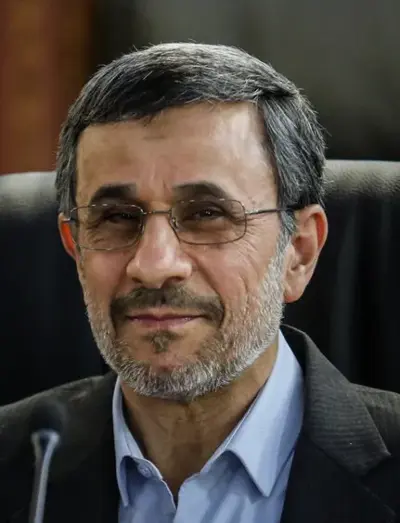
Mahmoud Ahmadinejad (Persian: محمود احمدینژاد, romanized: Mahmūd Ahmadīnežād [mæhmuːd(-e) æhmædiːneʒɒːd] (listen)), born Mahmoud Sabbaghian, is an Iranian conservative politician who served as the sixth President of Iran from 2005 to 2013. He was also the main political leader of the Alliance of Builders of Islamic Iran, a coalition of conservative political groups in the country, and served as mayor of Tehran from 2003 to 2005.
