Kathleen Troia McFarland Quotes
In politics, a picture is worth a thousand words.
McFarland, Kathleen Troia. Opinion column. Fox News, Fox News Network.


See Richard Joseph Daley and Don Hewitt.


Ronald Reagan’s media expert, Michael Deaver, developed a new approach to Presidential appearances. He realized that if the President made a 5 or 10 minute speech at an event, the Evening News would choose one or two 10-15 second excerpts, and that was what the vast majority of the country would see. Therefore, he reasoned, the words spoken meant relatively little. It was the image what would last in people’s memory. Therefore, he worked hard to concentrate on getting the right background for the President’s appearance. The Statue of Liberty, a naval ship, a factory at work. The set of images that people would have of the President in these different appearances would define the President in the minds of most people. Deaver would be more concerned that the TV camera’s showed the background scene he had planned (rather than a strange angle or just a close-up of the President’s face) than he would be about which words—sound bytes—the TV station would select. Hence Baker’s observation that words were less important than the TV images.


The ad, created by Tony Schwartz, only ran once, on September 7, 1964. It was so dramatic that News and other media replayed it and discussed it up until the election. LBJ’s opponent Barry Goldwater was a military hawk in the midst of the Cold war where nuclear war was everyone’s greatest fear. The Daisy ad was crystal clear and made overt what many Americans concern was about Goldwater. Johnson won in a landslide. See {586351} for the kinds of views that made Goldwater so vulnerable.


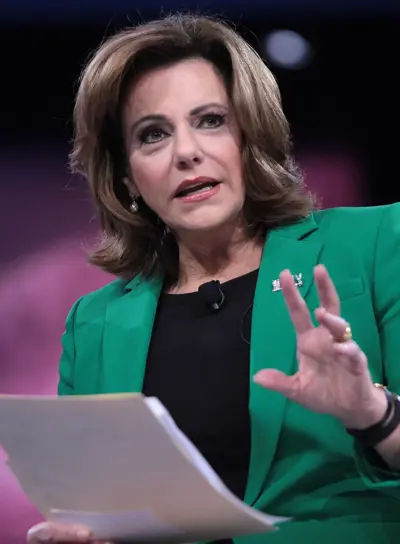
Kathleen Troia "K. T." McFarland is an American political candidate, former government official, and political commentator. She served as Deputy National Security Advisor under Michael Flynn for the first four months of the Trump administration. She was asked to step down by Flynn's successor H. R. McMaster; news of her pending nomination as U.S. Ambassador to Singapore was reported at the same time. President Trump nominated her in May 2017; she withdrew it in February 2018 due to concerns around her answers related to links between Trump associates and Russian officials, in particular about discussions between Flynn and Russian ambassador Sergey Kislyak.
