William Tecumseh Sherman Quotes
In order to insure the civilization of the Indians entering into this treaty, the necessity of education is admitted, especially of such of them as may be settled on said agricultural parts of this reservation, and they therefore pledge themselves to compel their children, male and female, between the ages of six and sixteen years, to attend school; and it is hereby made the duty of the agent for said Indians to see that this stipulation is strictly complied with; and the United States agrees that, for every thirty children between said ages who can be induced or compelled to attend school, a house shall be provided, and a teacher competent to teach the elementary branches of an English education shall be furnished, who will reside among said Indians, and faithfully discharge his or her duties as a teacher.
William Tecumseh Sherman, 1820-1891, General of the Army & Indian Peace Commissioner, Barboncito, 1820-1871, Navaho Indian Chief, Navaho Treaty, 1868
Sourced by: Eigen's Political and Historical Quotations


His specialty was early American history. The early colonists believed that the Indians in America were descended from the lost tribe of the Jews. Therefore, they saw it as their duty to educate them and bring them into the Christian fold, as they had never yet had the chance. Harvard in its earliest days had what and Indian students. King Phillip’s War with some Indians had soured the views of many whites and soon Harvard adopted an all white policy.
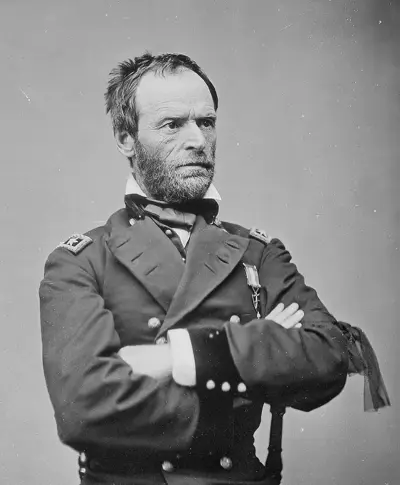
William Tecumseh Sherman was an American soldier, businessman, educator, and author. He served as a general in the Union Army during the American Civil War (1861–1865), receiving recognition for his command of military strategy as well as criticism for the harshness of the scorched earth policies he implemented in conducting total war against the Confederate States. British military theorist and historian B. H. Liddell Hart declared that Sherman was "the first modern general".
