John Turner Quotes
In opposition, there's not much one can do. One doesn't have the carrot and one doesn't have the stick. One can't promote and one can't fire. And persuasion has its limits.
John Napier Wyndham Turner, Prime Minister of Canada (Liberal), Quoted in Toronto Star, June 19, 1990
Sourced by: Eigen's Political and Historical Quotations


This apparently is an operational principle in most representative democracies. Attacking the opposition is always easier and more effective than defending your own party’s position. Doing anything else, especially providing a non partisan, rasoned analysis, is the thing most to be avoided.

This is especially true in the Senate, where there not only is the filibuster available to the minority but there are “holds” where a single senator can anonymously stop certain processes such as conformations of appointments and a number of other arcane techniques allowed by Senate rules.
At that time, the Republicans in Congress were able to block almost all the wanted by the Democratic President Barack Obama. Much of the behavior was motivated by a disagreement with the President’s proposals, but in many cases, the President had accepted and recommended what the Republicans had wanted (and in many cases had voted for earlier). The Republicans killed these proposals also going over the passive aggressive line that Wetzler had posited. Even when public opinion fell to less than 10 percent approval (lower than used car salesmen) for the Congressional Republicans, they were so locked in to the pattern of passive aggressive behavior, that they could not change.

The National Assembly at the time was the legislative branch, the executive branch, and the judicial branch all at the same time. “Intrigue” referred to a panoply of questionable behaviors including bribes, promises of jobs, appointments, threats of slander, personal destruction and other corrupt practices.


The state senator had voted to override his own party governor's veto of a popular solid waste disposal project. The governor retaliated by withdrawing nominations for appointments in the senator's district.


In a particularly acrimonious House debate on the largest military appropriations bill in the history of the country, the speaker limited an opponent to 45 seconds to argue against the pending bill. Jacobs shouted his protest:

The Civil Rights Bill of 1964


See John C. Calhoun who used Mackintosh’s phrase later.


It was never submitted as evidence in any proceeding or made a part of the U. S. investigatory record of war crimes of World War II. Nor was it ever found in Japan in the official records. The only copy was found in 2003 at the home of Bonner F. Fellers one of MacArthur’s top aids in the Japanese Occupation. Fellers and McArthur advocated not further investigating or trying the Japanese Emperor either because they, believed he was not guilty or because they thought his trial would be too disruptive to the occupation. The authenticity of this monologue has not been verified. Apologists for the Emperor argue that it shows that he was a virtual prisoner of the militarists and unable to stop the war or any of the war crimes; others argue that the Japanese military would never have gone against the will of the Emperor and that this document was probably prepared with the coaching of General Fellers as ex post facto “evidence” of the Emperor’s innocence. See {643148} and {601309} for examples of Fellers manipulating the “evidence.”


Explaination of why he threatened to block Senate approval of an appointment he favored in order to achieve another political objective.
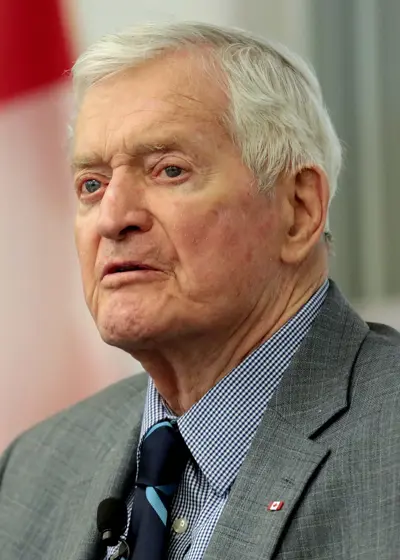
John Napier Wyndham Turner PC CC QC was a Canadian politician and lawyer who served as the 17th prime minister of Canada from June 30 to September 17, 1984.
