Martin Van Buren Quotes
In justly balancing the powers of the Federal and State authorities difficulties nearly insurmountable arose at the outset and subsequent collisions were deemed inevitable. Amid these it was scarcely believed possible that a scheme of government so complex in construction could remain uninjured. From time to time embarrassments have certainly occurred; but how just is the confidence of future safety imparted by the knowledge that each in succession has been happily removed! Overlooking partial and temporary evils as inseparable from the practical operation of all human institutions, and looking only to the general result, every patriot has reason to be satisfied.
Van Buren, one of our generally acknowledged poor Presidents, had a philosophy that scandal and corruption need not be investigated and stopped so long as things generally work out right.
Martin Van Buren, 1782-1862, 8th President of the United States (Democrat, NY), Inaugural Address, March 4, 1837
Sourced by: Eigen's Political and Historical Quotations


In addition, most state and local corrupt officials are detected, and prosecuted by Federal law enforcement officials as local and sometimes state corruption involves the local and state law enforcement officials as well as others so local authorities often turn a blind eye towards corruption.


Martin and other anti-Federalists argued against ratifying the new Constitution as they thought that it was inimical to the state’s interest. The notion of Federalism as a danger to states is clearly stated in this quotation for the debate on Constitutional ratification. Fundamentally, are Senators representatives of their states or of the Federal Government. If the former, who can the senators be recalled or impeached by the states to who the presumably owe their loyalty? This issue, like so many others, was compromised. The States would control the selection and method of selection of the Senators but could not recall or impeach. Looking back, we see this as logically inconsistent. However, looking at it as a political compromise between two legitimate points of view, it seems quite reasonable. Early America was a combination of idealism and pragmatism which has carried throughout American history.


Fortunately he was wrong, but the threat of a breakup of the American Union intimidated most members of Congress to avoid anything that would offend a state or group of states. Thus slavery became more and more entrenched till it exploded into the Civil War. At the time the issues of contention included the fact that Louisiana was primarily Roman Catholic and ALL other states were majority Protestant. The territory functioned under French Law—the Napoleonic Code, while all the other states operated under the English Common Law (even today this is so), and there was concern with the French and Creole language and whether the Creoles would fit into American Culture.


Later that year he sent federal troops to Little Rock, Arkansas to enforce a desegregation order.


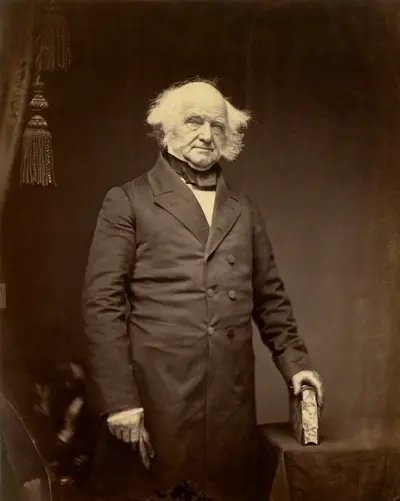
Martin Van Buren was an American lawyer and statesman who served as the eighth president of the United States from 1837 to 1841. A founder of the Democratic Party, he had previously served as the ninth governor of New York, the tenth United States secretary of state, and the seventh vice president of the United States. He won the 1836 presidential election with the endorsement of popular outgoing President Andrew Jackson and the organizational strength of the Democratic Party. He lost his 1840 reelection bid to the Whig nominee, William Henry Harrison, thanks in part to the poor economic conditions surrounding the Panic of 1837. Later in his life, Van Buren emerged as an elder statesman and an important anti-slavery leader who led the Free Soil Party ticket in the 1848 presidential election.
