Alexis de Tocqueville Quotes
In countries where associations are free, secret societies are unknown. In America there are factions, but no conspiracies.
By secret societies, de Tocqueville meant societies or organizations where the membership was secret. He was not referring to organizations like the Masons which had secret oaths and rituals. Secret societies had historically been destabilizing forces in societies. At the time this was written, there were no secret societies in America, but in 1855 a major one developed—The American Party whose members were better known as “Know Nothings” as when they would be asked anything about the party and its organization of beliefs, they would claim that the knew nothing. They were virulently anti-immigrant and anti-Catholic. Subsequently, there have been secret organizations in American politics from time to time, but they have generally been few compared to other countries, and their influence was not long lasting. Most recently, quirks in legal decisions and their interaction with the Constitution have produced non profit organizations which are financed and influenced by unknown people. The major officials of the organizations are known but the members and contributors are secret. These organizations then operate campaigns, most often to attack and damage the reputation of politicians running for political office—most frequently, the Presidency.
Alexis de Tocqueville, 1805-1859, French Foreign Minister & Writer, Democracy in America, Volume I, 1835
Sourced by: Eigen's Political and Historical Quotations

See Edmund Burke a similar phrase 12 years earlier.

Early political philosophers were very concerned about the conflicts that would be engendered in society by political parties. Many of the Founding Fathers had similar suspicions.

12 years later, James Madison used a similar expression at the Constitutional Convention.


There were many in England and America who thought that political parties or “factions” as the Americans called them were inimical to republican government. Smyth disagreed and thought parties necessary for freedom and democracy. Turkey at the time was an Islamic Empire that while in decline still controlled large parts of Europe and most of North Africa. However, the Sultan had absolute control over both “church and state”. He was like the Pope and the Holy Roman Emperor in one person, There was no freedom of thought or speech.


His use of the noun “Democracy” refers not to a form of government but the specific institution of the Democratic Party. Smith, like many of the Founding Fathers was deeply suspicious of political parties. See also {614907}. Smith had written to most of the then likely Presidential candidates of both major parties asking for their position on the Mormons who were facing persecution wherever they went. None of the politicians would make any satisfactory commitments. Smith took Direct Action and became the only major religious official to have run for the Presidency of the United States until Pat Robertson tried and failed in 2000. Smith’s assassination shortly thereafter cut his run for the Presidency short before it made much headway and politically he had no chance to affect the race.


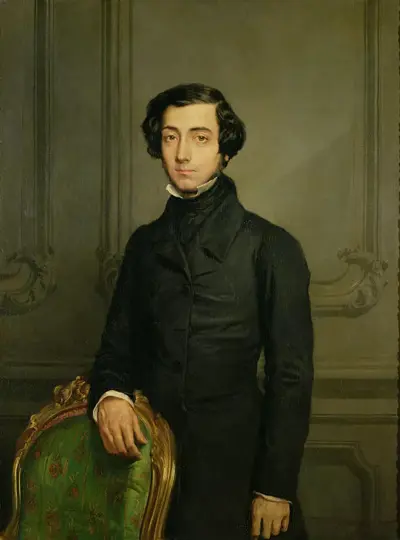
Alexis Charles Henri Clérel, comte de Tocqueville, colloquially known as Tocqueville (/ˈtɒkvɪl, ˈtoʊk-/), was a French aristocrat, diplomat, political scientist, political philosopher and historian. He is best known for his works Democracy in America (appearing in two volumes, 1835 and 1840) and The Old Regime and the Revolution (1856). In both, he analysed the improved living standards and social conditions of individuals as well as their relationship to the market and state in Western societies. Democracy in America was published after Tocqueville's travels in the United States and is today considered an early work of sociology and political science.
