New York Herald Quotes
In certain portions of the South there are expeditions forming for the purpose of sailing to San Domingo, and of conquering that island; and in other parts, expeditions are forming for a descent on the Island of Cuba; and others are looking to the acquisition of Mexico, with the ultimate creation of a new republic, commencing with Virginia at the North, and embracing San Domingo, Cuba, and Mexico up to Central America. All these wild measures, to our certain knowledge, are embraced more or less by certain parties now in Washington, and scattered over the South.
Secession of the South was not a new idea stimulated by the election of Abraham Lincoln. Fully 10 years before, there was this plan to form a Slave state union which would expand into Mexico and the Caribbean.
New York Herald, Editorial, "Mr. Clay's Compromise, and the Cabinet," New York Herald, February 1, 1850
Sourced by: Eigen's Political and Historical Quotations

The Southern states were illegal rebels. A confederacy had always meant a voluntary association of otherwise independent entities. However technically the Southern states were not independent but in a state of illegal rebellion against the United States. Lincoln, a lawyer, could not being himself to refer to the South by their preferred name—the Confederacy. So this was how he and many in his administration referred to the South.

The last lines of the editorial were tragically accurate in predicting the Civil War. The more the slavery question was debated in the nation, the more polarized the country became. If the South would persist in trying to curtail men’s freedom and maintain slavery, the slaves had the same right of revolution and insurrection as was established in the American Revolution. That was the view of most abolitionists. Southern slave holders, feared an armed slave rebellion more than anything else, and observed that debating the issue of slavery was just riling up Blacks and whites and would instigate such armed revolutions. The Southern solution was to cease debating the slavery question. The Northern solution was to end slavery. Neither side would accept the solution of the other and the Civil War ensued.

The slavery issue was the dominant issue in pre-Civil War America. It even drove foreign policy.

The Governor was a staunch Confederate supporter but his state legislature majority favored the Union. He was forced out of the governorship when the 1861 election gave the legislature a veto-proof pro Union majority.
The amendments failed as did the compromise.

In many respects, it is amazing that secession did not take place earlier.

The early Union military leadership was so poor and timid that it was not clearly demonstrated that a Confederacy was not viable until later in the war, and the Southerners possessed an extraordinary capacity for ignoring reality and self-delusion, that it was not demonstrated until Grant’s major victories and Sherman’s March through Georgia and the Southern East Coast that an independent South was not going to be.


The South had attacked Fort Sumter

While Douglas and Lincoln were political opponents with little love lost between them, both were patriots. Douglas’s position were much more popular in the South, and the moment he realized that Lincoln would win the Presidency, he headed South where he was very persuasive in trying to hold the Union together, but he could not see all the potential rebels and was only effective with some. South Carolina not only seceded, but in order to prevent any changing of minds, some the worst of the South Carolinians, attacked Fort Sumter firing on the American Flag and attacking and capturing the Union troops who were totally outnumbered. The Civil War was then inevitable.
When the first Southern States seceded, each appointed a whose job it was to persuade the other Southern States to also secede. In this case Hale was marketing secession to Kentucky which with Maryland were the only two Southern States to reject what they regarded as treason and rebellion. The importance of the quotation however is in his argument which was all based on enmity to racial equality and abolition. Later Southern apologists would argue that the Civil War was fought, not about slavery and racism butt about different philosophies of government. See {623715} .


The economic advantage of the North over the South in the Civil War is well known. Not so well-known is the huge technological advantage that the North had. This quotation gives an indication of the extreme difference. The North fought the war on all fronts including the technological one where no weapons and methodologies from the telegraph to the military railroad were critical. The South by contrast did not have the manpower to fight the war and keep industry and scientific technological development going also.

These failure of these secession opponents to influence most Southerners was one of the great tragedies of the war. William Tecumseh Sherman also counseled against the rebellion {627900}. Identity of many Americans at the time was defined by their State with less identification with the nation than today. Eggleston was an accomplished writer who had served in the Confederate army of the Civil War. 20 year after the war he wrote a series of articles for the prestigious Northern Atlantic Monthly trying to convey the war from the Southerner’s point of view.
Much of the South was so insular that people knew nothing about the notion of abolition and just assumed that no one would ever consider freeing the slaves. Many never knew that it was the South that first fired on the Union troops and flag. If the North won the war, the assumption was that Northerners would then own the plantations and the valuable slaves. In reality, while all slaves were emancipated in the South, very few plantations and farms were confiscated from their Southern owners by Northerners despite the fact that there was political pressure in the North to confiscate the land of all rebels who had committed treason and use the value to repay the Union bonds and care for the wounded Union veterans and the widows of dead Union Soldiers. Eggleston was an accomplished writer who had served in the Confederate army of the Civil War. 20 year after the war he wrote a series of articles for the prestigious Northern Atlantic Monthly trying to convey the war from the Southerner’s point of view.

It is often said that “elections have consequences”. The 1960 election was one that certainly had profound consequences. Lincoln was unwilling to force the Northern states to return fugitive slaves against the constitution, laws and will of the people of those states as Buchanan said he was (but had a hard time doing). Also Lincoln was unwilling to allow new territories to enter the union if they allowed slavery. In the end, most pro Slavery politicians realized that with the greater growth rate of the North, they Southern disproportionate power in the Congress was doomed as would be the institution of slavery itself. Crittendon a strong Unionist from a border state, understood the implication of Lincoln’s election for the Union.


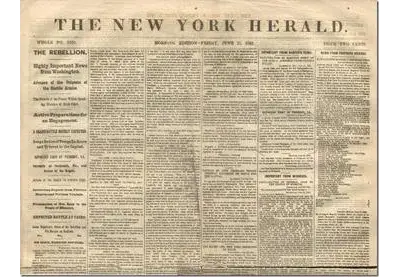
The New York Herald was a large-distribution newspaper based in New York City that existed between 1835 and 1924, when it was acquired by its smaller rival the New-York Tribune to form the New York Herald Tribune.
