Annie Jacobsen Quotes
In 1957, with the arms race in full swing, the Department of Defense had decided it was just a matter of time before an airplane transporting an atomic bomb would crash on American soil, unleashing a radioactive disaster the likes of which the world had never seen.
Jacobsen, Annie. Area 51: An Uncensored History of America's Top Secret Military Base. Little, Brown and Company, 2011.


Germany had some world class physicists. Our scientists, military intelligence people, and political leadership assumed that the Germans were also seeking to develop the Atomic Bomb. Ironically, it turned out that they were not, and what Truman reported in this quotation was untrue (although that was not fully known at the time.) Einstein and several of the scientists who were early pioneers in modern physics were Jewish, and Hitler referred to the study of nuclear fission and fusion as “Jewish Science.” As a result, the German government did not commit the resources to the development of an atomic bomb. Instead, they were betting on the development of the Jet Airplane which they succeeded in deploying against the Allies at the end of the war. But they did not have enough or enough pilots left alive to fly them, and Germany was overrun by the Allied Troops. Prior to Truman’s erroneous report about the German development of an atomic bomb, there had only been one piece of evidence that the Germans were not developing one. An OSS secret agent, Moe Berg, had talked with Werner Heisenberg, at a Swiss scientific conference during the war. He was going to assassinate the greatest of the German physicists if Berg thought he was working on a nuclear device. Berg concluded from his discussions that Heisenberg did not know enough about nuclear fission to have been working on that. Berg did not kill Heisenberg, and reported that he did not think the Germans were developing a bomb as if they were Heisenberg would have been deeply involved. However, the American intelligence people and the American scientists, did not trust Berg’s analysis and conclusion. Berg was not a trained scientist. He was a professional baseball player—the NY Yankee backup catcher to Bill Dickey. He was a college graduate, a brilliant guy and a very fast learner who had studied physics books and papers before his assignment. Berg turned out to have been right, but that was not confirmed until a few years after the war. Truman had relied on an incorrect intelligence estimate when he made this quotation. It was not the first such error of intelligence analysis in American history and it would not be the last.

This was the first Russian atomic explosion.


The Scientific Project that developed the Atomic Bomb. Oppenheimer was the great physicist who directed the successful development of the atomic bomb so as to build the weapon before Hitler did in World War II. However, as the technology evolved, he had doubts as to the wisdom of creating even more powerful hydrogen weapons. His viewpoint was hurting the administration’s policy of rapid unlimited nuclear weapons development, and he was the victim of a character assassination whereby his security clearance was withdrawn. The “father” of the atomic bomb was the first American casualty of atomic weapons development.

There had been so much nuclear activity—military and civilian—that he thought it inevitable, either by intention or accident, that there would be some catastrophes. Chernobyl and the crash of a nuclear bomb equipped plane in Spain destroyed the two areas for years thereafter proved him prescient but fortunately none of the “incidents” were bad enough to affect millions of people significantly although the damage of Chernobyl is still being discovered.


Canada had the same absurd civil defense propaganda in the Cold War as the U. S. did. Both governments wanted to persuade their publics that a nuclear attack was survivable.

This quotation is very important in helping to understand the 1950s in America with respect to nuclear weapons policy. McCormick was one the better educated, sophisticated, and influential Americans. Yet he appears to be a technological and nuclear ignoramous. Most people had not yet realized that atomic weapons were not just much larger traditional bombs. They could do terrible damage, but it would always be localized they thought. Chicago might be destroyed but the people out of range would be OK. He never got it that a dirty bomb could be dropped on Detroit and depending on which way the wind is blowing could wipe out Chicago and much of the Midwest as well. He knew nothing of the genetic effect the radiation, nor the implications for the environment of maintaining a large nuclear manufacturing industry. He and many like him did not realize that after the first bombs were created, how easy it would be for the Russians and others to also develop a nuclear arsenal. And 50,000 warheads was just a matter of effort. The implications of these things would inhibit our carrying out his and others ideological views of foreign policy. Oppenheimer and most nuclear scientists explained all this, but believing them and acting on those beliefs would have been too much of a change.


Perez was a virulent racist who was the strongest political boss in Louisiana. Perez wanted to maintain segregation despite any Federal Court orders, and if the Federal Government would send Federal Marshalls or Federal Troops to enforce desegregation court decision, he would have the Louisiana State Police keep them out or the state, even if it came to a shooting battle. The Governor used this quotation to talk him out of the idea.


He was playing the part of Captain Mandrake.


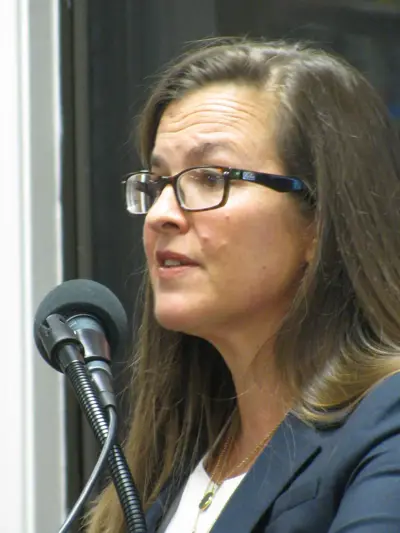
Annie Jacobsen is an American investigative journalist, author, and a 2016 Pulitzer Prize finalist. She was a contributing editor to the Los Angeles Times Magazine from 2009 until 2012. Jacobsen writes about war, weapons, security, and secrets. Jacobsen is best known as the author of the 2011 non-fiction book, Area 51: An Uncensored History of America's Top Secret Military Base, which The New York Times called "cauldron-stirring." She is an internationally acclaimed and sometimes controversial author who, according to one critic, writes sensational books by addressing popular conspiracies.
