C. S. Lewis Quotes
If we are going to be destroyed by an atomic bomb, let that bomb when it comes find us doing sensible and human things -- praying, working, teaching, reading, listening to music, bathing the children, playing tennis, chatting to our friends over a pint and a game of darts -- not huddled together like frightened sheep and thinking about bombs. They might break our bodies (a microbe can do that) but they need not dominate our minds.
C. S. Lewis, 1898-1963, Carl Staples Lewis, English Author, On Living in an Atomic Age, 1948
Sourced by: Eigen's Political and Historical Quotations


This quotation is very important in helping to understand the 1950s in America with respect to nuclear weapons policy. McCormick was one the better educated, sophisticated, and influential Americans. Yet he appears to be a technological and nuclear ignoramous. Most people had not yet realized that atomic weapons were not just much larger traditional bombs. They could do terrible damage, but it would always be localized they thought. Chicago might be destroyed but the people out of range would be OK. He never got it that a dirty bomb could be dropped on Detroit and depending on which way the wind is blowing could wipe out Chicago and much of the Midwest as well. He knew nothing of the genetic effect the radiation, nor the implications for the environment of maintaining a large nuclear manufacturing industry. He and many like him did not realize that after the first bombs were created, how easy it would be for the Russians and others to also develop a nuclear arsenal. And 50,000 warheads was just a matter of effort. The implications of these things would inhibit our carrying out his and others ideological views of foreign policy. Oppenheimer and most nuclear scientists explained all this, but believing them and acting on those beliefs would have been too much of a change.

The Scientific Project that developed the Atomic Bomb. Oppenheimer was the great physicist who directed the successful development of the atomic bomb so as to build the weapon before Hitler did in World War II. However, as the technology evolved, he had doubts as to the wisdom of creating even more powerful hydrogen weapons. His viewpoint was hurting the administration’s policy of rapid unlimited nuclear weapons development, and he was the victim of a character assassination whereby his security clearance was withdrawn. The “father” of the atomic bomb was the first American casualty of atomic weapons development.
The Scientific Project that developed the Atomic Bomb


Breslin was criticized in a Federal report for his alarmist news coverage of the Three Mile Island nuclear mishap:


It was part of the Duck and Cover campaign where school children were taught that in an a nuclear attack they should duck under their school desks and cover their heads with their hands. For other examples of simplistic defense methods that would calm the population see {636091} and England: Whitelaw {614440} and {618657}.
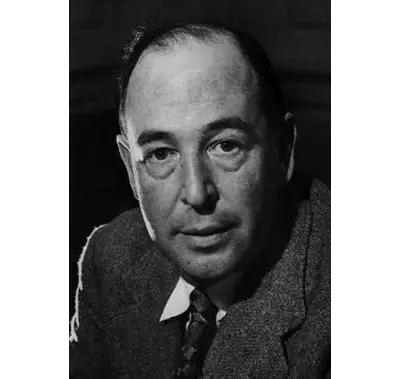
Clive Staples Lewis was a British writer and lay theologian. He held academic positions in English literature at both Oxford University (Magdalen College, 1925–1954) and Cambridge University (Magdalene College, 1954–1963). He is best known for his works of fiction, especially The Screwtape Letters, The Chronicles of Narnia, and The Space Trilogy, and for his non-fiction Christian apologetics, such as Mere Christianity, Miracles, and The Problem of Pain.
