Cetshwayo Quotes
I’m glad to know that the Transvaal is English ground; perhaps now there may be rest.
The whites had come to South Africa by sea—English and Dutch. Many settled at the Southern Shore—Capetown area. The Dutch Boers however were more interested in farming and commerce and moved North taking land from the natives who sparsely populated the interior of the land. At the same time the aggressive and sophisticated Zulus came from the North. Like the Boers, they were after land and seized it from the natives. It was inevitable that the two conquering, land grabbing groups would run into each other. The English had had a number of wars with the Zulus, but the English were not real competitors with the Zulu for land. So when England annexed the Tranvaal area, the Zulus were pleased as the English would control the Boers and the Zulus did not have to be contesting every bit of ground. However, the Boers and the English split over the English restricting the Boers from seizing native and Zulu land (which the Zulus had seized just like the Boers). The Boer War resulted, and to this day the Zulus and the native Black tribes are more comfortable with the South Africans of English extraction than those who are in the Boer community.
Cetshwayo, ~1826-1884, King of the Zulus, Statement upon hearing that the British annexed the Transvaal, 1877
Sourced by: Eigen's Political and Historical Quotations

English law required equal citizenship for Blacks. However, the Affrikaners—white settlers from Holland were totally opposed. It turned out to be impossible for the English to impose their law upon all of South Africa.
When the British first colonized South Africa, the area they used was not inhabited or very sparcely so. However, some Black tribes (including the Zulus) were moving from the north and themselves were colonizing or annexing the sparcely populated areas to their kingdom. The British were most interested in Trading so did not have large land asperations. The Dutch white Boer Africanners, in contrast, wanted to farm the lands and use the range for their cattle. They wanted the land. The English policy was that there would be friendly relations with the Black tribes surrounding their Cape Colony and no one should take their land. However the Boers started attacking the Black areas and seizing their farms and villages. At first, the English assumed that the Blacks would easily be able to ward off the invasion as the Afrikanners had no professional troops like the British. However, the neighboring native tribes were not very warlike or good fighters. They were being overrun by the Zulus coming from the North and the Boers from the South. The British Government had a real problem in that they would have to have British soldiers fight the white Afrikanners if they wanted to stop the illegal white invasions. This was the root of the Boer War where the British would be fully at war with the Africanners.

He was wrong and the Boer War resulted

The White Africaners were attacking the Blacks to force them off their land so the Afrkaners could take over. The country was under British rule and the unarmed Blacks were being slaughtered by the Afrikaners who were British Subjects. Eventually the Boer War set the English against the Afrikaners. See {583902} for a related quotation.
When the British first colonized South Africa, the area they used was akmost uninhabited or very sparcely so. However, some Black tribes (including the Zulus) were moving from the north and themselves were colonizing or annexing the areas to their kingdom. The British were most interested in Trading so did not have large land asperations. The Dutch white Boer Africanners, in contrast, wanted to farm the lands and use the range for their cattle. They wanted the land. The English policy was that there would be friendly relations with the Black tribes surrounding their Cape Colony and no one should take their land. However the Boers started attacking the Black areas and seizing their farms and villages. At first, the English assumed that the Blacks would easily be able to ward off the invasion as the Afrikanners had no professional troops like the British. However, the neighboring tribes were not very warlike or good fighters. They were being overrun by the Zulus coming from the North and the Boers from the South. The British Government had a real problem in that they would have to have British soldiers fight the white Afrikanners if they wanted to stop the illegal white invasions. This was the root of the Boer War where the British would be fully at war with the Africanners.
The White Boers viewed themselves as superior to the Blacks and the Blacks and Whites competed for land. In an early form of ethnic cleansing, the Boers attacked the undefended women and children of the Black tribes. The authorities opposed these atrocities but did not have any way of enforcing their orders.

The Boer farmers of South Africa invented commando tactics where they would surprise the British, hit and run. It was very effective. Although they could not win the war that way, the prolonged the battle against an overwhelmingly superior force setting an example of asymmetric warfare that lasted hundreds of years. The Sudanese to whom the General referred were the Islamic religious insurgents whom he had soundly defeated the year before in the Sudan. With their religious fervor they attacked en mass and although very courageous were not very effective.

Mohamed Anwar El-Sedat

It was the beginning of the Zulu War.

Gladstone received a telegram from Queen Victoria asking him to form a government and become Prime Minister:


The Irish Earls of Ulster, after a failed rebellion against English rule, fled to the European continent. As Chichester realized, this created an opportunity for the King to name new Earls and grant them the lands and possessions of the Earls who had fled. And since the Irish people were loyal to their traditional Earls. He suggested that English and Scots colonists be recruited to settle the lands. The King agreed and referred to the project as the “Ulster Plantation”. This was the reason that Northern Ireland had a much larger Protestant population percentage than the rest of Ireland and wanted to remain part of England when Ireland obtained its independence.

Henry Bartle Edwards. Actually, Shepstone had the support of the Colonial Secretary, Lord Carnarvon and Prime Minister Disraeli had deferred to him.

At this point in the convoluted history of Irish-English politics, the majority of the Irish upper class and members of Parliament were large landholders whose estates had been accumulated and legalized under English

1st Viscount Millner. A gold strike was causing many British subjects to immigrate to the Transvaal, but the Boers did not want the newcomers to be able to vote and dilute their power. Meanwhile the two cultures--British and Boer--had very different values and differed especially on how they should deal with the indigenous Blacks. The Boers would not reform in the Transvaal as the British wanted, and the Boer War ensued.

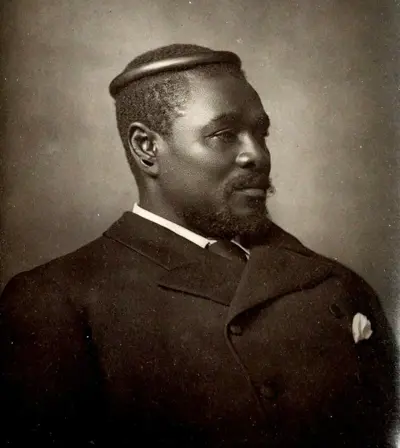
Cetshwayo kaMpande was the king of the Zulu Kingdom from 1873 to 1879 and its leader during the Anglo-Zulu War of 1879. His name has been transliterated as Cetawayo, Cetewayo, Cetywajo and Ketchwayo. Cetshwayo consistently opposed the war and sought fruitlessly to make peace with the British, and was defeated and exiled following the Zulu defeat in the war. He was later allowed to return to Zululand, where he died in 1884.
