George S. Patton Quotes
Ike is bitten with the presidential bug and is also yellow. He has convinced himself that he did me a favor by getting me out of the really grave risks of being a governor. He will never be president!…
Patton always believed that Eisenhower wanted to be President. At the beginning of the war Patton was much senior to Eisenhower, but President Roosevelt promoted Eisenhower above many more senior generals. Eisenhower thought Patton the best fighting general in the army, but a public relations and administrative problem. Several times when he had gone too far, Eisenhower reprimanded him but kept him in his command position. After the fighting was over, Patton became the military governor of part of Germany and was not as successful at peacekeeping and nation building as he was at fighting. Eisenhower was convinced that Patton would destroy himself and get fired by the army command and the President if he continued as governor. Patton confused Eisenhower’s prudent and politic demeanor with the allies as a lack of courage. And Patton could never get over the fact that Eisenhower and never commanded an army fighting in the field. He was jumped to Supreme Allied Commander, in a very bold and brilliant stroke by FDR who passed over many senior generals.
George S. Patton, 1885-1945, U.S. Army General, Letter to his wife, October 15, 1945
Sourced by: Eigen's Political and Historical Quotations


This quotation illustrates an interesting phenomenon in American Presidential Politics. There have been Democratic Presidents (FDR and Obama are the most glaring examples) for whom there was vituperative hatred and derision from the conservative Republicans who would frequently refer to them as Socialists and would believe that they were trying to lead the country on the path to socialism. The Presidents always stated that they were opposed to socialism, but to little avail with their conservative haters. But the socialists of the times and even the left wing of the Democratic Party not only did not see them as socialists, but were not very supportive or complementary of their skills and capabilities. Roosevelt reveled in the situation and “welcomed: their hate. Obama was more of a public centrist who tried to avoid the president getting involved in the extreme partisanship of the day.


Truman told Kennedy to keep quiet or he would "throw him out the window." Truman was about to physically attack Kennedy he was so angry. Kennedy was a Nazi sympathizer and an admirer of Mussolini and Hitler and this ended his active political career. His oldest son Joe was his favorite, but Joe did not share his father’s fascist inclinations. He not only enlisted for service in WWII but he volunteered for a very risky secret mission on which he was killed. Kennedy blamed Roosevelt for assisting England (he had been the ambassador was pro Hitler and had urged against American involvement) and hence the war. Kennedy’s oldest son Joe, had enlisted to fight Germany. He was a pilot who had volunteered for a very dangerous secret mission in which his plane blew up and he was killed. Joseph Kennedy blamed Roosevelt personally for the death of Joe. Driven out of active politics, Kennedy used his wealth to promote his second son’s political career, and JFK and his brothers had managed thereafter to be politicians in the mold of Franklin D. Roosevelt and reject their father’s political philosophy. To this day, most Americans have no idea that the elder Kennedy held such positions.


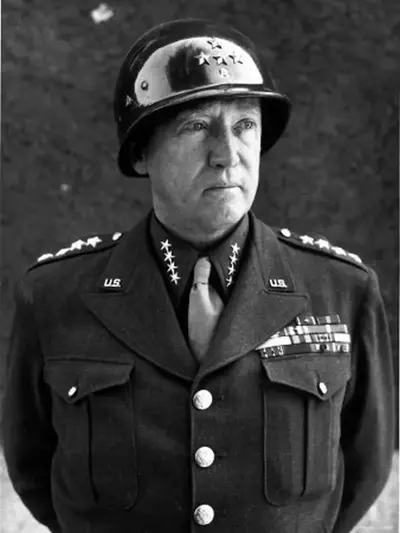
George Smith Patton Jr. was a general in the United States Army who commanded the Seventh United States Army in the Mediterranean theater of World War II, and the Third United States Army in France and Germany after the Allied invasion of Normandy in June 1944.
