Thomas Friedman Quotes
Romney is pretending to be something he is not. He is renting the Republican party in order to fulfill his ambition of being President. The Republican party is renting Romney in order to fulfill its ambition of beating Barack Obama.
Thomas Friedman, Foreign Affairs Columnist & Journalist, Interview, PBS The Charlie Rose Show, September 19, 2012
Sourced by: Eigen's Political and Historical Quotations


The discussion was about Ronald Reagan who had always castigated government, but when he became Governor of California and President of the Untied States, he set all records for expanding the size of government and government spending until George W. Bush expanded the government and created a budget deficit even larger than Reagan’s. Bush also constantly denounced big government and even government of any size.

Indeed Senator Thomas Collier Platt, in cooperation with major New York corporations, was leading just such an effort. See {624063}. However, many close friends and supporters wanted him to do for the national ticket what he had done for New York—reform. These schemes succeeded beyond the proponents’ wildest dreams when President McKinley was assassinated, and TR was the President. His enemies however were crestfallen—Party leader Thomas Collier Platt was very distressed. See {585078}.

Patton always believed that Eisenhower wanted to be President. At the beginning of the war Patton was much senior to Eisenhower, but President Roosevelt promoted Eisenhower above many more senior generals. Eisenhower thought Patton the best fighting general in the army, but a public relations and administrative problem. Several times when he had gone too far, Eisenhower reprimanded him but kept him in his command position. After the fighting was over, Patton became the military governor of part of Germany and was not as successful at peacekeeping and nation building as he was at fighting. Eisenhower was convinced that Patton would destroy himself and get fired by the army command and the President if he continued as governor. Patton confused Eisenhower’s prudent and politic demeanor with the allies as a lack of courage. And Patton could never get over the fact that Eisenhower and never commanded an army fighting in the field. He was jumped to Supreme Allied Commander, in a very bold and brilliant stroke by FDR who passed over many senior generals.


In 1912 TR lost the Republican primary election because of archaic rules that gave party regulars overwhelming power relative to ordinary Republicans with whom he was be far the most popular. So Roosevelt ran for President on the Bull Moose Party and proved his point be outpolling the Republicans. However the right wing was split and Woodrow Wilson became President by a plurality.

Describing Samuel Gompers, the founder of the American Federation of Labor:


He was a liberal Republican in an era where the Republican paty was controlled by arch conservatives, the Tea Party extremists, and evangelical Protestants while Gullani was divorced, a Catholic, and lived openly with a woman to whom he was not married. He supported a woman’s right to abortion and gay rights.


This quotation illustrates an interesting phenomenon in American Presidential Politics. There have been Democratic Presidents (FDR and Obama are the most glaring examples) for whom there was vituperative hatred and derision from the conservative Republicans who would frequently refer to them as Socialists and would believe that they were trying to lead the country on the path to socialism. The Presidents always stated that they were opposed to socialism, but to little avail with their conservative haters. But the socialists of the times and even the left wing of the Democratic Party not only did not see them as socialists, but were not very supportive or complementary of their skills and capabilities. Roosevelt reveled in the situation and “welcomed: their hate. Obama was more of a public centrist who tried to avoid the president getting involved in the extreme partisanship of the day.


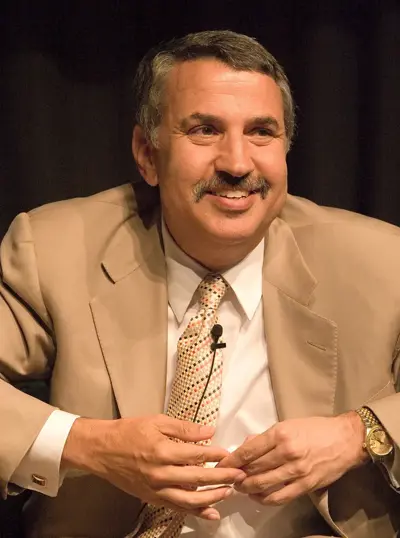
Thomas Loren Friedman is an American political commentator and author. He is a three-time Pulitzer Prize winner who is a weekly columnist for The New York Times. He has written extensively on foreign affairs, global trade, the Middle East, globalization, and environmental issues.
