John L. Lewis Quotes
If we must grind up human flesh and bones in the industrial machine, then, before God, I assert that those who consume coal, and you and I who benefit from that service, owe protection to those men [the miners] first, and we owe security to their families after, if they die. I say it! I proclaim it! And I care not who in heaven or hell oppose it!
John L. Lewis, 1882-1947, President, United Mine Workers of America, Testimony, House Labor Committee, April, 1947
Sourced by: Eigen's Political and Historical Quotations


With the large number of jobs that are going overseas, and the increasing productivity, the economics of the late 20th century and early 21st century made job security an anachronism. Therefore the unions were weakened.

The coal miners’ strike had been going for 5 months. The major issue was the right to union recognition. The mine owners refused to do that and decided to take the strike. President Theodore Roosevelt mediated a settlement where the miners won more money but no union recognition. The great appeal and significance of this speech is that it stressed the young children who started working in the mines at ages 8 or 9 by working on the “breakers” where they broke up large chunks of coal into smaller chunks. The children never saw daylight and never had a chance for education much less a childhood. At the time, and well into the 20th century the Republican Party was adamantly opposed to any legislation regulating child labor and when two decades later public opinion finally forced Congress to pass Child Labor legislation, the Supreme Court declared it unconstitutional and it took a Constitutional Amendment. See {32240}, {642469}, and {36885}.


In 1902 there was a major coal and railroad labor crisis. The owners and operators refused to negotiate or bargain with labor: This quotation is very famous because it is an iconic picture of the views and attitudes of the large industiralists at the turn of the 20th Century. More than opposing labor unions, they actually believed that God had selected them to run the economic and business affairs of the country if not the world. It was their Christian values and paternalism that the workers should look to in order to determine the rights and priviliges of the working man or woman. This upper class attitude was one of the major reasons that class warfare broke into the open. Ironically, there was not much difference between the attidudes of the industiral leaders and the notions of fudalism.

Mencken had a genius for finding the weak and hypocritical aspects of all institutions and most people. As a result he is frequently quoted by one political side or another to attack something they want to diminish. His career is so prolific that it is usually easy to find something nasty he said about any group, idea or person. In this case, he also wrote scathingly against businessmen, corporations, capitalism and politicians favoring the wealthy.

This quotation became a slogan of the miners. Lewis did not originate it. It has been referred to as early as 1902 in the bitter coal strike of that year. Generally coal mining strikes have involved more force and military than most labor disputes. While labor representatives maintain that force does not help, mine owners have believed that force is absolutely necessary. See Richard B. Mellon’s testimony to Congress in 1937--{563576}.


Eleanor Roosevelt frequently was the political surrogate for where handicapped husband. However, she became respected and loved for she went just about everywhere including places where no President would be allowed by the Secret Service.


3rd Earl Russell of Kingston
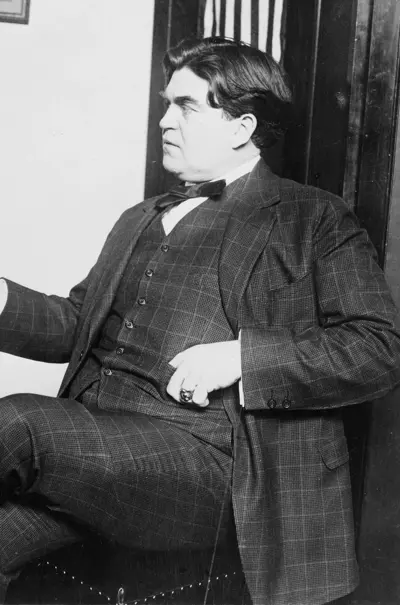
John Llewellyn Lewis was an American leader of organized labor who served as president of the United Mine Workers of America (UMW) from 1920 to 1960. A major player in the history of coal mining, he was the driving force behind the founding of the Congress of Industrial Organizations (CIO), which established the United Steel Workers of America and helped organize millions of other industrial workers in the 1930s, during the Great Depression. After resigning as head of the CIO in 1941, Lewis took the United Mine Workers out of the CIO in 1942 and in 1944 took the union into the American Federation of Labor (AFL).
