Joseph Stalin Quotes
If the opposition disarms, all is well and good. If it refuses to disarm, we shall disarm it ourselves.
Stalin did not want any political opposition with its own militia. American gun control opponents often cite this quotation to show that in Russia, Stalin achieved dictatorial power by disarming the population in general and only allowing government officials to have guns. They argue that even Stalin could not have tyrannized the entire Soviet Union if every citizen had the right to bear arms as provided for by the Second Amendment.
Joseph Stalin, 1879-1953, Russian Premier, The Political Report of the Central Committee, The Fifteenth Congress, December 7,1927
Sourced by: Eigen's Political and Historical Quotations

The Supreme Court had ruled that the Constitution prohibited the Federal Government from regulating conditions of child labor. A Constitutional amendment was passed by Congress and submitted to the States for ratification. That amendment is still the legal basis for all the Federal involvement in child labor. However there were many opponents. The idea of telling an employer that he could not work an 8 year old child for 14 hours a day was actually considered Communistic by some right wing elements. This quotation is famous for two reasons: First, it illustrates the extreme view against any kind of regulation of business that a strong minority held at the time. Second, this was a statement by a Roman Catholic Cardinal. The Catholic has generally been one of the progressive forces for labor reform (with the exception of racial discrimination and slavery) in the United States. Most modern Catholics are very surprised that a Cardinal actually issued such a Pastoral Letter—especially since he had been progressive on other issues {627510}.


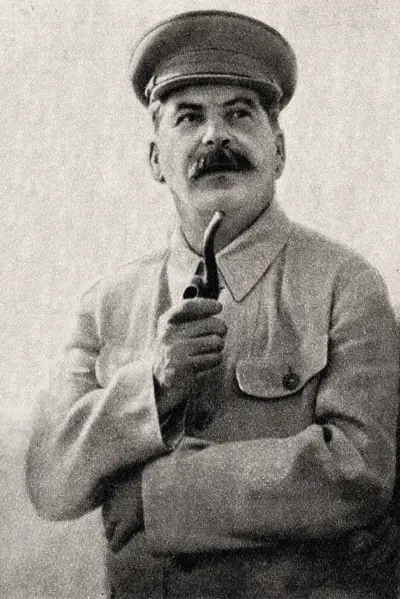
Joseph Vissarionovich Stalin was a Georgian revolutionary and the ruler of the Soviet Union from 1927 until 1953. He served as both General Secretary of the Communist Party of the Soviet Union (1922–1952) and Chairman of the Council of Ministers of the Soviet Union (1941–1953). Despite initially governing the country as part of a collective leadership, he ultimately consolidated power to become the Soviet Union's de facto dictator by the 1930s. A communist ideologically committed to the Leninist interpretation of Marxism, Stalin formalized these ideas as Marxism–Leninism while his own policies are known as Stalinism.
