George B. McClellan Quotes
If I tell him [President Abraham Lincoln] my [war] plans they will be in the New York Herald tomorrow morning. He can’t keep a secret.
Meigs had urged McClellan that it was his obligation to keep the President abreast of the planning for the war effort.
George B. McClellan, 1826-1885, General-in-Chief of the Union Army, Democratic candidate for President, Whispered remark to General Montgomery C. Meigs at a meeting with the President, January 13, 1861
Sourced by: Eigen's Political and Historical Quotations


Snowden, was a contract worker for Booz Allan assigned to the National Security Agency (NSA). He felt that some of the NSA activities were illegal and unethical and tried to complain to NSA officials who rebuffed him. Despite the fact that he had signed an agreement not to do so, he copied many critical, classified documents that exposed much of the NSA activities that the NSA officials had denied existed—including lying under oath to the Senate. Laura Poitras, the journalist, was not accused or suspected of anything. However, on the belief, that Snowden might have given her some classified material, the American government prevailed upon the British to seize her personal computer. Snowden made the programs public as the highest level intelligence officials were lying to Congress about them. The position of the US Government was that Snowden had violated American Law. Others praised him for revealing illegal activities in which the government was engaged and was lying about including to the Congressional oversight committees. Snowden repeatedly outsmarted the government and ended up getting asylum in Russia. In the case of the computer material, he had encrypted the material using “strong encryption” which most computer experts believe is impossible even for the best code breakers and computers to crack. See {628105} . In this quotation he argues that all journalists should use strong encryption on ALL of their notes and other materials that they receive from confidential sources. Government officials had tried to keep strong encryption secret even though it was invented by a private scientists with no government support or involvement. They failed, but have been trying to find a way to defeat strong encryption since. Ironically, most non-technical private individuals and companies do not use it even though it is quite easy and the software is free. Editors and publishers are ambivalent in that they could not comply with court orders or show them to employees even though it is their own property if the individual reporter or the source did not want them to.


Arguably, in the intelligence world, most of the classified documents are not truthful because there are many different work products that are designed to obtain all points of view. There have been major areas were NONE of the documents on a subject were true as they were all based on faulty assumptions or ignoring critical information. None of the classified intelligence documents even hinted at the breakup of the Soviet Union for example. By number, most of the documents in the FBI secret files are raw intelligence reports and are full of unverified opinion—including biased and self-serving statements.


Helms had very bad experience even in hinting at unfavorable news about the Vietnam War. See {634520}. He didn’t even send copies to his own executives, the White House Chief of Staff or the other White House staff like the National Security Advisor who would normally receive copies of top secret memos.

Kerry was a decorated Vietnam War hero who opposed the war in its later years.

The leaks not only did not stop, but they became worse than ever.


The “gentleman” was a member of Congress. This is an issue between the Congress and the Executive Branch which has existed as long as our Republic: Whether all members of Congress should have access to all classified secret information of the Government. Mrs. Roosevelt who was usually an advocate of transparency, on this issue tended to side with the argument of the executive branch. Note that the arguments made in 1939 are still fought over today.


This was a very clever play on a slogan that Las Vegas was using at the time to promote tourism and gambeling: “What happens in Las Vegas stays in Las Vegas”


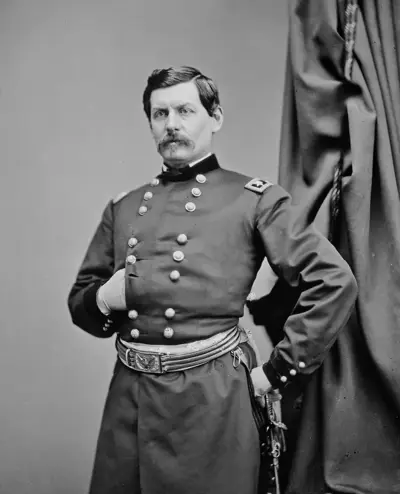
George Brinton McClellan was an American soldier, civil engineer, railroad executive, and politician who served as the 24th Governor of New Jersey. A graduate of West Point, McClellan served with distinction during the Mexican–American War (1846–1848), and later left the Army to work on railroads until the outbreak of the American Civil War (1861–1865). Early in the conflict, McClellan was appointed to the rank of major general and played an important role in raising a well-trained and organized army, which would become the Army of the Potomac in the Eastern Theater; he served a brief period (November 1861 to March 1862) as Commanding General of the United States Army of the Union Army.
