David Ben-Gurion Quotes
If I knew that it would be possible to save all the children in Germany by bringing them over to England and only half of them by transporting them to Eretz Israel, then I opt for the second alternative.
Ben-Gurion, David. Speech to Mapai Central Committee, 7 Dec. 1938. Quoted in Teveth, Shabtai. The Burning Ground, 1881-1939. Houghton Mifflin, 1987, p. 855.


The large Jewish immigration to America was like most immigrations before and since. Some elements of American society thought the immigrants undesirable and worse. Others felt America needed immigrant labor to grow and do the undesirable chores of society. Still others saw immigration to America as a part of American destiny. Herzl’s understanding of America was superficial and the anti-Semitism that many Jews faced dominated his thinking on the subject.


In 2016 millions of refugees were fleeing the chaos, violence, dictatorships, and revolutions of many of the Muslim Nations of the Middle East and the nations in Africa where Islamists were using violence and terrorism to try and take over the governments. Many, despite the danger, tried to reach Europe, and millions did—–far more than the European governments were prepared to handle and most European populations were unwilling to accept. This immigration created another crisis of its own.

Because of the classic historical anti-Semitism and discrimination, Jews were barred from land ownership and as a result few were farmers or had agricultural experience in their families. They were tradesmen, artisans, professionals in Europe. So amongst Jews and non Jews alike the notion of Jews settling the land of Palestine and farming it or trapping, the way the Boers had in South Africa or the French in Canada, was not a very credible image. The Zionists, realizing this potential weakness, placed strong emphasis on agriculture, developed the agricultural kibbutz concept and encouraged Jews to become farmers. The effort was so successful that almost all the leading early Zionist immigrants to Palestine became farmers. When independence came to Israel, the Jewish agriculture was more productive than most of that in Europe and almost on a par with small farms in the United States. The Israelis were known for “making the desert bloom.

At that time Jews in Palestine were in the minority. The issue of how to obtain the land was hotly debated amongst Jewish groups. Jabotinsky was at one extreme—colonize and take the land just as the Arabs had done to the Jews when there was a Jewish majority. His view did not however prevail. The policy was to buy the land from individual Arabs and Jewish land up to 1948 was obtained that way. In that year the UN partitioned Palestine and 11 Arab armies attacked the new state of Israel and asked the Arab civilians to leave the area so that the Army could cleanse it of Jews. Many did not, and they or their descendants are still on their land or have sold it. The Arabs who left, were suspected of being possible collaborators or terrorists, and they have never been paid for their land or allowed to return. Compensation is still in dispute. At the same time Jews driven out of Arab countries by law and the military have never been compensated or given any right of return either.

When the United Nations partitioned Palestine into a Jewish and a Palestinian State the Arab Countries all jointly attacked the fledgling Jewish State of Israel. Despite the Israeli’s being overwhelmingly out numbered in man and weapons, they beat back the invaders. However while many Arabs stayed on their Israeli land and some helped the Jews defend against the Arab Armies some abandoned their homes and land and went to neighboring Arab Counties. This is what they had been asked to do by the Arab governments who wanted to be able to attack communities without worrying about killing Arabs. To spur the evacuation the spread false propaganda about Israeli atrocities and frightened them into leaving. As a motivation to leave they were told that they could move into the Jewish lands and property when the Jews had been driven out. To make matters worse, some Israeli radicals repeated the lies to induce the Arabs to abandon their lands. In at least one case Arabs who stayed were subjected to violence. After the defeat of the Arabs, the Israelis had a dilemma in that they could not tell which Arabs were residents who had just been frightened and which had fought on the Arab side or helped the invaders. The result was that with few exceptions, the Arab refugees were not allowed back. Meanwhile, the Arab countries would not allow the refugees to settle and become citizens of the Arab countries (except for Jordan). The Palestinian refugees were a particularly fertile population and were cared for by the United Nations and have multiplied to many times their original size maintaining a continuous festering problem.

The strategy was to have Arab refugees, who had been trained to not only hate the Israelis but also in military and terrorist techniques, to return to israel and foment an insurgency. Ironically, this quotation was cited at the time as one of the few statements upon which the Israeli and Egyptian governments could agree.

The recommendation for partition was the basis of the decision of the United Nations in 1949 to partition Palestine.

Often referred to as the "Balfour Declaration." 1st Earl of Balfour


The Defense Secretary opposed U. S. support for the founding of the state of Israel. See Clemenceau for an earlier expression of oil being a critical factor in foreign policy.


This is the first statement of a Jewish nation since Biblical Times.

David Ben-Gurion was the Zionist leader in Palestine and became the first Israeli Prime Minister. In 1948 the United Nations Partitioned Palestine into two states, one Jewish and one Arab. But over a dozen Arab Armies invaded the Jewish area to take it by force. They were repulsed by a much smaller, poorer armed, Zionist population of desperate Jews. In some areas Palestinian Arabs at the request of the outside Arab leaders attacked their Jewish neighbors and where they did or they had helped the Arab armies, the civilian population was ejected. Arab leaders and demagogues told Arab Civilians to go to the West Bank behind the front lines so that the Arab armor could advance unimpeded. They were told that they could return the following week after the victory. When the victory never came, the Israelis would not allow the Arabs to return and this was the origin of the Refugee problem. About the only thing that the Jewish and Arab leadership agreed upon was that the Arab civilian population should leave the front and go to the West Bank.
Mehmet Talaat Pasha. This document is one of the coldest writing in the history of humanity. In modern times, only the German Nazis would exceed this evil in brazen purpose. The Christian Armenians, a minority in Turkey and its lands, were discriminated against like other non Muslim minorities in the Ottoman Empire. But during the Turkish War with Russia and WWI, some Armenians defected and served on the Russian side. Many Turkish citizens took revenge on Armenians by means of murder and torture. Soon, the extermination of the Armenians became the official “Young Turk” government policy. Hundreds of thousands of Armenians were killed outright, and about an equal number were “deported” to special areas. Many died of malnutrition along the forced march of Ethnic Cleansing. Others were murdered as they were deported. No one knows exactly how many Armenians were killed with estimates ranging from ½ million to 4 million. This was the first genocide of the 20th century. Modern Turkish leaders however, are in denial about the Armenian deaths. They claim that there was a war and food was scarce; the only Armenians killed, the claimed were proven Russian agents. They further claim that the Armenian behavior was in large part responsible for the forced deportations because of their lack of patriotism and unwillingness to help the Turkish authorities identify the Russian agents. Most Turks today are unaware of the Armenian Genocide as nothing is taught about the massacres in schools or other institutions. It is against the law in Turkey to even have an intellectual study of the Turkish behavior towards the Armenians, much less publish anything about it.
This quote is very important historically as it bears on the two different narratives of the creation of Israel given by the Jews and the Arabs. The Arabs claim that in the 1948 partition of Palestine, the Jew attacked the Arabs and drove them out of the areas in which they had lived for years, The Israelis claim that they urged the Arabs to stay and that all those who did, received full citizenship in the new state of Israel. The Arab leaders pressured and in some cases even forced the Arabs to leave so that the Arab armies could use artillery and other war weapons and not have to worry about hitting Arabs. They promised the Arabs who left that they could return in a few days when the Jews were defeated and pushed into the sea, and the Arabs could have the Jewish property. This report of an impartial actor, tends to support the Jewish view of the happening in so far as the behavior of the Jews was concerned. There was no pressure placed on Arabs by Jews to leave. It was actually, the reverse. There were however, two small rural areas where Jewish radicals did try and drive the Arabs out, but in general the Haifa experience was the norm.

DPs were “displaced persons” -- the euphemism for people who were no longer welcome in their country of birth. Congress, made up mostly of immigrants or the children of immigrants who were poor and downtrodden, were not enthusiastic about the United States absorbing many of the world’s DPs resulting from WWII.


Some Palestinians and other Arabs either ignore or are delusional about history as the Jews had been in the Area for 5 thousand years, and when Christ was born and died and Christianity born, the Jews were the majority population in the area of Israel and Palestine. Even in the Muslim Controlled Ottoman Empire, Jews were living in the area and are described on thousands of Ottoman legal and historical documents. The reason that this quotation is so important is that Abbas was supposed to be the most reasonable of the Arab leaders regarding a two state solution, and here in 2014 he argued that the Jews to not belong in the area and have no roots there. The other Hamas Arab leaders required in their charter the destruction of Israel and the death of all Jews anywhere in the world. Who then, many conservative Israelis ask, can Israel reasonably negotiate with as no state will negotiate for its own existence—especially the most democratic, most developed, and has the highest average standard of living for its citizens and the most freedom for Arabs of any nation in the Middle East.
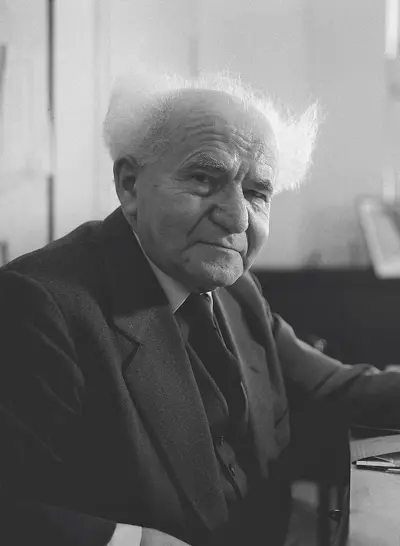
David Ben-Gurion, born David Grün, was the primary founder of the State of Israel and the first Prime Minister of Israel. Ben-Gurion's passion for Zionism, which began early in life, led him to become a major Zionist leader and Executive Head of the World Zionist Organization in 1946. As head of the Jewish Agency from 1935, and later president of the Jewish Agency Executive, he was the de facto leader of the Jewish community in Palestine, and largely led its struggle for an independent Jewish state in Mandatory Palestine. On 14 May 1948, he formally proclaimed the establishment of the State of Israel, and was the first to sign the Israeli Declaration of Independence, which he had helped to write. Ben-Gurion led Israel during the 1948 Arab–Israeli War, and united the various Jewish militias into the Israel Defense Forces (IDF). Subsequently, he became known as "Israel's founding father".; David Ben-Gurion was the primary founder of the State of Israel and the first Prime Minister of Israel.
