Harry S. Truman Quotes
I sincerely wish that every member of Congress could visit the displaced person's camp in Germany and Austria and see just what is happening to 500,000 human beings through no fault of their own.
DPs were “displaced persons” -- the euphemism for people who were no longer welcome in their country of birth. Congress, made up mostly of immigrants or the children of immigrants who were poor and downtrodden, were not enthusiastic about the United States absorbing many of the world’s DPs resulting from WWII.
Harry S Truman, 1884-1972, 33rd President of the United States (Democrat, MO), Letter to Walter F. George, October 1946
Sourced by: Eigen's Political and Historical Quotations


In the history of man, states, nations, and countries, have been a very recent development. Even in Afghanistan and some other parts of the world there is little understanding of, desire for, or tolerance of a modern state. Most of the world was that way not so long ago. Even empires were understood long before countries.


“Fora” is the plural of forum. It was then preferable to “forums” as the plural form, because “forum” was a Latin word and the Latin plural for nouns ending in “um” was “a” as in “flora and fauna”. This was adopted as U. S. Policy until the second decade of the 21st century when the combination of the War on Terror, and the huge world refugee crises triggered by the Syrian revolution produced much nativist and and-immigration feeling to go along with the small proportion of American anti-immigrants who have almost always been a part of the American pluralistic landscape.


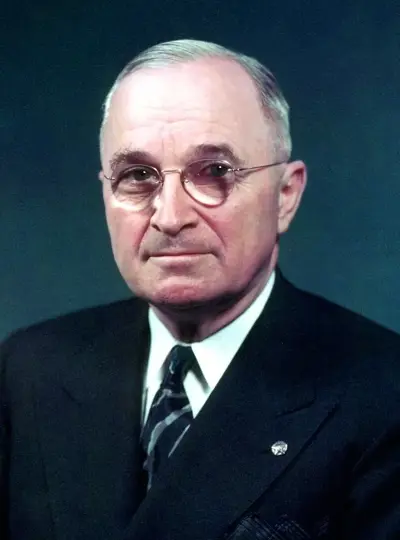
Harry S. Truman was an American politician who served as the 33rd President of the United States (1945–53). He served as a United States Senator from Missouri (1935–45) and briefly as Vice President (1945) before he succeeded to the presidency on April 12, 1945 upon the death of Franklin D. Roosevelt. He was president during the final months of World War II, and approved the plan to drop atomic bombs on Hiroshima and Nagasaki. Truman was elected in his own right in 1948. He presided over an uncertain domestic scene as America sought its path after the war and tensions with the Soviet Union increased, marking the start of the Cold War.
