Golda Meir Quotes
It is a dreadful thing to see the dead city. Next to the port I found children, women, the old, waiting for a way to leave. I entered the houses, there were houses where the coffee and pita bread were left on the table, and I could not avoid [thinking] that this, indeed, had been the picture in many Jewish towns [i.e., in Europe, during World War II].
Meir, Golda. A Land of Our Own: An Oral Autobiography. Edited by Marie Syrkin, G. P. Putnam's Sons, 1973, p. 64.


DPs were “displaced persons” -- the euphemism for people who were no longer welcome in their country of birth. Congress, made up mostly of immigrants or the children of immigrants who were poor and downtrodden, were not enthusiastic about the United States absorbing many of the world’s DPs resulting from WWII.


When the United Nations partitioned Palestine into a Jewish and a Palestinian State the Arab Countries all jointly militarily attacked the fledgling Jewish State of Israel. Despite the Israeli’s being overwhelmingly outnumbered they beat back the invaders. However while many Arabs stayed on their Israeli land and some helped the Jews defend against the Arab Armies, some others abandoned their homes and land and went to neighboring Arab Counties. This is what they had been asked to do by the Arab governments who wanted to be able to militarily attack communities without worrying about killing Arabs. To spur the evacuation the Arab leadership spread false propaganda about Israeli atrocities and frightened them into leaving. As a motivation to leave they were told that they could move into the Jewish lands and property when the Jews had been driven out. To make matters worse, some Israeli radicals repeated the lies to induce the Arabs to abandon their lands. In at least one case, Arabs who stayed were subjected to Jewish violence. Each side has since railed about what the other side did at that point in time and each fails to mention how they contributed to the refugee problem.
This quote is very important historically as it bears on the two different narratives of the creation of Israel given by the Jews and the Arabs. The Arabs claim that in the 1948 partition of Palestine, the Jew attacked the Arabs and drove them out of the areas in which they had lived for years, The Israelis claim that they urged the Arabs to stay and that all those who did, received full citizenship in the new state of Israel. The Arab leaders pressured and in some cases even forced the Arabs to leave so that the Arab armies could use artillery and other war weapons and not have to worry about hitting Arabs. They promised the Arabs who left that they could return in a few days when the Jews were defeated and pushed into the sea, and the Arabs could have the Jewish property. This report of an impartial actor, tends to support the Jewish view of the happening in so far as the behavior of the Jews was concerned. There was no pressure placed on Arabs by Jews to leave. It was actually, the reverse. There were however, two small rural areas where Jewish radicals did try and drive the Arabs out, but in general the Haifa experience was the norm.
In the history of man, states, nations, and countries, have been a very recent development. Even in Afghanistan and some other parts of the world there is little understanding of, desire for, or tolerance of a modern state. Most of the world was that way not so long ago. Even empires were understood long before countries.
Most Arabs blamed only the partition of Palestine and the creation of Israel and ignored what they did or did not do since 1949.


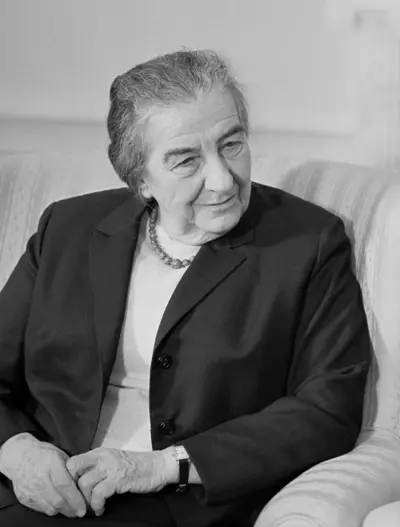
Golda Meir was an Israeli stateswoman, politician, teacher, and kibbutznik who served as the fourth Prime Minister of Israel.
