Ernest Bevin Quotes
Truman wants the Jews to go to Palestine because he doesn’t want them in New York.
Ernest Bevin, 1881-1951, British Foreign Minister (Labour), Speech, November 13, 1945
Sourced by: Eigen's Political and Historical Quotations

Question of FDR who was explaining the Jewish Claims to Part of Palestine. That was a considered option but the Jews had no historical relationship to Germany in the sense that the did in the Middle East, Fir several hundred years all of Palestine, Syria, Lebanon and much of the rest of the Middle East belonged to a Jewish Kingdom under a dynasty of Jewish Kings. Jews had lived in the Middle East for over 5000 years. However, the Jewish Kingdom fell to the Romans, and then hundreds of years later the area was under Muslim Rule, then it was controlled by the Christian crusaders, retaken by the Muslims, and then conquered by the Jews when 14 Arab Armies attacked the fledgling state of Israel. So all the contesting ethnic groups claiming the Middle East as their land, base that claim on their domination and rule of the area by conquest at different points of history. All have conquered the land from someone else and ruled it till they were conquered with the Jews being the latest conquerors. So Arabs and Jews both have claims and can object to the other’s behavior of taking the land by force.

Some Palestinians and other Arabs either ignore or are delusional about history as the Jews had been in the Area for 5 thousand years, and when Christ was born and died and Christianity born, the Jews were the majority population in the area of Israel and Palestine. Even in the Muslim Controlled Ottoman Empire, Jews were living in the area and are described on thousands of Ottoman legal and historical documents. The reason that this quotation is so important is that Abbas was supposed to be the most reasonable of the Arab leaders regarding a two state solution, and here in 2014 he argued that the Jews to not belong in the area and have no roots there. The other Hamas Arab leaders required in their charter the destruction of Israel and the death of all Jews anywhere in the world. Who then, many conservative Israelis ask, can Israel reasonably negotiate with as no state will negotiate for its own existence—especially the most democratic, most developed, and has the highest average standard of living for its citizens and the most freedom for Arabs of any nation in the Middle East.

Because of the classic historical anti-Semitism and discrimination, Jews were barred from land ownership and as a result few were farmers or had agricultural experience in their families. They were tradesmen, artisans, professionals in Europe. So amongst Jews and non Jews alike the notion of Jews settling the land of Palestine and farming it or trapping, the way the Boers had in South Africa or the French in Canada, was not a very credible image. The Zionists, realizing this potential weakness, placed strong emphasis on agriculture, developed the agricultural kibbutz concept and encouraged Jews to become farmers. The effort was so successful that almost all the leading early Zionist immigrants to Palestine became farmers. When independence came to Israel, the Jewish agriculture was more productive than most of that in Europe and almost on a par with small farms in the United States. The Israelis were known for “making the desert bloom.

of the Jewish refugees from the German concentration camps

Often referred to as the "Balfour Declaration." 1st Earl of Balfour

There was a strong movement among the early religious Christian Americans to go to the Holy Land to reclaim the Kingdom God promised in the Bible. American missionaries went to the Middle East. See {585147} for another early American politicians view.


He also expressed his pleasure with the British Balfour Declaration granting the Jews their own country in part of Palestine ({594001}). Wilson had earlier committed himself to support the Zionist claim for Palestine. See {585124}.
Wilson did so later: {585123}. Wilson was not the only early American President who had “Zionist” aspirations for Palestine. See John Adams quotation: {585141}.

This is the first statement of a Jewish nation since Biblical Times.


In Christian Europe anti-Semitism was rampant until the end of WWII. Innocent Jews were tortured and massacred. Many Islamic lands were much more tolerant and humane; many Jews not only flocked to them but thrived. Great Jewish Rabbis and philosophers did much creative work in Islamic lands—especially Andalusia which was then a Muslim nation. So many Muslims who deplored the Holocaust were puzzled when the United Nations placed the Jewish Homeland in the Middle East. Why not have Israel in Germany? However the Jews had a kingdom encompassing Palestine, Lebanon, Syria and much else of the Middle East centuries before Arabs ever came to the area and Islam existed. The Jews had conquered; then others did, and then the Ottoman Turks. Everyone with a claim on Palestine has taken it from some other people and then has had it taken from them by others. But there is a type of argument that the historically worst anti-Semites should provide the land for Israel.


The recommendation for partition was the basis of the decision of the United Nations in 1949 to partition Palestine.


Olmert was speaking for a significant minority of Israelis who believe that God consecrated the land of Palestine to the Jewish People and all other peoples who controlled it did so by conquest. So their logic is for those who do not believe in the Bible and give no modern credence to God’s will, the Jews have no taken back the land by conquest which is the way the Palestinians and all of the many peoples had controlled that land. For believers, the Jews have the highest right; for non-believers, their right of conquest is no weaker than any of the others.

Prior to 1948 and the establishment of the state of Israel, there were large number of Jewish refugees who were stateless and, regardless of whatever moral rights they may have had, there was no politi.cal mechanism to enforce or claim these rights. For example, in 1956 Nassar expelled most of the Egyptian Jewish population. It was only the existence of Israel that gave these people the right to come to Israel and not depend on the good will of the world to help them as refugees. The difficulty for most refugees is that there is no state to demand, support, and enforce their rights.

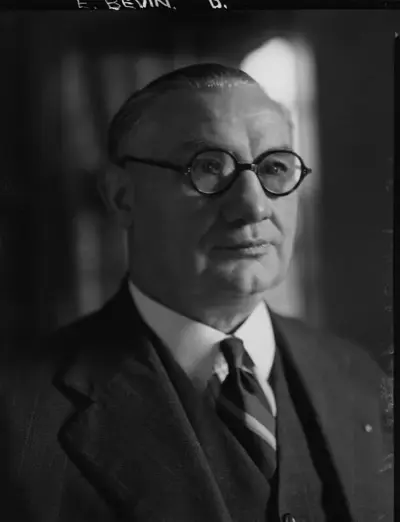
Ernest Bevin was a British statesman, trade union leader, and Labour politician. He co-founded and served as General Secretary of the powerful Transport and General Workers' Union in the years 1922–1940, and served as Minister of Labour and National Service in the war-time coalition government. He succeeded in maximising the British labour supply, for both the armed services and domestic industrial production, with a minimum of strikes and disruption.
