Hammurabi Quotes
If a man be taken prisoner in war and there be no sustenance in his house and his wife go to another house and bear children; and if later her husband return and come to his home: then this wife shall return to her husband, but the children follow their father.
Hammurabi, ~1755 BC-1713 BC, King of Babylon, Code of Hammurabi
Sourced by: Eigen's Political and Historical Quotations


A fatwa is a religious legal ruling.


Editorial castigates the many divorce seekers from other states coming for Indiana liberal divorce laws

At the time, the mother had no legal rights whatsoever over the upbringing of their own children. If the father did not want the mother to nurse a child, she could not. Although born and educated in the United States, she lived mostly in England and was politically active there.


No amount of ill usage, without adultery superadded, will in England free a wife from her tormentor.
The requirement of adultery for any divorce extended to the 1960's in America.

The notion that the only purpose of marriage is to have and rear children has a long history. Even today in many countries and religions, inability to conceive children or the lack of doing so is grounds for annulment or divorce. It is only in relatively modern times that marriage has been seen as having other virtues to which these are not universally agreed.

Citizen of U. S. & Israel

Parker and other escaped slaves in Christiana fought off slave catchers and killed the slave owner leading them. Charged with treason, he escaped to Canada with his family and lived there the rest of his life. While not a polished writer, after he himself had escaped and went to Christiana and leaned to read and write. He wrote this narrative of his life as a slave—one of the few written works we have from slaves.

“Political correctness” is a loosely defined concept of not discussing political issues in terms that are derogatory and/or might be offensive to particular groups or nationalities. Many orthodox Muslims (and orthodox Christians) are of the opinion that their religion calls for the male being the dominant figure in the household and having the right and obligation to discipline the children and the wife or wives. To state that such a practice is sexist, barbaric, undemocratic, and damaging to family and society is an insult to some of these religious believers. The Egyptian law was passed to reflect God’s commandments and so to question it is to some, blasphemous and for other nations to criticize it is insulting to some ultra orthodox Muslims. However, in cases like these, Ms. Eltahawy argues for ignoring political correctness and most Americans would agree as would most of the modern and generally educated Muslims in Egypt.

This was an amazingly controversial quotation. At first glance it seemed like a typical position that a very conservative, anti-government politicization might take—the government should not interfere with a parents bringing up their children. However, there was a more ominous part of the quotations. While everyone in America would certainly agree with Paul that the Government does not “own” the children, there are few who would agree with the point that follows—that the Parents “own” the child. Paul reveals the normally hidden aspect of his politics—that he is highly influenced by the extreme, Biblical Literalist Fundamentalist Christians and Jews. In the Old Testament, the Father really did OWN the child. The latter was his chattel. A father had the legal and duty-bound power of life and death over his children. Most American Christians and Jews have long since abandoned the literal biblical notion of children being owned by a father and today see a child as a person who can sometimes need the protection of the state just like any other citizen. And there are occasions where the child must be PROTECTED from the parents who may be acting within their fundamentalist notions of Biblical rights and duties, but not with their civil rights and duties. Ownership, of a child is not one of the modern civil rights of parents.

Robertson was so fearful of feminism that he ascribed almost every evil in society to it as well as witchcraft.


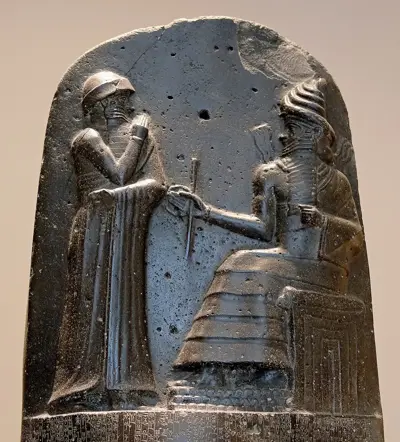
Hammurabi (c. 1810 – c. 1750 BC) was the sixth king of the First Babylonian dynasty of the Amorite tribe, reigning from c. 1792 BC to c. 1750 BC (according to the Middle Chronology). He was preceded by his father, Sin-Muballit, who abdicated due to failing health. During his reign, he conquered Elam and the city-states of Larsa, Eshnunna, and Mari. He ousted Ishme-Dagan I, the king of Assyria, and forced his son Mut-Ashkur to pay tribute, bringing almost all of Mesopotamia under Babylonian rule.
