Lazarus Powell Quotes
If a constitutional amendment could regulate the relation of master and servant, it certainly can, on the same principle, make regulations concerning the relation of parent and child, husband and wife, and guardian and ward.
Lazarus Powell, 1812-1867, U.S. Senator (Democrat, KY), Quoted in Cott, Public Vows, 2000
Sourced by: Eigen's Political and Historical Quotations


Of course all the members were men. At that time, the father was always the guardian of the children by law. Although born and educated in the United States, she lived mostly in England and was politically active there.
At the time, the mother had no legal rights whatsoever over the upbringing of their own children. If the father did not want the mother to nurse a child, she could not. Although born and educated in the United States, she lived mostly in England and was politically active there.

This was an amazingly controversial quotation. At first glance it seemed like a typical position that a very conservative, anti-government politicization might take—the government should not interfere with a parents bringing up their children. However, there was a more ominous part of the quotations. While everyone in America would certainly agree with Paul that the Government does not “own” the children, there are few who would agree with the point that follows—that the Parents “own” the child. Paul reveals the normally hidden aspect of his politics—that he is highly influenced by the extreme, Biblical Literalist Fundamentalist Christians and Jews. In the Old Testament, the Father really did OWN the child. The latter was his chattel. A father had the legal and duty-bound power of life and death over his children. Most American Christians and Jews have long since abandoned the literal biblical notion of children being owned by a father and today see a child as a person who can sometimes need the protection of the state just like any other citizen. And there are occasions where the child must be PROTECTED from the parents who may be acting within their fundamentalist notions of Biblical rights and duties, but not with their civil rights and duties. Ownership, of a child is not one of the modern civil rights of parents.

In 1953 the Senator had proposed a Constitutional amendment that would severely curtail the treaty making powers of the President. President Eisenhower actively opposed Bricker and the right wing of his own party. The Senator was outraged. Despite Bricker’s complaining, the public and the Congress sided with the President.


At the time, in many states married women could not control their own inheritance, could not sign a contract, owned no part of a family business that a women might have founded and worked in her entire life, could not be an executor of a will—even if it were her husband’s.

This editorial reflected majority Southern political positions of the time. There was never going to be any compromise by ending or curtailing slavery in any way. Amongst the abolitionists, there was an equally rigid view towards compromise. Many Northerners felt that the anti-slavery Americans had been compromising for half a century and slavery was a larger institution that it ever was. They wanted no further compromise. The South had never budged from its original position at the founding of the nation. Historically, it was just a matter of time before there would be a showdown politically and probably militarily. The explosion took 10 more years.

This proposed Constitutional Amendment was debated just before Abraham Lincoln would take office. The South wanted to tie his hands on the Slavery issue, and wanted to end what had become a constant polarized Congressional debate over slavery. Of course, their idea of ending the debate was to Constitutionally prohibit further attempts to outlaw or otherwise interfere with slavery in the Southern states. A number of Northern members of Congress voted for it realizing that there was little or no chance of obtaining the ratifications of ¾ of the states and they wanted to buy some time for the Southerners to calm down over their fear of Lincoln and his upstart Republican party. The Amendment never obtained the needed votes though a few states did ratify it. Secession and the Civil War mad the amendment moot. The Southern position was so rigid, that they would compromise in no way on the slavery issue, and ended up of course losing more than they ever thought was possible by succeeding. Another reason this proposed amendment is historically important, is that it is yet another strong piece of evidence that the issue of the Civil War was slavery and not differences in political and economic philosophies as many Southerners have claimed since then. If States Rights in general were the great concern, would have been no reason to single out slavery if it were not the major issue. Yet the last phrase, “including that of persons held to labor or service by the laws of said State” does just. Similar evidence is given by the Secession Resolutions of the Southern States and the debates around them. It is clear that slavery was the issue that the South fought over.

Parker and other escaped slaves in Christiana fought off slave catchers and killed the slave owner leading them. Charged with treason, he escaped to Canada with his family and lived there the rest of his life. While not a polished writer, after he himself had escaped and went to Christiana and leaned to read and write. He wrote this narrative of his life as a slave—one of the few written works we have from slaves.

This is a fascinating quotation. In general we associate religious fundamentalism and especially theocracy with retrograde and ancient views of living with modernity avoided wherever possible. However, in Iran, where almost all other fundamentalist leaders have claimed that in vitro fertilization in general and 3rd-party donation in particular are against God’s law, the Supreme Leader, not only allowed this techniques but also instituted major programs of birth control and in vitro fertilization to allow the woman to control her reproduction. His stricture was that the parents of these children bring them up following Islamic law.


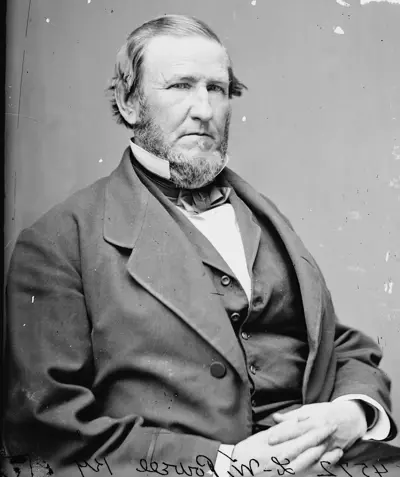
Lazarus Whitehead Powell was the 19th Governor of Kentucky, serving from 1851 to 1855. He was later elected to represent Kentucky in the U.S. Senate from 1859 to 1865.
