Charleston Mercury Quotes
The Union can be saved by an amendment to the Constitution, which will secure the rights of the South. The Union can be saved by giving the South an equal share of the common domain, and by restoring fugitive slaves to their owners. The South has no compromises to offer.
This editorial reflected majority Southern political positions of the time. There was never going to be any compromise by ending or curtailing slavery in any way. Amongst the abolitionists, there was an equally rigid view towards compromise. Many Northerners felt that the anti-slavery Americans had been compromising for half a century and slavery was a larger institution that it ever was. They wanted no further compromise. The South had never budged from its original position at the founding of the nation. Historically, it was just a matter of time before there would be a showdown politically and probably militarily. The explosion took 10 more years.
Charleston Mercury, Editorial, "Mr. Calhoun's Speech," Charleston (SC) Mercury, March 5, 1850
Sourced by: Eigen's Political and Historical Quotations

The amendments failed as did the compromise.

In June of 1850, a bipartisan group of Southern politicians met in Nashville, TN for the purpose of organizing strategy and tactics to ward off and defeat the growing aggressiveness of Northern politicians and other leaders in trying to abolish slavery. They issued an address to the people. This is one of the clearest statements of the position of most of the Southern Politicians on the increased efforts to abolish or curtail slavery. They felt that a deal had been made by the founding fathers and the first Congress not to deal with the slavery issue, and that deal must be honored in perpetuity. Most Northerners agreed that a deal had been made, but it was not binding forever—that a Congress could not limit the scope of a future Congress except via a Constitutional Amendment. The deal on Slavery was a deal not to address it for a while. It was not a deal to accept the Southern point of view. And none of it was written into the Constitution because opinion was even then split and a majority could not be mustered for a compromise that would write legal slavery into the Constitution. But many Southerners believed that its absence implied that it could not be addressed by the government. They demanded the right of their states to choose slavery if they so wished. Time was not on the side of the South and the Southerners who insisted on State’s Rights regarding slavery opposed States Rights for Northern States who wished to disallow fugitive slaves to be returned to owners. The more fugitive slaves there were, the more hypocritical the Southern position became as they needed Federal preemption on the issue of Fugitive Slaves, else slavery would end by escape and non-return of slaves.

As a key member of Lincoln’s cabinet, William H. Seward was most concerned with preserving The Union. However, since the Constitution was written in 1787, there had been compromises made with the pro slavery forces of the South to give them proportionally more political power and to avoid interfering with the institution of slavery. The Dred Scott Supreme Court decision forced the Northern States to actively cooperate in enforcing and maintaining slavery. Large numbers of abolitionists had reached their limit and wanted no more compromises regarding slavery. Mrs. Seward was one of those. This quotation also illustrates the influence that some women had in politics even though women could not vote. Frances Seward was very much a political partner with her husband who was favored to beat Lincoln for the Republican Presidential nomination.

Bragg and other Southerner leaders had an unusual concept of equality. Ever since the original Constitution, Northerner’s votes counted for themselves only while a single Southerner’s vote counted for all his slaves as well. So the individual Southerner always had more political power than his Northern counterpart. However, this notion of equality reached it’s acme when it came to the new territories. The Southern argument was that Southerners could not equally prosper in the new territories of Kansas and Nebraska if they could not bring their slaves to work the land. The thought that Southerners were equally able to personally work the new lands or pay labor seems to never have occurred to them. If Northerners could prosper that way then Southerners should be equally able to do so also. However, many Southern whites simply could not conceive of a “gentleman” working in the fields. Therefore they would not be equally able to prosper in the new territories.


In many respects, it is amazing that secession did not take place earlier.
See Mark {606304}; also Matthew {606727}. Lincoln had used the “house divided” biblical metaphor in 1843 when arguing for Whig solidarity. The first political use of the Biblical metaphor and quotation with respect to American slavery appears to have been by Sam Houston in 1850 {603970}. The first use with respect to American slavery was byMassachusetts abolitionist, Edmund Quincy, in 1852. The second sentence of this famous quotation was forsaged earlier. See Lincoln, {619494} & {584918}. Also See Felix Rohatyn who used the Lincoln line to refer to poverty: {70611}.

This proposed Constitutional Amendment was debated just before Abraham Lincoln would take office. The South wanted to tie his hands on the Slavery issue, and wanted to end what had become a constant polarized Congressional debate over slavery. Of course, their idea of ending the debate was to Constitutionally prohibit further attempts to outlaw or otherwise interfere with slavery in the Southern states. A number of Northern members of Congress voted for it realizing that there was little or no chance of obtaining the ratifications of ¾ of the states and they wanted to buy some time for the Southerners to calm down over their fear of Lincoln and his upstart Republican party. The Amendment never obtained the needed votes though a few states did ratify it. Secession and the Civil War mad the amendment moot. The Southern position was so rigid, that they would compromise in no way on the slavery issue, and ended up of course losing more than they ever thought was possible by succeeding. Another reason this proposed amendment is historically important, is that it is yet another strong piece of evidence that the issue of the Civil War was slavery and not differences in political and economic philosophies as many Southerners have claimed since then. If States Rights in general were the great concern, would have been no reason to single out slavery if it were not the major issue. Yet the last phrase, “including that of persons held to labor or service by the laws of said State” does just. Similar evidence is given by the Secession Resolutions of the Southern States and the debates around them. It is clear that slavery was the issue that the South fought over.

The Governor was a staunch Confederate supporter but his state legislature majority favored the Union. He was forced out of the governorship when the 1861 election gave the legislature a veto-proof pro Union majority.
It is often said that “elections have consequences”. The 1960 election was one that certainly had profound consequences. Lincoln was unwilling to force the Northern states to return fugitive slaves against the constitution, laws and will of the people of those states as Buchanan said he was (but had a hard time doing). Also Lincoln was unwilling to allow new territories to enter the union if they allowed slavery. In the end, most pro Slavery politicians realized that with the greater growth rate of the North, they Southern disproportionate power in the Congress was doomed as would be the institution of slavery itself. Crittendon a strong Unionist from a border state, understood the implication of Lincoln’s election for the Union.


As just one example of Southern States' reasons, see {583044}. Many of the Northern States had passed laws declaring everyone in the state was free and making it illegal to return or assist in the returning of escaped slaves. The Southerners got the Federal Fugitive Slave Act passed which required all Americans to assist in recapturing escaped slaves. It was the Northern States who claimed states' rights were being trampled. The South was vehemently opposed to States' Rights when it came to allowing individual states to decide who was free and who was not. The Southerners had only one fundamental reason for secession—the maintenance of the Negro slavery system on which much of their economy depended as did their sociology, culture, and way of life.


The large majority of the American people opposed legal segregation and for years, the segregationist, racist, Southern white minority were able to prevent any Civil Rights legislation by using the filibuster until President Lyndon Johnson, formerly a Southern Senator who understood the legislative process better than any other American president used his great skill to pass Civil Rights legislation instead of opposing it which he had done for years as a Texas Senator and the Majority Leader of the Senate.
This was Lincoln’s first anti—slavery speech and it was memorable
Gusley had been captured by the Confederates and was in a prison camp. Richardson published Gusley’s diary and Southerners were surprised to find that this Yankee who had been bombarding them from a ship was very similar to them in many ways including slavery but saw the situation regarding succession as worth fighting for preservation of the Union.

As this passage makes clear, the Southern States would not accede to a Union unless they had more representation than the larger Northern states. Thus the infamous three-fifths clause. This meant that white slave owners had proportionally more representatives in Congress and more votes in the Electoral College than whites in the Northern States. This artificial majority kept slavery from being abolished until the Civil War.


In February of 1861, in a last ditch effort to hold the Union together the Senator offered this proposed Constitutional amendment which would not only guarantee the existence of slavery in the South, but would assure that there could be no later Constitutional amendment to do so—the so-called "unamendable amendment." Surprising to us today is the fact that this amendment was not only supported by incoming President Abraham Lincoln, but was passed by the required two-thirds of both houses of Congress. However, before it could be ratified by the States, events overtook the amendment, the South seceded, and the Civil War began.
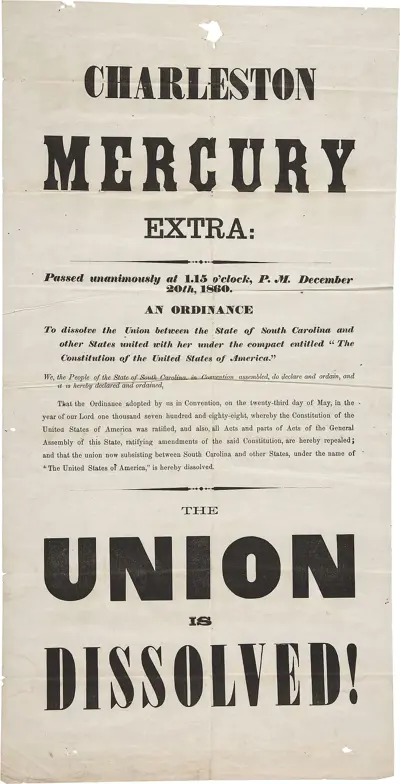
The Charleston Mercury was a secessionist newspaper in Charleston, South Carolina, founded by Henry L. Pinckney in 1819. He was its sole editor for fifteen years. It ceased publication with the Union Army occupation of Charleston. After the American Civil War, publication resumed in November 1866 before the paper closed permanently two years later in 1868.
