Slobodan Milosevic Quotes
If 200 or 300 thousand people will be killed, it will be worth it to restore Duklja’s kingdom.
Duklja was the capital of the Empire of Serbia in the 12th century when Serbia controlled the entire region.
Slobodan Milosevic, President of Serbia, Statement to his colleagues justifying the Serbian war and the atrocities he and his supporters committed, Quoted on National Public Radio, March 11, 2006
Sourced by: Eigen's Political and Historical Quotations

He was a brutal, sadistic war criminal who was assassinated by one of his many enemies in 2000 before he could be brought to trial.

Chamberlain’s policy was to appease Hitler and Germany to avoid war. Although he did not see Czechoslavkia as a critical British national interest and claimed he had secured peace {585941} , the reality was that he gave Germany room to start its aggression which would engulf all of Europe and much of the world. The British became the only bulwark against Hitler until the Russians stopped the Germans and America entered the war.


This was a precursor of the total war views of William Tecumseh Sherman and Ulysses S. Grant during the American Civil War half a century later.


The possibility of intervention in the affairs of other counties even if there is no U. S. national interest involved, was not new when the George W. Bush administration sent troops to Somalia and Bill Clinton bombed Serbia. There were appeals made “to our sympathies” and there were serious atrocities. But these modern Presidents were just following the policy clearly stated by Theodore Roosevelt in 1904.


Churchill saw before many others that technology and weaponry had changed the nature of warfare. At the time the military leadership of all the major powers were pursuing 19th century tactics with 20th century weaponry including mass bayonet charges against machine guns behind barbed wire. Churchill and other civilians, although they had legal control over the military, had little de facto tactical control. As a politician he became an itinerant meddler in military tactics thereafter.

The Serbs were in a conflict with the Ottoman Muslims almost 1000 years ago. However, they have never seen that war as having ended. When the Albanian Muslims were breaking from the weakened Ottoman Empire, the Serbs not only wanted to dominate Albania, but also to extract vengeance for alleged wrongs committed by Ottoman Muslims hundreds of years earlier. This attitude existed through and after the Serbian war and the Kosovo Albanian population would not live under Serbian control given the Serb war crimes and atrocities perpetrated on Muslims—not only in the historical past but even in the Serbian War. Tucovic was one of the very few Serbs who not only argued that the Serbian policy of oppression of the Muslims was not only morally wrong but counter productive from the Serbian point of view. For many Serbs, Tucovic was considered a traitor.

This was written when the United States was not a dominant military power. At the beginning of the 20th century, the U. S. had the same size military as Argentina. It was France, German, Turkey and England who had the military superiority and it was they who tended to find excuses for war. After WWII, the U. S. was dominant and was involved with a number of wars and military incursions, often with nations that had not attacked the U.S. Korns’ principle was most dramatic when the George W. Bush administration invaded Iraq on the excuse that the Iraqis were developing weapons of mass destructions and then might attack the United States. After the successful invasion, the excuse was shown to be hollow as there were no signs of sophisticated weapons development.

After the attack on Fort Sumter, the South Sent “diplomats” to negotiation with the Government. Unfortunately for all, the South really was not open to negotiations as they only had two predetermined positions they would agree to: The first was that the Government should guarantee the perpetual right of states to have slavery if they wished and that fugitive slaves would be returned by the non-slave states. The second was that the Union should recognize the Confederacy as an independent nation and have peaceful relations between the two. The first was impossible to deliver even if the Union would agree to continue slavery, there was no way that the Federal Government could enforce the return of fugitive slaves from many northern states where they were free the second they set foot in the state, and the Northern states demanded States Rights and not being forced to return Fugitive Slaves forcing the Southern States to oppose States Rights when it came to Fugitive Slaves while favoring it for slavery itself. The Federal government could not enforce the Dred Scott Decision under the pro-South Buchanan administration. And Lincoln and most of the Northern Politicians would not accept a complete dissolution of the Union. There are no other possibilities the South would accept and there was really nothing to negotiate.

The Germans wanted war with Serbia and used the dispute between Austria and Serbia as an excuse to mobilize and go to war ostensibly to protect their ally, the Austrian Empire, from the Serbs who they knew would be likely supported by Russia which had traditionally supported their fellow Eastern Orthodox against Roman Catholic or Protestant enemies. Russia still tends to protect and support the Serbs. This statement was one of the many that showed that Germany was the major aggressor in the First World War and therefore had to pay reparations to France and others.


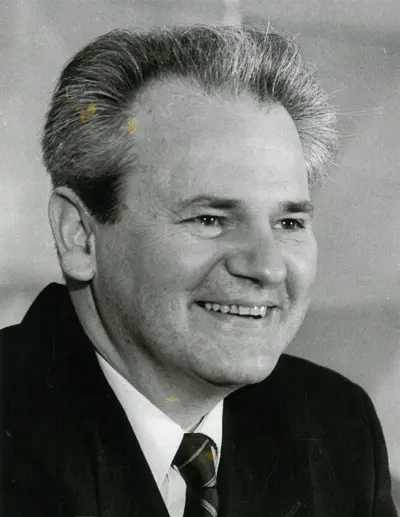
Slobodan Milošević was a Yugoslav and Serbian politician who served as the President of Serbia (originally the Socialist Republic of Serbia, a constituent republic within the Socialist Federal Republic of Yugoslavia) from 1989 to 1992 and within the Federal Republic of Yugoslavia from 1992 to 1997, and President of the Federal Republic of Yugoslavia from 1997 to 2000. He led the Socialist Party of Serbia from its foundation in 1990 and rose to power as Serbian President during efforts to reform the 1974 Constitution of Yugoslavia in response to alleged marginalization of Serbia, views that Serbia's autonomous provinces had too much power, making them almost independent from Serbia, and claims of political incapacity to deter Albanian separatist unrest in Serbia's autonomous province of Kosovo.
