Bob Marley Quotes
I want to say 'I Shot The Police' but the government would have made a fuss so I said 'I Shot The Sheriff' insteadbut it's the same idea: justice.
Salewicz, Chris. Bob Marley: The Untold Story. Farrar, Straus and Giroux, 2010.


Justice Black would quote the 1st Amendment—"Congress shall make no law abridging the freedom of speech or of the press"—then slam his hand on his desk and exclaim:

It is a common misconception that anarchists would not have any societal mechanism for preventing and combatting crime. Anarchists believe in the long run that with anarchism the reasons and motivations for crime will disappear, but until then they generally have been willing to use force to protect against force being used against the citizens. To critics, this seems to be government, and a government which uses force. Anarchists have never well detailed how they would manage such a seemingly conflicting situation.


Charles I had caused the death of his subjects with impunity and was called to account. However, the English Parliament did not know what specific crime the King had committed. Kings had executed people, guilty of crimes and otherwise, for centuries. For what could a king be accountable. Cooke developed the crime of Tyranny and drew up and presented the indictment for that. The King was found guilty and executed. This was the first time in legal history that a ruler was called to account for crimes committed against his own people. It became the foundation for many trials thereafter including that of Saddam Hussein in 2006.

He was trying to justify the arrest, torture and mistreatment of 15 trade union activists in Zimbabwe, and in the process showed himself for the brutal dictator that he had become.


It is hard for us today to understand why intelligent, thoughtful, people would seriously consider and even advocate anarchy. Yet there were many intelligent people who preached anarchy. The key to understanding this is that it is also hard for us to realize how terrible and actually dangerous was typical life under the Russian Government of the Czars. It was not only that most people were serfs--virtually slaves, but the government officials, the military and civilian both, could and did, abuse people in every way imaginable. In America today, if any of us were unfortunate to be the victim of violence, the odds are high that it would be at the hands of another citizen. In Russia (and other countries) at the time, the odds were that the perpetrator of the violence was a government official or government sanctioned person—police, military, aristocrats, civil officers. As but one example. Cossacks would frequently get drunk, pillage and rape a community and kill any who resisted—all with impunity. This quotation from Tolstoy is the classic argument of the anarchist at the time. It was impossible that the absence of government could be as bad as the government then was.


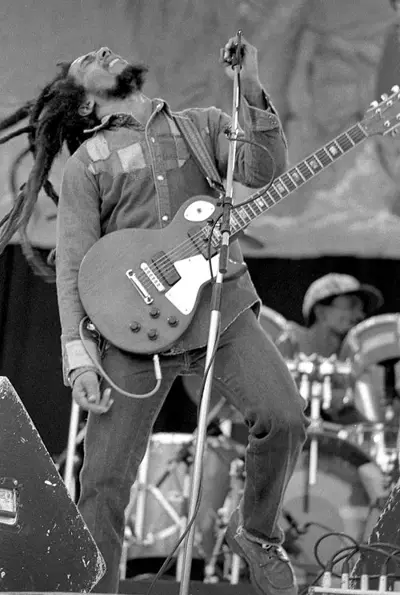
Robert Nesta "Bob" Marley, OM was a Jamaican singer, songwriter, and musician. Considered one of the pioneers of reggae, his musical career was marked by fusing elements of reggae, ska, and rocksteady, as well as his distinctive vocal and songwriting style. Marley's contributions to music increased the visibility of Jamaican music worldwide, and made him a global figure in popular culture for over a decade. Over the course of his career Marley became known as a Rastafari icon, and he infused his music with a sense of spirituality. He is also considered a global symbol of Jamaican music and culture and identity, and was controversial in his outspoken support for the legalization of marijuana, while he also advocated for Pan-Africanism.
